
Reducing Founder Dependency by Building a Business That Runs Without You

A business that needs its founder in every decision is harder to transfer. Reducing founder dependency means distributing decision-making, customer relationships, and operational knowledge across a capable team, ideally beginning 18-24 months before a sale. The goal isn’t to make the founder irrelevant; it’s to build a company that can keep delivering without relying on their constant involvement.
Founder dependency often develops for understandable reasons: founders know the company’s history, hold key customer relationships, and step in to solve problems quickly. But what works at one stage of growth can become a bottleneck later, especially when ownership may change. Reducing founder dependency means delegating decisions, building a management team that can operate without constant intervention, and giving new ways of working time to take hold.
Key Takeaways
- Spot reliance on the founder by noticing where decisions, customer trust, or essential knowledge still sit with one person.
- Record recurring decisions and processes so responsibilities can be transferred and work delivered consistently.
- Build leadership capacity by sharing customer relationships, clarifying accountability, and giving managers room to make decisions.
- Approach delegation as a gradual shift in ownership, supported by clear expectations and trust, rather than a sudden handoff.
- Begin preparing for a sale 18-24 months before going to market to give new systems and leadership responsibilities time to take hold.
What is founder dependency?
Founder dependency exists when essential knowledge, customer trust, authority, and decisions remain concentrated in one person. Meaningful progress typically takes 12 to 24 months, while cost depends on the scope of documentation and operational redesign, internal capacity, and advisory support required.
Documenting Processes and Responsibilities
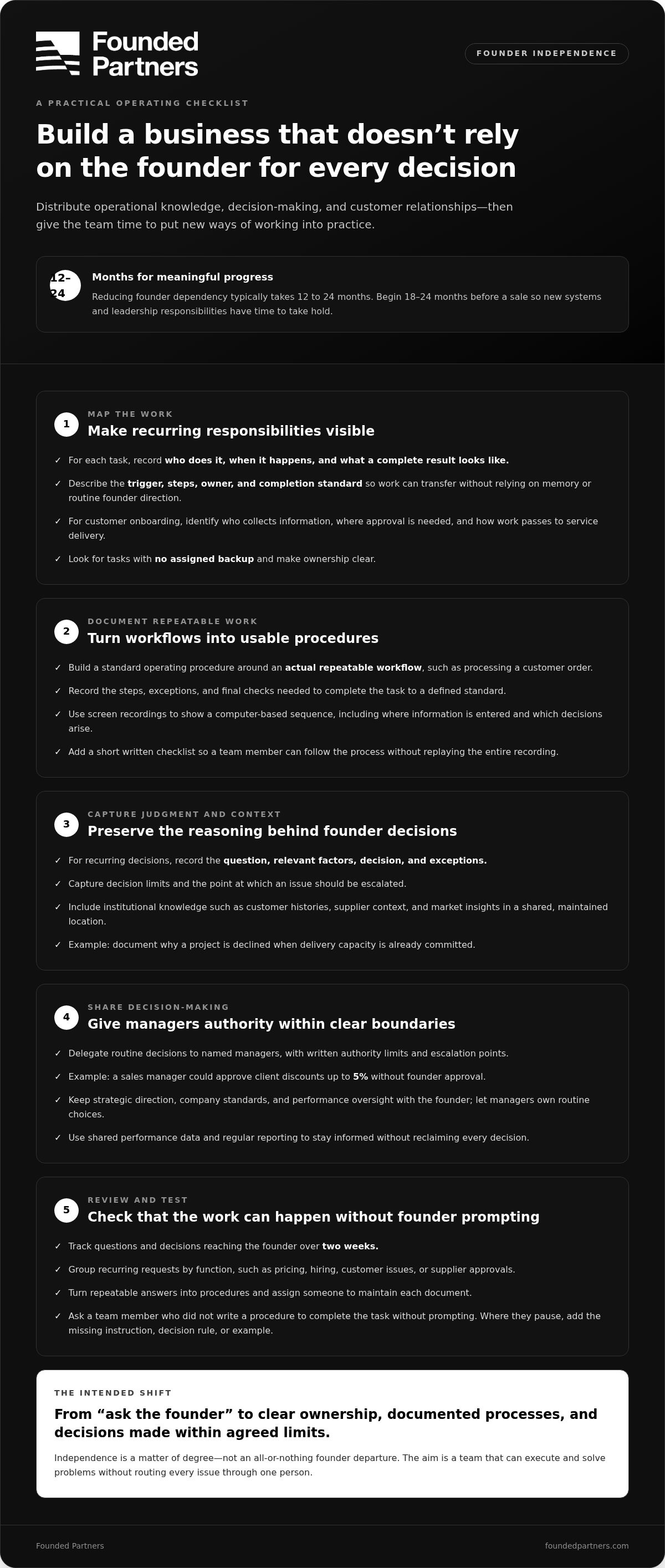
Document processes and responsibilities by recording who does each task, when it happens, and what a complete result looks like. This helps owners transfer operational work without relying on memory or interrupting the founder for routine direction. For example, a customer onboarding process can identify who collects information, where approval is needed, and how the work passes to service delivery. Clear ownership also reveals tasks without an assigned backup.
Creating and Recording Standard Operating Procedures
A standard operating procedure (SOP) is a documented sequence for completing a repeatable task to a defined standard. Build one around an actual workflow, such as processing a customer order, and record the steps, exceptions, and final checks. Screen recordings can show the sequence on a computer, including where information is entered and which decisions arise. Add a short written checklist so a team member can follow the process without replaying the entire recording.
Capturing Founder Decisions and Institutional Knowledge
Document recurring decisions by capturing the principles and context behind the founder’s choices. Record the question, relevant factors, decision, and exceptions. For example, note why a project is declined when delivery capacity is already committed. Institutional knowledge also includes customer histories, supplier context, and market insights. Keeping these details in a shared, maintained location helps managers make informed decisions instead of repeatedly asking the founder to recall them.
Track the questions and decisions that reach the founder over two weeks. Group recurring requests by function, such as pricing, hiring, customer issues, or supplier approvals. Turn repeatable answers into SOPs, then assign someone to maintain each document. This review helps distinguish work that needs founder judgment from work that needs a clear process.
- Process: Describe the trigger, steps, owner, and completion standard.
- Decision: Record the factors, limits, and escalation point.
- Knowledge: Capture customer history, market context, and key relationships.
Undocumented work creates friction during onboarding, weakens consistency, and can complicate due diligence. Test each procedure by asking a team member who did not write it to complete the task without prompting. Where they pause, add a missing instruction, decision rule, or example. This makes documentation a practical operating tool, rather than a folder of files nobody uses.
Founder involvement versus business independence
Delegate within clear decision boundaries: managers own routine choices, while founders retain strategic decisions and review shared performance data. A business is less dependent on its founder when the team can execute and solve problems without routing every issue through them.
Common Systemization Mistakes
Systemization fails when owners document procedures without assigning decision rights or testing whether the team can use them. A manual may describe every step yet leave employees uncertain about exceptions, approvals, or who owns the result. Another common mistake is delegating tasks while keeping all meaningful decisions with the founder. The structure then looks different, but the founder remains the operational bottleneck.
Independence is a matter of degree, not an all-or-nothing departure from the business. A founder can set strategy, protect company standards, and review results while managers handle daily decisions. Shared performance data helps leaders see what is working, where results are slipping, and what action is needed. That visibility replaces constant intervention with a deliberate review rhythm.
Delegating Decisions Without Losing Control
Decision delegation gives named managers authority within agreed limits, while keeping strategic direction and oversight with the founder. For example, a sales manager could approve client discounts up to 5% without seeking founder approval. A written authority matrix should clarify who decides, which limits apply, and when an issue must be escalated. Regular reporting keeps the founder informed without reclaiming every choice.
Transferability matters because buyers assess whether a company can continue after ownership changes, not only how it performed under its founder. Founder-dependent businesses may receive valuations 30-50% below market comparables. The lower middle market sale multiple cited for independent businesses is 7-8x EBITDA; founder-dependent companies may struggle to achieve 3-4x multiples. These figures illustrate how perceived continuity risk can affect a transaction, rather than guarantee a particular valuation.
Preparing for a sale means showing that leadership, customer relationships, and operational delivery can continue through a transition. Buyers may examine customer retention, revenue visibility, management strength, and continuity. If the business still depends on the founder, a buyer may seek a longer handover, future-performance-linked consideration, or continued founder involvement after completion. Reducing dependency before going to market gives the team time to demonstrate that responsibilities have genuinely transferred.
- Retain: Strategic direction, company standards, and performance oversight.
- Delegate: Routine decisions with clear authority limits and escalation points.
- Demonstrate: Consistent execution through management ownership and shared reporting.
A structured transition plan can align authority, management responsibilities, and sale preparation. Business transformation planning can help shape that work around the company’s strategic priorities.
Building a transferable management team
A transferable team manages customer relationships, operational decisions, and delivery without constant founder involvement. Integrated property management software, automated guest access, and validation can reduce workflow friction and manual oversight.
Transferring Customer Relationships
Transferring customer relationships means giving managers shared context and direct responsibility for each account, not merely copying them on the founder’s emails. Rank the top five relationships from 1, meaning founder-only, to 5, meaning fully transferred. Any relationship rated below 3 becomes a transition priority. For example, a customer accounting for 20% of revenue needs a named second contact, a clear relationship history, and regular manager-led conversations.
Embedding Transferable Systems
Embed transferable systems by placing recurring work in shared platforms and repeatable workflows that managers can operate. A property management system can anchor a technology stack and connect operational tools. Digital procedures for cleaning, maintenance, and guest access make service delivery repeatable while creating a performance trail. Automating guest access and validation can help staff manage more units without tying revenue growth to proportional increases in headcount.
Transferability and Buyer Risk
Transferability is the ability to sustain customer relationships and business performance after ownership changes. Buyers assess customer retention, revenue visibility, management strength, and operational continuity. A management team that can explain account risks, delivery processes, and current performance helps buyers understand how the business operates beyond its founder. For example, a manager-led customer review can show who owns the relationship and how renewal risks are handled.
Planning the Cultural Transition
Plan for the cultural transition by preparing employees and customers for decisions to move from the founder to named leaders. Explain the change through specific roles: an operations lead resolves delivery issues, while an account manager leads customer conversations. Reinforce the new structure in team meetings and customer handoffs. A consistent message about who decides, who supports, and when issues escalate reduces confusion.
Build leadership capacity across operations, sales, finance, and service delivery. Assign each function an accountable lead, then connect their responsibilities through shared performance data and regular cross-functional discussions. For example, sales can flag a customer commitment early, while operations assesses delivery capacity before the founder needs to intervene.
Test the team’s readiness by temporarily stepping back from routine questions. Track which decisions still return to the founder, then clarify authority or strengthen a system where the team gets stuck. A smooth handoff, completed without constant founder involvement, shows that relationships, processes, and management responsibilities are becoming transferable.
Addressing the emotional side of delegation
Delegation can feel personal because founders often connect their identity to the work they built. A founder who approves every proposal, resolves every customer concern, and checks every hire may see stepping back as a risk to quality. Start by naming the concern: lost revenue, inconsistent service, or a weakened customer relationship? Each concern calls for a different safeguard.
Start with a function where the founder is frequently involved but decisions are repeatable. For example, let an operations lead resolve routine delivery issues using agreed standards, while the founder retains decisions about major strategic changes. This creates room for leadership without asking the founder to abandon oversight. It also shows the team that authority is being shared intentionally.
Control often comes from visibility, not personal approval of every task. Agree on outcomes such as delivery quality, customer retention, or revenue performance, then review them with the responsible manager. If service quality slips, discuss the cause and adjust the process together. This keeps standards consistent while allowing the manager to own the function.
Founders may feel uneasy when a new leader handles a valued relationship differently. Before handing over an account, explain the customer’s priorities and introduce the new contact in a joint conversation. Let the manager lead the next discussion while the founder listens and offers context only when needed. This gradual transition respects established trust and gives the new owner practical experience.
- Identify the concern: Describe the specific risk behind holding onto a decision.
- Set boundaries: Clarify what the manager can decide and what needs escalation.
- Review outcomes: Use agreed performance measures instead of taking back routine work.
When a delegated decision produces a different result, separate discomfort from actual harm. If a manager takes a different approach to a customer complaint but resolves it within company standards, treat that as sound judgment, not a failure. If the outcome falls short, review the decision criteria and provide coaching before reclaiming authority.
Reducing founder dependency also means redefining the founder’s contribution. Instead of personally fixing every operational issue, founders can set direction, develop leaders, and address problems that cross functions. For instance, a founder can coach a sales lead on customer priorities while letting that lead manage routine negotiations.
Make the emotional shift visible through regular reflection. After a handoff, note which decisions the founder released, which concerns arose, and what the team learned. Share specific examples in leadership discussions, such as a manager resolving a delivery problem independently. Recognizing sound judgment reinforces ownership and helps the founder distinguish strategic involvement from constant intervention.
Starting dependency-reduction work before a sale
Sale preparation is more effective when it starts before a buyer is evaluating the business. Begin reducing founder dependency 18-24 months before going to market, giving leaders time to assume responsibility and demonstrate continuity. Meaningful reduction typically takes 12 to 24 months, so late preparation can leave important customer, operational, or decision-making risks unresolved.
Map the founder’s involvement across sales, customer relationships, operations, finance, and leadership. For each function, identify decisions that still depend on the founder, who could own them, and what would demonstrate a successful handover. For example, if the founder handles renewals, assign a manager to lead customer reviews and track retention. This turns a broad goal into actionable work for the management team.
Prioritize dependencies by their effect on continuity. A customer relationship held only by the founder creates a different risk from a process that an employee can follow using documented instructions. Start with areas where a disruption could affect customer retention, revenue visibility, or delivery. Then establish clear accountability, share relevant information, and give the new owner authority to make appropriate decisions.
- Map: Identify founder-dependent decisions, relationships, and responsibilities.
- Transfer: Assign each priority to a leader and support the handover with practical guidance.
- Demonstrate: Review business performance and continuity without routing routine issues back to the founder.
Starting only six months before a sale may produce less favorable outcomes than beginning 18 to 24 months ahead. A short runway can leave too little time to build management strength, transfer customer trust, and show that new responsibilities are established. The goal is not merely to announce a new structure. Buyers need to see the team operating through it, including how leaders respond when an issue arises.
Build progress into regular leadership reviews. Discuss which responsibilities have moved, where the founder still intervenes, and what evidence shows that the change is working. If a manager owns renewals, for instance, review customer retention and how the manager handles account concerns. If a process still requires founder judgment, clarify its decision principles or escalation point before relying on it during a transaction.
Early preparation also makes the founder’s future role clearer. The founder may remain involved for an agreed period after a sale, but that support should not substitute for capable leadership or operational continuity. A focused leadership advisory discussion can help founders and managers clarify responsibilities, strengthen leadership, and prepare for the transition.
Founded Partners: Capital raising support
Founded Partners supports founder-led businesses where growth or ownership plans call for stronger foundations and clear leadership. Its capital raising support helps businesses prepare to attract investment aligned with their strategic objectives. For companies working to reduce founder dependency, capital planning can complement clearer management responsibilities and stronger operational structure.
Turn to Founded Partners when evaluating funding as part of a growth plan, preparing for a potential sale, or aligning leadership with the business’s next stage. Business Transformation Consulting, Exit planning, and Leadership Advisory can support these priorities. The right focus depends on the company’s goals and the decisions ahead.
To discuss your business’s next steps, contact Founded Partners.
Make the Next Stage Less Founder-Dependent
The next stage of growth can begin with a different question: what should the founder’s role make possible, rather than what must the founder personally carry? That shift gives leaders room to develop and helps the business build resilience around its people, decisions, and priorities. Reducing founder dependency is not about stepping away before the organization is ready. It is about shaping a business where the founder can focus on the work that benefits most from their judgment.
Choose the next move according to the company’s direction. Founded Partners offers Business Transformation Consulting to support organizational change, Exit planning for owners preparing for a transition, and Capital raising support for businesses pursuing investment aligned with strategic growth. These services can connect operational priorities with broader plans for growth or ownership.
Start a focused conversation about the decisions ahead and the structure your business needs to support them. Contact Founded Partners to discuss your business. A more durable business is built through deliberate choices, and the next one can start now.
Frequently Asked Questions
How do you know you are the bottleneck?
You may be a bottleneck when work repeatedly waits for your approval, even when the decision follows a familiar pattern. Review your calendar and message history for recurring requests, delayed approvals, and tasks that return to you after delegation. Then trace one delayed project from request to completion. If the same decision or handoff repeatedly pauses until you respond, clarify who owns the decision and what information your team needs to proceed.
Is the Goal to Remove the Founder from the Business?
No. The goal is to shift the founder’s involvement toward the work where it creates the most value, not to require them to leave. A founder might stop approving routine customer proposals and instead set commercial priorities and coach the person responsible for proposals. The right balance depends on the business’s needs and the founder’s intended role. Ask whether the founder’s involvement advances direction and leadership or simply keeps everyday work moving.
What does founder freedom actually look like?
Founder freedom means having meaningful choices about where to focus, rather than being pulled into every operational issue. For example, a founder might pursue a new market opportunity while a department lead handles a staffing decision. The founder still monitors business performance and contributes where judgment matters. Look for freedom in the quality of the founder’s calendar and the team’s ability to make progress without waiting for routine answers.
What does founder dependency mean in a business?
Founder dependency means the company’s ability to deliver, make decisions, or sustain customer confidence relies too heavily on its founder. This differs from healthy founder leadership: a founder can set a clear direction without personally controlling every task. Consider a business where customers call only the founder to resolve service issues. If no other leader understands the history or can respond confidently, the relationship itself has become a point of dependency.
How can a company assess its founder dependency risk?
Assess risk by tracing what could stall if the founder were unavailable during a normal workday. Examine approvals, customer escalations, access to critical information, and decisions without a capable backup. For each exposure, note the likely business consequence and who could take ownership. A delayed customer renewal, for example, can reveal whether the team has enough context and authority to respond without the founder stepping in.
What are the best ways to reduce founder dependency in a startup?
Startups can reduce founder dependency by assigning clear owners to essential work before informal habits become fixed. For example, name one person accountable for customer onboarding and another for cash-flow reporting, even if both responsibilities sit within a small team. Set decision boundaries for each role, then review where work still returns to the founder. Prioritize tasks that interrupt delivery or prevent leaders from owning results.
How do documented processes and standard operating procedures reduce founder dependency?
Documented processes let employees follow shared instructions instead of repeatedly asking the founder to explain familiar work. An effective SOP should state its purpose, the person responsible, the key steps, and how to handle an exception. After drafting it, ask someone unfamiliar with the task to follow the procedure and identify unclear instructions. Assign an owner to keep it current as the process or customer expectations change.
How should a company build a leadership team and succession plan around the founder?
Build leadership depth by matching essential responsibilities with people who can own decisions and develop the judgment those decisions require. Map the company’s critical functions, identify where leadership coverage is thin, and give emerging leaders assignments that test their readiness. A succession plan should describe who coordinates work if the founder changes roles and how employees and customers will learn about the transition. Review the plan as the organization evolves.