
Operational Bottlenecks in Scaling Businesses: How to Find and Address Them

What if the biggest obstacle to growth isn’t a lack of effort, but an operating model that hasn’t kept pace? As demand rises, processes that once felt manageable can start to strain. Teams wait for approvals, decisions, information, or another function to move work forward. These are common signs of operational bottlenecks in scaling businesses, but the visible delay may not reveal its cause.
When a backlog builds, it’s natural to add capacity or ask people to move faster. But if the underlying constraint is an unclear decision path, an inefficient workflow, or poor coordination, that response may leave the real issue untouched. This article explains how to recognize a recurring bottleneck, trace symptoms to their root causes, and choose a measured response that supports sustainable growth. You’ll learn how to map where work stalls, distinguish process issues from capacity, decision, or coordination problems, and prioritize changes without adding unnecessary complexity.
Key Takeaways
- Notice where work repeatedly slows or queues build, without mistaking every delay for a crisis.
- Operational bottlenecks in scaling businesses often signal that the operating model needs to evolve, not that the team needs to work harder.
- Map the workflow, trace dependencies, and identify what’s missing to uncover the cause behind visible delays.
- Prioritize constraints by their effect on important work, then match the response to the underlying issue.
- When bottlenecks are interconnected, Strategic Growth & Business Transformation, led by Matt Pierce, can help founders assess operating challenges and shape a tailored response.
What operational bottlenecks look like as a business scales
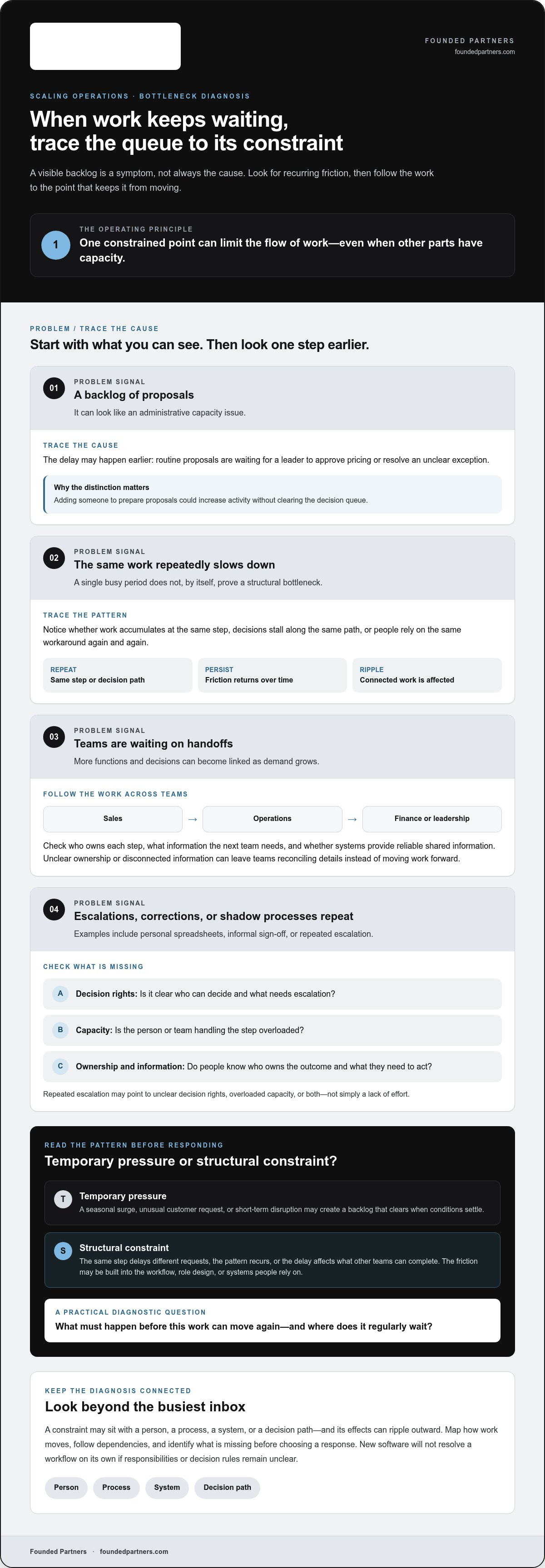
An operational bottleneck is a constraint that limits the flow of work or decisions through a business. As demand grows, a process that once relied on informal coordination may become a recurring source of delay. For example, a founder who used to approve every proposal may find routine decisions waiting in a queue while other work piles up.
Growth doesn’t make every delay a crisis. A busy period, an unexpected absence, or a one-off customer request can temporarily slow a team without indicating a structural problem. Look for repetition: work accumulates at the same step, decisions stall along the same path, or teams rely on the same workaround again and again.
The distinction matters because the visible symptom and the underlying constraint aren’t always the same. A backlog of proposals might look like an administrative capacity issue, but the actual delay may happen earlier, when a leader must approve pricing or resolve an unclear exception. Adding someone to prepare proposals could increase activity without clearing the decision queue. Operational bottlenecks in scaling businesses often reveal where responsibilities, workflows, or decision paths haven’t adapted to the organization’s growth.
There’s a useful parallel in engineering: a system’s overall flow can be limited by one constrained point, even when other parts have capacity. Understanding Bottlenecks in Engineering provides context for this idea. In a business, the constraint may be less visible, but its effects can ripple outward: work waits, teams coordinate around delays, and opportunities may pass while people clear accumulated tasks.
Common signals that work is slowing down
Look for recurring approval waits, backlogs that return, repeated corrections, and handoffs that depend on one person. Teams may create shadow processes, such as tracking requests in personal spreadsheets or seeking informal sign-off, when the formal workflow can’t keep pace. Repeated escalation is another signal. It may point to unclear decision rights, overloaded capacity, or both, rather than a lack of effort.
A bottleneck is a constraint, not simply a busy day
An isolated disruption usually passes without repeatedly affecting the same workflow. A bottleneck creates persistent friction at a particular point, whether the constraint sits with a person, a process, a system, or a decision path. Notice where work regularly waits and what must happen before it can move again. That pattern helps distinguish temporary pressure from an operating constraint worth examining.
Why growth exposes deeper operational bottlenecks
A process can work well at one level of demand and become strained at another. A small team may coordinate customer requests through quick conversations and a shared spreadsheet. As volume rises, that approach can lead to inconsistent updates, repeated data entry, and uncertainty about who should act next. The process hasn’t necessarily failed; it may have been designed for a smaller, less interdependent operation.
Growth also increases the number of decisions and handoffs involved in delivering work. A request might pass from sales to operations, then to finance or leadership, with each function depending on information from the previous one. If ownership is unclear or systems don’t share reliable information, teams spend time reconciling details instead of moving work forward. New software may help in some cases, but it won’t resolve a workflow without clear responsibilities or decision rules.
This is why operational bottlenecks in scaling businesses can’t always be diagnosed by looking at one crowded inbox or overworked team. The constraint may come from the relationship between roles, processes, information, and approvals. Even a well-intended fix can shift the queue. If a leader delegates an approval, for instance, the next constraint might appear in the review or handoff that follows. The goal is to understand how work moves across the organization, not just relieve the most visible pressure point.
Temporary pressure or a structural constraint?
A seasonal surge, unusual customer request, or short-term disruption can create a backlog that clears when conditions settle. A structural constraint tends to recur because it is built into the workflow, role design, or systems people rely on. To distinguish the two, look for persistence, repetition, and effects across connected work. Does the same step delay different requests? Does that delay affect what other teams can complete?
Context matters. A queue may grow during a busy week without revealing a lasting problem. But if people repeatedly bypass a process, wait for the same approval, or correct the same missing information, the pattern deserves attention. Consider whether the friction continues after demand eases and whether it delays decisions or commitments beyond the team where it first appears.
How founder-led teams can outgrow informal operating habits
Founder involvement can provide clarity when a business is small. As responsibilities spread, routing routine decisions through one person can turn that involvement into a queue. Role ambiguity creates another risk: two people may duplicate a task while another assumes someone else owns it. Teams may then escalate decisions that should have a clear owner or pause work until the founder weighs in.
As the organization grows, revisit who owns outcomes, which decisions need escalation, and what information people need to act confidently. Broader operating foundations are explored in this business scalability consulting guide. When constraints connect across roles and workflows, hands-on operations optimization can help founders assess the operating model behind them.
How to diagnose which operational bottleneck matters most
Start diagnosis with evidence, not the first explanation that sounds plausible. A team may describe a process as understaffed, while a closer look shows that requests repeatedly arrive without the information needed to proceed. To identify which constraints deserve attention, follow the work from its starting point to its outcome, then compare what the workflow shows with people’s experience of doing it.
Map the workflow from request to outcome
Choose a recurring process that matters to customers, employees, or strategic execution, such as fulfilling a customer request or preparing a decision for leadership. Map the current path, not the ideal one. Include each handoff, approval, decision, and system people rely on. Mark where work waits, returns for correction, or depends on one person to move forward.
Then trace real examples through the map. Ask: Where does work wait? Who must act next? What information is missing? Where does rework begin? A delay at one step may depend on an earlier handoff, so follow the sequence rather than treating each department as a separate problem.
Trace symptoms to root causes before choosing a fix
Use the map to test possible explanations. Is the queue growing because there’s more work than available capacity, or because ownership is unclear? Are decisions delayed by limited authority, missing information, or a process that sends routine work through unnecessary review? Check whether a workaround is repeatedly compensating for a flawed step or handling an unusual exception.
Workflow evidence matters, but so does staff experience. Ask the people doing the work what slows them down, then compare their accounts with observed handoffs, returned requests, and accumulated work. One anecdote can offer a useful lead, but it doesn’t establish a pattern on its own. Look for examples across the process and note where experiences agree or differ. Disagreement may point to inconsistent procedures or unclear expectations.
To trace a visible delay to its source, follow the work backward through its handoffs and dependencies until you find the decision, capacity, information, or process constraint that keeps causing it.
Once you have a likely cause, assess its effect before deciding what to address first. Consider how often the constraint recurs, which work it delays, who else depends on that step, and whether it creates rework or stalls downstream decisions. This keeps attention on meaningful operating constraints instead of whichever complaint is loudest.
After making a change, compare the same workflow evidence with staff experience. Are fewer requests waiting at the constrained step? Has the queue simply moved elsewhere? Clear measures help distinguish a lasting improvement from a temporary shift in pressure. For a practical framework, see measuring transformation success. When diagnosis raises broader questions about roles, decisions, and execution, experienced operational guidance can help founders consider the connected parts of the operating model.
How to prioritize a bottleneck response without creating more friction
Once you’ve identified a likely constraint, resist the urge to fix every point of friction at once. Start with the bottleneck that most affects important work, blocks the most dependencies, or limits the team’s ability to execute. A recurring delay in a customer-facing commitment may deserve attention before an internal inconvenience, especially if other teams are waiting on it.
Prioritization isn’t just about the size of a queue. Consider what is held up, how many parts of the business depend on that step, and whether the constraint creates downstream rework or missed opportunities. Then match the response to the cause. A new tool won’t clarify who owns a decision, and extra capacity may not help if requests arrive incomplete.
Match the intervention to the constraint
Choose a response that addresses why work stalls, not just the visible symptom. If ownership or handoffs are unclear, define responsibilities and decision points. If the workload consistently exceeds the available attention, consider whether capacity or roles need to change. If a system limitation or repeated manual step is the constraint, evaluate whether a technology change is appropriate.
Automation can support a well-understood workflow, but it isn’t a substitute for understanding that workflow. Automating a process with unclear inputs, unnecessary approvals, or inconsistent ownership can make confusion move faster rather than resolve it. First establish what should happen, who is accountable, and which exceptions require judgment. Then decide whether automation or another system change will improve the flow.
Sequence change around dependencies and people
Even a focused adjustment can affect connected work. Changing an upstream review step may send more requests to a downstream team, or speed up processing while reducing the time available for a customer-facing check. Before expanding a change, consider who receives the work next and what they need to handle it well.
Involve the people who perform the workflow in shaping the response. They can identify practical complications, informal checks that protect quality, and workarounds that hide a dependency. Their input helps distinguish a change that looks efficient on paper from one the team can carry out reliably.
A measured sequence keeps the response manageable:
- Address the constraint most directly linked to important work and downstream dependencies.
- Make a focused change in the relevant process, role, handoff, or system.
- Observe whether work flows more smoothly and whether friction has shifted elsewhere.
- Adjust the approach before applying it to unrelated operations.
This measured approach is especially useful when operational bottlenecks in scaling businesses involve decision rights, capacity, and cross-team coordination. Track whether the original queue eases, downstream work remains clear, and staff can follow the revised process without creating a new workaround. Founded Partners’ operations optimization work supports founders who want practical help strengthening operations as the business grows. Learn about operations optimization with Founded Partners.
How Founded Partners helps founders address scaling bottlenecks
Some operating constraints are connected. A delay that appears to sit within one team may involve decision rights, leadership capacity, handoffs, and the company’s broader priorities. Once the pattern is clear, founders may benefit from an experienced partner who can help assess those connections and consider a practical response that fits the organization, rather than treating each symptom in isolation.
Founded Partners supports founders and entrepreneurial leaders through operations optimization, business transformation, and leadership advisory. Strategic Growth & Business Transformation is led by Matt Pierce and tailored to the organization. The work focuses on understanding how the business operates, where its current approach is under strain, and what changes can strengthen execution as the company grows.
For founders who want dedicated one-on-one support, Founder Advisory is provided by Co-Founder and Chief Advisor Adam Miron. It brings leadership decisions and operating challenges into the same conversation, particularly when a founder is balancing immediate execution with the organization’s longer-term direction. For related context on evaluating advisory support, explore this growth consulting buying guide.
Hands-on support for consequential business moments
Operational change affects people, priorities, and how decisions get made. Direct partner involvement helps founders examine those implications alongside the process itself, with practical, founder-focused guidance. That broader view is valuable when a bottleneck touches several functions or when resolving one constraint could affect the business’s ability to execute its strategy.
Operational bottlenecks in scaling businesses may call for more than a process adjustment. The work may also involve clarifying leadership responsibilities, aligning teams around priorities, or reconsidering how the operating model supports growth. The right response depends on the organization’s context and the decisions its leaders need to make.
A measured next step for founders
Before deciding what to change, consider three questions: What constraint is affecting important work? Which decisions or commitments does it delay? What part of the operating model may be contributing to it? A clear view of these points can make the next step more focused, whether that means refining a workflow, clarifying ownership, or addressing a wider leadership challenge.
Founded Partners’ overall experience includes 25+ companies founded, 100+ acquisitions supported, 35+ acquisitions supported, and $3B+ companies advised in market cap created. These figures reflect company-wide experience, not the outcome of any individual service. A focused discussion can help founders consider how to strengthen their operating model. Explore Founded Partners’ advisory and consulting services.
Turn the constraint into a clearer next step
A recurring slowdown can be more than an obstacle to clear. It can show where the business needs stronger decision paths, clearer ownership, or an operating model better suited to its next stage of growth. Treat operational bottlenecks in scaling businesses as signals to examine how work and leadership decisions fit together.
Choose one constraint with meaningful impact. Agree on who owns the next step, what change is within reach, and how you’ll tell whether it improves the flow of work without creating a new delay elsewhere. A focused response gives your team room to learn and refine how it operates.
If the issue spans multiple functions or raises broader questions about how the organization should scale, a thoughtful outside perspective can help clarify the choices ahead. Start a conversation with Founded Partners about the operating challenges your business is facing.
Growth brings complexity, but it also creates an opportunity to build with greater intention. One well-chosen improvement can help your organization move forward with more clarity and confidence.
Frequently Asked Questions
Can a founder be the operational bottleneck?
Yes. A founder can become a point of delay when routine work depends on their approval or personal relationships. That doesn’t mean they’re failing; it may mean decision responsibilities haven’t kept pace with the business. For example, if customer exceptions, hiring decisions, and supplier changes all wait for the founder, separate the decisions that need their judgment from those a designated leader can make. Clear boundaries help preserve founder attention for decisions that truly need it.
Does hiring more people always resolve operational bottlenecks?
No. Hiring can help when there’s more work than the current team can reasonably handle, but it won’t necessarily fix a process that sends requests back for missing details or routes simple choices through multiple approvers. Before opening a role, review what the new person would own and which delays that responsibility should reduce. If the work remains unclear or depends on the same approvals, added capacity may increase coordination needs without relieving the constraint.
Can new software fix operational bottlenecks?
Sometimes, especially when a system limitation or repetitive manual task directly slows work. But software won’t determine who owns an exception or whether an approval is necessary. For example, digitizing a form may speed up submission while leaving requests stalled in an unclear review process. Define the operational result first, such as reducing duplicate entry or making status visible, then assess whether a system change supports that result and fits the workflow.
Are operational bottlenecks always signs of poor management?
No. A constraint can emerge because the organization’s workload, team structure, or coordination demands have changed, even if the process once worked well. Treat a recurring delay as information, not evidence of individual failure. For example, a new product line may bring requests that don’t fit existing decision rules. Talk with the people handling those requests to understand what has changed and whether the process still matches the work.
What happens if an operational bottleneck is left unresolved?
Important work may continue to stall, and teams may spend more time chasing updates or maintaining workarounds. For operational bottlenecks in scaling businesses, the consequences depend on which commitments are affected and how closely other work depends on them. Start by identifying delayed customer or internal decisions, then consider whether those delays recur or create uncertainty for other teams. That helps leaders judge the issue’s practical significance.
How can leaders address bottlenecks without damaging team morale?
Frame the discussion around the work, not blame. Ask team members to describe a recent task that stalled, what they needed to proceed, and which steps felt unclear or duplicative. Then explain what the organization hopes to improve and invite input on a workable adjustment. For instance, people who handle customer requests may notice a missing handoff detail that leaders can’t see from a process chart alone. Review the change together and acknowledge useful feedback.
When should a founder seek outside help with operational bottlenecks?
Consider outside support when a constraint crosses teams, repeatedly delays consequential decisions, or persists despite local process adjustments. An experienced advisor can offer a broader view of how roles, priorities, and workflows interact, while the founder and team remain responsible for decisions and execution. Founded Partners provides business transformation consulting, operations optimization, and leadership advisory for growth-oriented founders. The work helps clarify the challenge and shape a more considered path forward.