
How to align sales and operations teams through shared planning

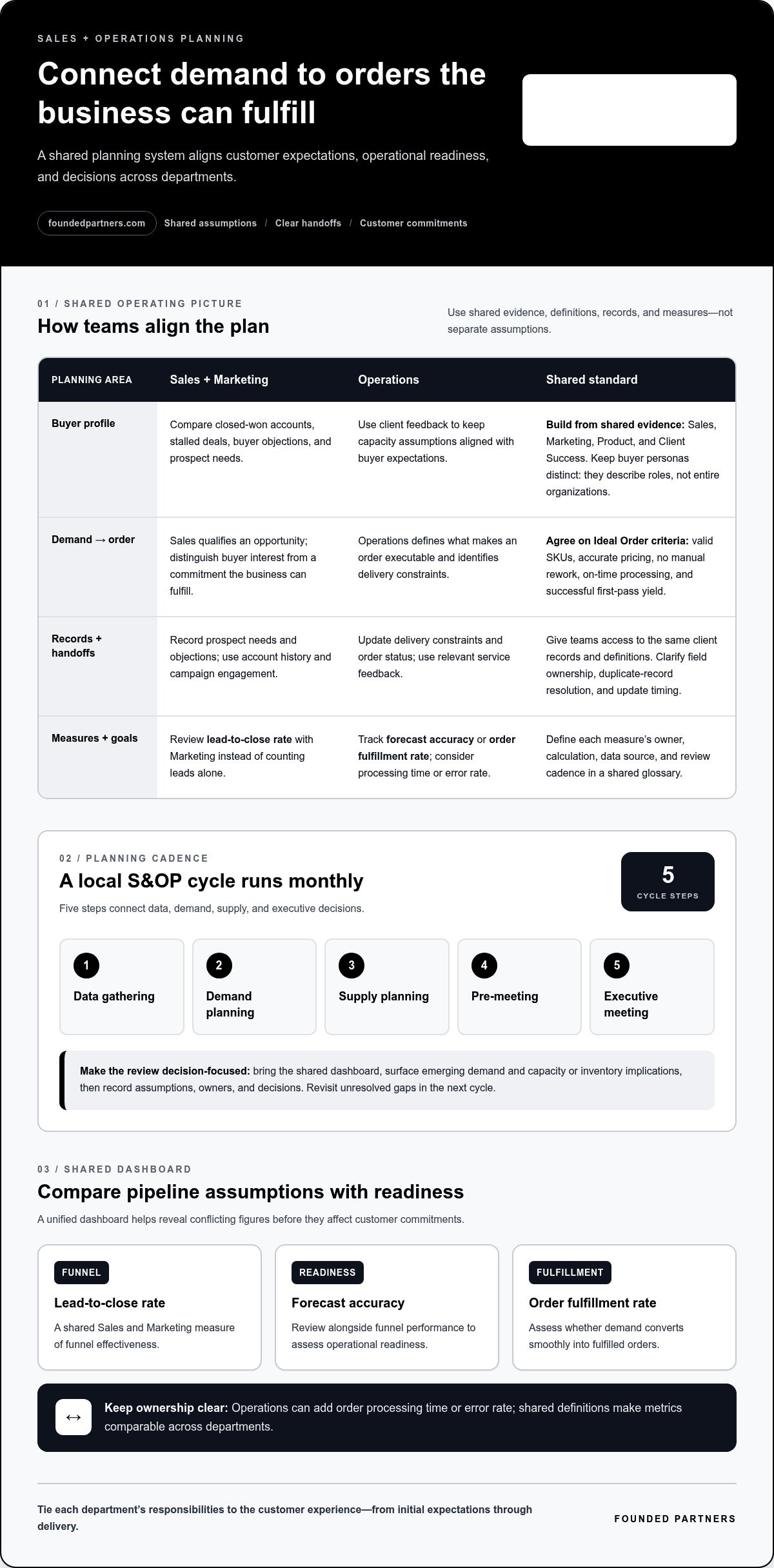
Sales and operations planning breaks down less from a lack of forecasts than from teams acting on different assumptions. Aligning sales and operations teams means creating a shared planning rhythm that connects demand, capacity, supply, and customer commitments. According to the National Center for Biotechnology Information, a local S&OP cycle usually runs monthly and has five steps: data gathering, demand planning, supply planning, pre-meeting, and executive meeting.
Planning meetings can easily become update sessions instead of decision-making forums, especially when teams rely on different buyer insights, measures, or workflows. Shared planning makes the work more practical: teams can agree on who they serve, coordinate handoffs, and surface operational constraints before they affect customer expectations.
This guide explains how to build alignment through shared buyer profiles, collaborative resources, recurring meetings, and coordinated workflows. It also covers how to identify planning gaps, establish common measures, and keep decisions tied to customer outcomes so teams can move forward with greater clarity.
Key Takeaways
- Build buyer profiles from shared insights so teams plan around the same customer needs and expectations.
- Map cross-department workflows to reveal handoff gaps, duplicated effort, and opportunities to improve coordination.
- Use recurring meetings to surface blockers, review progress, and turn updates into shared decisions.
- Connect each department’s responsibilities to the customer experience, from initial expectations through delivery.
- Address misaligned goals and unclear ownership with common outcomes, practical measures, and a change plan teams can follow.
Shared ideal customer profiles and buyer personas
- Build an ideal customer profile from evidence shared by Sales, Marketing, Product, and Client Success. Compare closed-won accounts, stalled deals, support questions, and recurring buyer objections. Document organizational characteristics, decision-making roles, urgent problems, buying triggers, and service expectations. For example, an operations-focused buyer may prioritize reliable delivery, while Finance prioritizes predictable costs. Keep buyer personas distinct: personas describe roles, not entire organizations. Review both against client feedback to keep targeting and capacity assumptions aligned.
- Translate the profile into shared definitions for qualified demand and an Ideal Order. Sales may qualify an opportunity, while Operations defines what makes an order executable. Set Ideal Order criteria such as valid SKUs, accurate pricing, no manual rework, on-time processing, and successful first-pass yield. These standards distinguish buyer interest from commitments the business can fulfill. Use lead-to-close rate as a shared Sales and Marketing measure of funnel effectiveness, alongside forecast accuracy or order fulfillment rate to assess operational readiness.
- Give Sales, Marketing, and Operations access to the same client records and definitions. An integrated CRM can connect account history, campaign engagement, order status, and service feedback. Agree on who owns each field, how duplicate records are resolved, and when information is updated. Sales can record prospect needs and objections; Operations can update delivery constraints. A unified dashboard helps compare pipeline assumptions with capacity and fulfillment performance, revealing conflicting figures before they affect customer commitments.
- Set shared goals that reward outcomes across handoffs, not isolated activity. Sales and Marketing can review lead-to-close rate together rather than counting leads alone. Operations can add order processing time or error rate to show whether demand converts smoothly. Define each metric’s owner, calculation, data source, and review cadence in a shared glossary. This prevents terms such as “qualified opportunity” or “completed order” from meaning different things across departments. Use client feedback to refine targeting and messaging as buyer behavior changes.
- Connect these measures through a recurring planning meeting with a decision-focused agenda. According to the National Center for Biotechnology Information, a local S&OP cycle usually runs monthly and has five steps: data gathering, demand planning, supply planning, pre-meeting, and executive meeting. Bring the shared dashboard to each review, then record assumptions, owners, and decisions. Sales can flag emerging demand; Operations can identify capacity or inventory implications. Assign action owners and revisit unresolved gaps in the next cycle.
Cross-departmental collaboration resources
Sales and Operations can become misaligned when they rely on separate data, goals, or handoff rules. Unclear ownership and limited feedback may leave Sales making promises that Operations cannot plan around.
-
Choose Transparency and Collaboration Tools
Choose shared tools that make requests, decisions, and process updates visible across departments. A central communication channel can hold sales requests, marketing feedback, operational updates, and action owners. A shared dashboard can show pipeline status alongside order progress, helping teams spot conflicting assumptions. Prioritize tools that connect with existing systems, and clarify who maintains each data field.
Check whether Sales can see order status and whether Operations can access relevant customer commitments. For example, a dashboard that shows quotes but not fulfillment updates leaves a critical handoff hidden. Avoid adding another tool if teams still have to enter the same information separately. Set clear access, update, and escalation practices so collaboration supports daily work instead of creating duplicate records.
-
Map the Order Process Together
Map an order from the first sales conversation through processing and fulfillment with representatives from Sales, Operations, and IT. Record each handoff, required information, decision, and system used. For example, trace how a quote becomes an order, then identify where pricing validation or missing customer details can delay processing. A shared map exposes manual steps and unclear ownership.
Compare the documented process with how employees actually complete orders. Note repeated data entry, inconsistent checks, and exceptions that trigger rework. Then agree which gaps need a process change, clearer instructions, or technical support. Don’t assume automation is the answer before identifying the cause. A map grounded in real work gives departments a shared basis for prioritizing improvements.
-
Identify Barriers to Collaboration
Identify barriers by asking each department where information, decisions, or customer commitments stall. Sales may lack timely delivery updates; Operations may receive incomplete order details; Marketing may miss feedback about buyer objections. Record each issue with its impact, owner, and next action. This turns general frustration into a specific collaboration problem teams can address.
Look for conflicting targets, siloed systems, unclear handoff rules, and resources teams cannot access. Sales and Marketing can centralize campaign updates and share prospect feedback, objections, and content gaps. Operations can flag process constraints that affect customer expectations. Review unresolved barriers at a recurring cross-functional touchpoint, and track whether assigned actions remove them.
If process gaps persist across departments, consider a structured review of cross-functional operations to clarify workflows and priorities.
Joint task forces and recurring meetings
Set a dependable meeting rhythm so Sales, Operations, and Marketing can make decisions together. Give each meeting a defined purpose, shared measures, and documented follow-through.
-
Form Joint Task Forces
Form a task force around a specific shared outcome, such as reducing missed handoffs between Sales and Operations. Include the people who own the relevant work and a leader who can resolve cross-departmental blockers. A focused group can examine causes, assign actions, and report progress without turning every issue into a broad committee discussion.
Write a short charter that names the problem, decision rights, and evidence of progress. For example, a team reviewing order exceptions can track recurring causes and identify which handoff needs clarification. Bring Marketing into the task force when campaign promises affect delivery expectations. Don’t assign responsibility without giving the group access to the information and decision-makers it needs to act.
-
Review the Pipeline and Plan Together
Schedule weekly pipeline reviews to identify poor lead fit, missed handoffs, and opportunities that could affect operational capacity. Ask Sales to explain changes in deal timing and buyer requirements. Have Operations assess delivery implications, then record decisions, owners, and dates. Keep the discussion focused on issues that change the forecast or customer commitment, rather than reviewing every open deal.
Use a closed-loop cadence: hold weekly operations reviews and monthly business revenue reviews. At each review, compare the previous forecast with actual results, explain material differences, and assign follow-up actions. Sales and Marketing can also meet weekly or every two weeks to assess pipeline health and campaign performance. These distinct rhythms connect immediate execution with broader revenue planning.
- Plan campaigns jointly before launch, then review what happens after launch. Quarterly go-to-market planning gives Product, Finance, Sales, and Marketing a shared forum to align priorities and resource assumptions. During a launch, schedule biweekly syncs to review campaign response, lead quality, and seller feedback. For account-level coordination, use brief 5-10 minute stand-ups every two or four weeks to surface urgent needs.
Agree on the campaign audience, core promise, handoff rules, and operational constraints before materials go live. Sales can contribute buyer objections and examples of questions prospects ask. Operations can identify delivery dependencies that affect timing or capacity. After launch, compare planned outcomes with pipeline activity and customer feedback. Adjust messaging or execution when the evidence shows the campaign is attracting poor-fit demand.
Buyer-centric coordination across departments
Trace the customer journey across departments, then assign clear ownership to every handoff.
- Map the buyer’s path from research to purchase and delivery. A Forrester blog reports that 73% of B2B purchases involve three or more departments. That makes coordination part of the buying experience, not an internal efficiency exercise. Mark where Marketing informs, Sales advises, Finance supports terms, and Operations delivers. For each transition, document what the buyer needs, what information moves forward, and who owns the next action.
Use a buyer outcome, such as receiving a usable service by an agreed date, to test each handoff. If a sales promise depends on operational capacity, make that dependency visible before the commitment reaches the buyer. A seamless journey doesn’t require identical roles. It requires departments to understand how their separate actions shape one customer outcome.
- Clarify responsibility for expectations, workflows, and systems. Sales owns customer relationships and sets expectations; Operations owns order workflow and fulfillment; IT owns systems, integration, and security. Document these responsibilities in the process map, then identify decisions that need joint input. For example, Sales may flag a time-sensitive account, Operations may assess delivery capacity, and IT may identify a data limitation.
Define an Ideal Order together using practical criteria: valid SKUs, accurate pricing, no manual rework, on-time processing, and successful first-pass yield. These criteria connect what a buyer agrees to with what teams can execute. Review exceptions by cause, such as missing details or incorrect pricing. Assign each cause to the process owner best positioned to prevent it next time.
- Measure cross-functional effectiveness through buyer outcomes, not departmental activity alone. Compare time and cost efficiency, goal achievement, and customer satisfaction across the functions that support Sales. For example, a faster quote process has limited value if incomplete information later delays fulfillment. Pair customer feedback with operational evidence, then identify which handoff most affects the experience.
Use the findings to build shared accountability. If Operations changes a delivery step, Sales should understand how that affects customer communication. If Sales hears a recurring concern, Operations should know whether it points to a workflow issue. Record the action, its owner, and the intended buyer outcome. Revisit those decisions during the next planning review.
- Build a communication framework that keeps buyer needs visible between formal reviews. Give Sales a clear route to flag urgent customer risks and Operations a way to report constraints affecting commitments. Use a shared record for the issue, current status, owner, and next action. For example, a delayed order should show both its operational cause and who owns the customer update.
Keep the focus on resolving the buyer’s need rather than assigning blame. When patterns emerge, bring the relevant departments together to adjust the workflow, guidance, or decision rights. This turns individual feedback into practical improvement. Over time, aligning sales and operations teams around customer outcomes makes decisions more consistent across the entire journey.
Challenges to sales and operations planning
Aligning sales and operations teams improves demand visibility, capacity decisions, and customer commitments. Sales can pursue achievable opportunities while Operations plans the resources needed to deliver them.
Build an S&OP process by gathering data, planning demand, planning supply, holding a pre-meeting, and making decisions in an executive meeting. According to the National Center for Biotechnology Information, a local S&OP cycle usually runs monthly and has five steps.
Resolve forecast and capacity conflicts by comparing assumptions, timing, and constraints together. For example, review the likelihood and delivery requirements of a large opportunity, then agree whether to adjust the forecast, capacity plan, or customer commitment.
Implementation time depends on data quality, decision rights, process complexity, and teams’ ability to adopt the cadence. Start with a workable first cycle, then refine the process as teams establish consistent inputs and follow-through.
- Establish verifiable outcomes. Choose measures that show whether planning decisions are working, such as forecast accuracy, fulfillment performance, or customer satisfaction. Define how each measure is calculated and who owns the source data. Without verifiable outcomes, teams may disagree about progress because they are using different definitions of success.
- Clarify decision rights. Document who can revise a forecast, approve a capacity trade-off, or communicate a changed delivery expectation. For example, Sales can flag a strategic deal while Operations explains its capacity implications. Name the decision-maker for unresolved trade-offs so they don’t remain open between meetings.
- Surface assumptions before they become commitments. Ask Sales to distinguish confirmed demand from early-stage opportunities. Operations can then test the forecast against available capacity, inventory, and workflow constraints. Record the assumptions behind changes, such as a buyer’s decision timing or a required delivery date.
- Create a change management plan. Explain the purpose of the planning cadence, the information each team must provide, and how decisions will be shared. Include training for those who maintain forecasts or operational inputs. A tool alone won’t resolve misalignment if teams keep using separate processes or ignore agreed handoffs.
- Review and adjust the cycle. After each monthly review, compare planned demand with actual results and identify missed assumptions. Assign corrective actions with owners and deadlines. If data arrives late, decision rights remain unclear, or outcomes can’t be verified, address that barrier before expanding the process.
For a structured review of planning and operational challenges, discuss your next planning steps.
Founded Partners: Capital raising support
Founded Partners provides capital raising support for founder-led organizations preparing to fund strategic growth. Shared planning can clarify the demand, operational capacity, and investment priorities behind a growth plan. When those priorities call for external capital, a coherent operating plan helps leaders explain how funding supports business objectives.
Founded Partners also offers Business Transformation Consulting, Exit planning, and Leadership Advisory. These services can support different organizational needs: improving how the business operates, preparing for an eventual transition, or strengthening leadership decisions. The right next step depends on the challenge your planning process has surfaced.
Build alignment into your next stage of growth
Shared planning is more than a meeting cadence. It’s a leadership commitment to make decisions across the business using a common view of customer needs, capacity, and long-term priorities. Choose one planning challenge your team can address together, then give it an owner and a clear path to action.
For founder-led organizations, aligning sales and operations teams can be part of strengthening the business for its next stage. Founded Partners offers capital raising support, Business Transformation Consulting, and Exit planning. These services help leaders connect operating priorities with growth objectives or prepare for a future transition.
If you’re ready to discuss how stronger alignment can support your organization’s direction, contact Founded Partners to discuss alignment. A thoughtful next step can help your teams build momentum with greater purpose and confidence.
Frequently Asked Questions
What is sales and operations planning?
Sales and operations planning is a recurring process for balancing expected demand with the resources needed to meet it. It gives leaders a structured way to make decisions about production, staffing, inventory, and customer commitments. For example, if a large order may require overtime or affect other customers, S&OP brings the trade-off into a shared business decision instead of leaving it to one department.
Where should operations report?
Operations should report to the executive who can connect delivery decisions with organizational priorities and resolve cross-functional trade-offs. In some businesses, that’s a chief operating officer; in others, it may be the CEO or another senior leader. The reporting line matters less than clear authority. For example, the operations leader needs a way to raise capacity risks before Sales commits to delivery expectations.
What does sales and operations alignment mean?
Sales and operations alignment means teams make compatible decisions about what customers are promised and what the business can deliver. Both teams don’t need to share every task. They do need a reliable way to raise conflicts, assess the impact, and agree on a response. For example, if a customer requests faster delivery, Sales and Operations can assess feasibility before confirming a revised commitment.
What are the best practices for aligning sales and operations?
Start by identifying the decisions that repeatedly create friction, such as delivery dates, product availability, or exceptions to standard terms. Assign an owner to each decision and define what information that person needs. Then document how teams escalate disagreements and communicate decisions to affected staff. For example, a change to a delivery commitment should reach the account owner and fulfillment lead through an agreed channel.
Which KPIs measure sales and operations alignment?
Useful KPIs include forecast accuracy, lead-to-close rate, order fulfillment rate, order processing time, and order error rate. Pair related measures to understand the cause, not just the result. For example, compare forecast accuracy with fulfillment performance to see whether demand projections support delivery planning. Track a focused set of measures, define each calculation consistently, and assign an owner who can explain changes.
What tools and software help align sales and operations teams?
A CRM can organize account and opportunity information, while an ERP system can hold order, inventory, and fulfillment records. Shared dashboards help teams review connected information; workflow tools can document handoffs and outstanding actions. These tools work best when teams agree on data ownership and update practices. For example, a dashboard should show which system supplies order status rather than displaying conflicting updates.
How often should sales and operations teams meet?
Set meeting frequency according to the decisions teams need to make. A monthly S&OP cycle can support demand and supply planning, while a weekly operations review can address immediate blockers. Teams coordinating revenue can use monthly business reviews to examine broader performance. Keep each meeting’s purpose distinct: resolve urgent execution issues in operations reviews and reserve business reviews for decisions that affect wider priorities.
Who should own sales and operations planning?
An executive sponsor should own the business outcomes, while a designated process leader coordinates inputs, meetings, and follow-through. The sponsor resolves trade-offs teams can’t settle within their authority. The process leader maintains a consistent planning routine and makes open decisions visible. For example, a Finance or Operations leader may coordinate preparation, while the executive team approves choices affecting capacity, revenue priorities, or customer commitments.