

A strong recommendation does not create change on its own. To understand how to ensure consultant recommendations are implemented, connect each one to clear evidence, organizational priorities, an accountable owner, and a practical next step. Then make time to review progress and adjust the work as conditions change.
It is natural to expect a well-founded plan to move quickly into action. In practice, recommendations are more likely to take hold when decision-makers are ready, teams have capacity, and everyone understands what success looks like. This article explains how evidence-based reasoning builds confidence, how to time recommendations around client readiness, and how regular reporting keeps work visible. It also shows why implementation support matters: a consultant’s role can extend beyond presenting findings to helping teams assign responsibilities, address obstacles, and sustain progress.
Key Takeaways
- Anchor recommendations in relevant evidence and organizational goals so decision-makers can understand the rationale and weigh the trade-offs.
- Time recommendations around stakeholder readiness and the organization’s capacity, giving teams room to shape workable next steps.
- Use weekly progress reviews to surface obstacles early and keep implementation connected to agreed goals.
- Build implementation support into the engagement, with clear responsibilities and practical follow-through as plans meet day-to-day operations.
1. Supporting recommendations with independent, fact-based arguments
Recommendations gain credibility when consultants connect evidence to organizational goals and explain their reasoning plainly. They may assess performance metrics, workflows, interviews, and observations, then build a case that describes the problem, the proposed change, and its expected operational value. For example, if a communication change is based on an online survey, the consultant can identify whether people who rely on direct mail were excluded and recommend broader research before rollout.
Prioritization weighs potential impact against cost, available resources, and feasibility. Consultants can compare options, assess risks and ways to mitigate them, then recommend a practical sequence that fits the organization’s capacity. A recommendation with strong potential value may still need to wait if it depends on unavailable staff or conflicts with operational priorities.
Leadership buy-in is stronger when decision-makers see the evidence and help shape the response. Consultants can present concise recommendations, explain how each supports agreed goals, and invite stakeholders to raise concerns. Discussion helps leaders decide what to adopt, allocate resources, and resolve disagreements before they become barriers to implementation.
Recommendations can stall when evidence is incomplete, responsibilities are unclear, or the organization lacks time and ownership. Advisory support can address these obstacles by clarifying assumptions, defining responsibilities, and breaking a broad proposal into manageable actions. Consultants should also disclose where confidence is limited, so leaders can distinguish established findings from questions that need further analysis.
Before implementation, consultants test whether a recommendation is beneficial, feasible, and worth the effort required. They assess likely risks and identify mitigation steps, then define how progress will be evaluated against agreed goals. Limited consulting support may suit a specific decision or defined deliverable; recurring support can help with ongoing reviews and emerging managerial questions. Implementation costs depend on scope, internal capacity, and the changes required; professional support fees depend on the case and are provided after a quote request.
Automation can reinforce existing routines rather than create a separate process. For example, a metrics dashboard can draw on routinely collected performance data, while scheduled reminders prompt owners to update progress. Select tools and methods that fit the organization’s current systems and agreed scope, rather than assuming every product or methodology is appropriate.
2. Timing recommendations to match client readiness
Recommendations are more likely to land when decision-makers take part in discovery and can act on the outcome. During interviews and working sessions, consultants gather perspectives from affected departments, identify competing priorities, and clarify what success means to each group. Before presenting final recommendations, they confirm that stakeholders understand the challenge and have capacity to consider the proposed changes. Even a sound plan can falter if it arrives during a major operational transition.
Client involvement should shape the solution, not stop at reviewing a finished report. Consultants can present a framework, share relevant evidence, and invite the team to adapt responsibilities and workflows. For example, a new approval process should reflect how managers and frontline employees actually make decisions. Co-creating the process helps uncover practical constraints early and gives the people who will use it a meaningful role in its design.
To communicate recommendations and manage resistance, consultants should explain what will change, why it matters, and how the change affects each team. They can present the rationale, invite questions, and use feedback to address concerns or refine the approach. If stakeholders disagree, the consultant should raise the issue and involve the client sponsor before unresolved tensions undermine adoption.
Case studies can make an unfamiliar recommendation easier to assess, provided consultants explain the context and differences. A relevant example might show how another organization approached a similar workflow challenge, while making clear which conditions may not apply. Client success stories should illustrate decisions and lessons, not imply that another company’s results will automatically follow. Findings from the client’s own discovery remain central to the recommendation.
Timing also depends on resources and ownership. If a department is handling a major transition, the consultant can sequence the work or begin with a manageable pilot. Clear decision points let leaders revisit readiness as circumstances change. For organizations seeking support to align leadership around practical change, leadership alignment and transformation can provide a useful next step.
3. Creating weekly progress-reporting routines
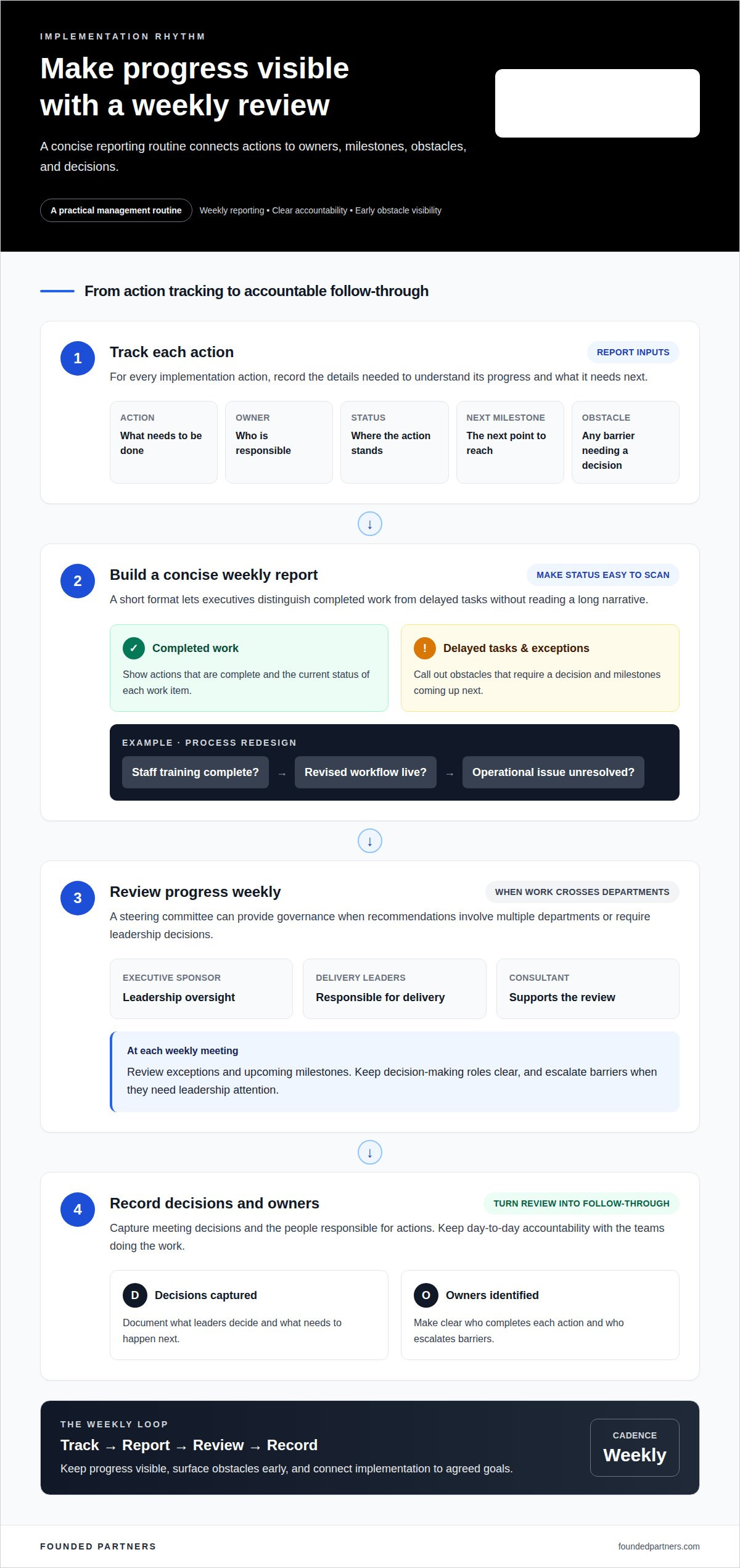
A weekly report turns an implementation plan into a working management routine. The consultant records each action, its owner, current status, next milestone, and any obstacle requiring a decision. A concise format helps executives distinguish completed work from delayed tasks without reading a long narrative. For example, a process redesign might track whether staff training is complete, whether the revised workflow is live, and which operational issue remains unresolved.
A steering committee can provide governance when recommendations cross departments or require leadership decisions. Include the executive sponsor, the leaders responsible for delivery, and the consultant; clarify who decides, who completes actions, and who escalates barriers. At each weekly meeting, review exceptions and upcoming milestones, then record decisions and owners. This structure gives leaders a direct view of progress while keeping day-to-day accountability with the teams doing the work.
Metrics make reports useful only when they connect to the intended outcome. Before implementation, the consultant and client define a baseline, agree on the measure, and set a review rhythm. For an associate attorney performance initiative, billed hours before, during, and after implementation can help assess change. The chosen metric should reflect the specific goal, not simply data that is easy to collect. Pairing outcome measures with milestone tracking shows whether actions are being completed and results are moving as intended.
Each review should end with a clear action: resolve a dependency, adjust a task, or keep the plan on course. A weekly self-report can reveal stalled work within a few weeks, giving the team time to address ownership or resource gaps. The U.S. Department of Health and Human Services says programs should identify a process for monitoring and assessing implementation of an improvement plan. Consultants can use that process to capture findings, track follow-through, and bring emerging issues to the steering committee before delays compound.
4. Extending a consulting engagement through implementation
A final report marks a decision point, not the end of the work. Recommendations still need owners, coordinated tasks, and feedback from employees expected to put changes into practice. When implementation falls outside the original engagement, the consultant and sponsor can agree on an extension with defined deliverables, decision rights, and review points. This keeps the next steps connected to the original goals.
A practical extension turns each recommendation into a clear flow of responsibilities. The consultant works with the client team to set task order, assign accountable owners, identify dependencies, and agree how progress will be reviewed. For example, a workflow change may require a process owner to revise procedures, managers to communicate the change, and employees to apply it. Clarifying these handoffs helps keep tasks from falling between departments.
Implementation support should fit the work. A recommendation involving a new process may require the consultant to work alongside managers, coach team leads, and help address barriers. Technology adoption may call for guidance as teams adjust workflows, while employee training can help establish consistent practice. The consultant can also review performance measures, employee feedback, and customer insights, then recommend adjustments when results differ from expectations.
Plan the evaluation before changes go live. Record the launch date, the relevant baseline, the expected outcome, and the date for reviewing results. A few weeks after the change goes live, compare actual performance with the baseline and capture lessons in a change log. The Centers for Disease Control and Prevention notes that using evaluation recommendations requires planning, collaboration, and commitment from evaluators and those expected to act.
Keep the extension focused: agree on what the consultant will support, what the internal team owns, and how unresolved issues will be escalated. If new issues emerge beyond the agreed scope, define them separately rather than letting the engagement expand without clear priorities. To structure responsibilities and follow-through, discuss implementation support.
Founded Partners
Founded Partners helps founder-led organizations turn strategic priorities into coordinated business action. When recommendations require organizational change, leadership alignment, or a stronger operating foundation, its Business Transformation Consulting and Leadership Advisory support the move from decisions to execution.
A useful next step is a focused conversation about the recommendation, the teams responsible for it, and the barriers slowing progress. That context helps clarify where advisory support fits, whether the need is aligning leaders, strengthening operations, or preparing for a broader transition. The aim is practical: define the work, establish ownership, and keep implementation connected to organizational priorities.
For support putting recommendations into action, contact Founded Partners.
Make implementation part of the next decision
A practical way to understand how to ensure consultant recommendations are implemented is to treat execution as part of the decision, not a phase left for later. Before moving forward, clarify what must change in daily operations, who will guide that shift, and how leaders will keep it connected to organizational priorities. That discipline also helps when strategic work involves capital raising support or exit planning, where recommendations must lead to thoughtful action.
The next step is to identify where momentum is most likely to stall: unclear ownership, competing priorities, or a gap between the plan and the team’s capacity. A focused discussion can turn that concern into a defined path, with responsibilities and support suited to the organization’s goals. Founded Partners works with founder-led organizations on complex business decisions and organizational change. Contact Founded Partners to discuss implementation and consider a practical next step for your business. Progress begins when good advice becomes work the organization is ready to own.
Frequently Asked Questions
How do consultants turn recommendations into an actionable implementation plan?
A practical way to understand how to ensure consultant recommendations are implemented is to translate each one into clear deliverables, required inputs, dependencies, and approval points. Consultants define what “complete” means, such as a revised procedure approved and available to staff. They also identify decisions that could affect the sequence, so leaders can see what must happen first and how a delay might affect connected work.
How do consultants assign owners, deadlines, and accountability for recommendations?
Consultants distinguish the person accountable for an outcome from colleagues responsible for specific tasks. They align each owner’s responsibility with the authority and capacity to make progress, then set due dates around dependencies and approvals. If ownership changes, the plan records the handoff and any open commitments. This makes accountability visible and helps leaders understand why a deadline slipped, rather than treating the missed date as the whole story.
How do consultants track implementation progress with KPIs, milestones, and dashboards?
Consultants pair outcome indicators with leading signals that show whether work is on course. For a customer-response improvement, a leading measure might track staff use of the new process, while an outcome measure reflects response performance. A dashboard should define each measure, its data source, and who updates it. Shared definitions help leaders interpret changes consistently and spot when a result needs closer investigation.
How do consultants measure the ROI and outcomes of recommendations?
For leaders considering how to ensure consultant recommendations are implemented and deliver value, ROI analysis compares relevant benefits with implementation and ongoing operating costs. Consultants separate direct financial effects from wider outcomes, such as improved service or reduced process friction, and examine the assumptions behind the comparison. A revenue shift, for example, may also reflect market conditions. Reviewing these influences helps leaders assess the recommendation’s contribution without overstating its impact.