

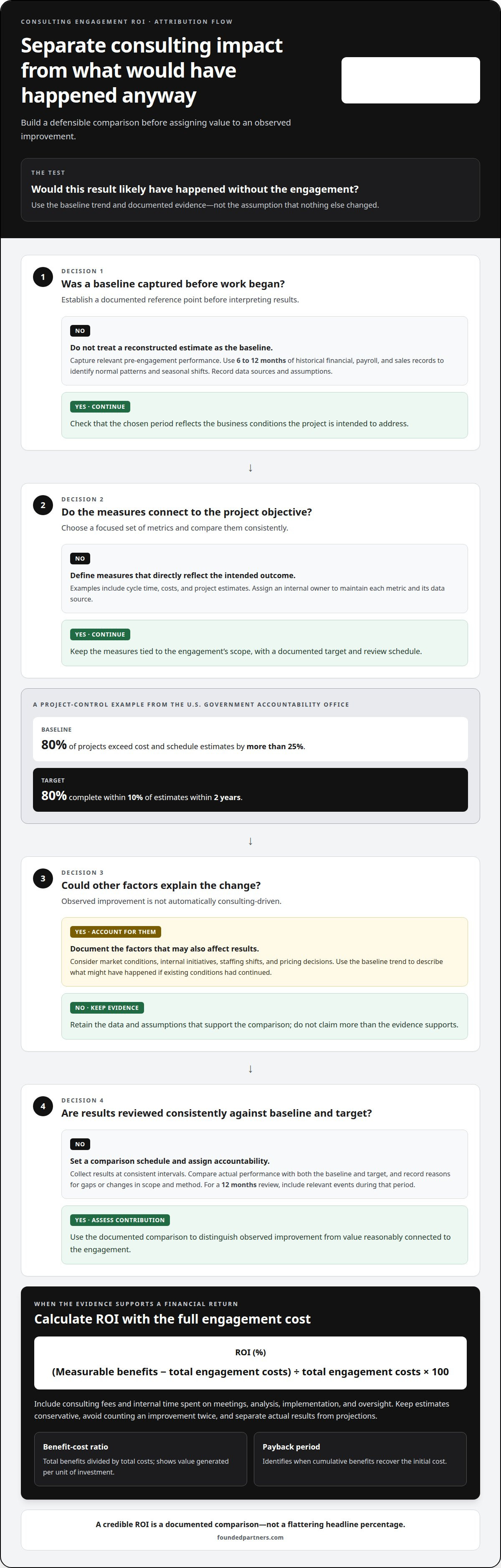
A consulting engagement’s ROI is only meaningful when you separate its contribution from what would have happened anyway. Calculate it by subtracting total engagement costs from measurable benefits, dividing the result by total engagement costs, then multiplying by 100 for a percentage. That is the core of measuring the ROI of a consulting engagement, but the calculation is only as credible as its baseline and evidence.
It’s reasonable to expect consulting outcomes to appear in the numbers. Yet revenue, margins, delivery speed, and team capacity can shift for reasons beyond the engagement, so a headline percentage alone may tell an incomplete story.
This guide explains how to establish a counterfactual baseline, choose a focused set of KPIs tied to the engagement’s objectives, and assess financial and operational gains against the full cost. It also shows how to distinguish contribution from coincidence and present results in terms leaders can use to make decisions. The goal is a clear, defensible account of value, not a flattering score.
Key Takeaways
- Build a counterfactual baseline from pre-engagement performance so you can distinguish consulting’s contribution from changes that would have happened anyway.
- Choose a focused set of KPIs tied to the engagement’s objectives, then track them against consistent data.
- Include the full engagement cost when calculating ROI, and use benefit-cost ratio and payback period to add useful context.
- Present results in business terms, connecting measurable gains and operational improvements to decisions leaders need to make.
Can You Measure Consulting ROI Without External Help?
Yes. Internal teams can measure ROI by defining the intended outcomes, recording the costs, and keeping evidence for each claimed gain. Measuring the ROI of a consulting engagement starts with a clear comparison, not a headline percentage.
-
Calculate Returns From Gains and Costs
Document measurable gains, then subtract total engagement costs from those gains. Divide the result by total engagement costs and multiply by 100 to express ROI as a percentage. Include benefits the business can trace to records, such as realized savings or added revenue. Avoid counting one improvement twice, and separate actual results from projections. This gives leaders a consistent basis for measuring the ROI of a consulting engagement.
-
Include Internal Time and Fully Loaded Costs
Include consulting fees and internal time spent on meetings, analysis, implementation, and oversight. To compare consulting with an in-house alternative, estimate the roles, time, and resources needed to produce comparable work. Review the pricing model and scope together, since fixed-fee, hourly, or milestone billing affects when costs are recorded.
-
Identify Calculation Mistakes and Risks
Check that the measurement window captures both costs and the period in which benefits appear. Don’t attribute every revenue increase to the consulting firm; market conditions, internal initiatives, and other changes may also affect results. In companies where return on cost of investment was falling, 65% had SG&A costs outpacing revenue growth. Compare SG&A with revenue trends, document assumptions, and keep estimates conservative. These steps help avoid overstating gains or overlooking costs.
Incremental value versus a counterfactual baseline
A baseline makes improvement visible; a counterfactual asks what might have happened without the engagement. Establish both before work begins, then compare results using consistent metrics.
-
Set a Baseline Before Work Begins
Capture relevant performance before the consulting engagement starts. Use 6 to 12 months of historical financial, payroll, and sales records to identify normal patterns and seasonal shifts. Select a period that reflects the business conditions the project will address. Record the data source and any assumptions, so later decisions rely on a documented reference point, not a reconstructed estimate.
-
Record Metrics and Assign Accountability
Choose measures that connect directly to the project’s intended outcome, such as cycle time, costs, or project estimates. The U.S. Government Accountability Office gives a project-control example. At baseline, 80 percent of projects exceed cost and schedule estimates by more than 25 percent. Its target is 80 percent completing within 10 percent of estimates within 2 years. Assign an internal owner to maintain each metric and its source.
- Define the counterfactual before interpreting results. Describe how performance would likely have changed if existing conditions had continued, using the baseline trend rather than assuming nothing would change. Then document market conditions, internal initiatives, staffing shifts, and pricing decisions that could also affect the outcome. This helps separate observed improvement from value reasonably connected to the engagement.
- Set the comparison schedule and accountability together. A client-side metric owner can collect results at consistent intervals, while the engagement lead explains changes in scope or method. Compare actual performance with both the baseline and target, and record reasons for gaps. For a 12 months review, include relevant events during that period instead of crediting every change to consulting.
What KPIs should you use to evaluate an executive consulting engagement?
Choose measures that connect strategic objectives to operational outcomes, financial returns, and benefits that may take longer to emerge.
-
Set Project Baselines and KPIs
Before a consulting project begins, select KPIs that reflect its intended output and business objective. Track the relevant baseline, such as gross margin, production time, or invoice collection days, then set a measurable target and review date. For example, a goal might be raising gross profit margin from 32% to 36% within 9 months. Include the data source and keep measures focused on the engagement’s scope.
-
Calculate Returns and Payback Measures
Calculate financial ROI by subtracting engagement cost from financial benefits, dividing by engagement cost, then multiplying by 100. A benefit-cost ratio divides total benefits by total costs, showing the value generated per unit of investment. Payback period identifies when cumulative benefits recover the initial cost. Present all three where useful: each clarifies a different aspect of performance, and none replaces the underlying evidence.
-
Value Tangible and Intangible Benefits
Translate measurable financial improvements into money using conservative assumptions. For instance, value reduced manual processing hours using the affected staff’s labor rate. Track nonfinancial outcomes separately, including stronger decision-making, improved employee experience, or clearer strategy. These benefits can support the business case, but don’t assign them invented dollar values or blend them into financial returns without a defensible method.
-
Separate Unpriced Benefits From Financial Returns
Keep a distinct record of benefits that matter but lack a reliable monetary value. Employee feedback, customer satisfaction, and process adoption can show whether an improvement is taking hold. Transformation benefits may unfold over 24-48 months, with the ROI inflection point often arriving in months 18-30 as adoption matures. Set review points across that horizon so early indicators and later financial outcomes remain visible.
Communicating engagement’s business value
Leadership needs more than a percentage to understand an engagement’s contribution. Connect financial results and operational changes to the decisions the organization needs to make.
- Frame the analysis around a decision. State the engagement objective, the period measured, and the business outcome leadership needs to assess. For example, connect a pricing change to margin and profit, while showing a process initiative’s effect on output. This helps executives distinguish a useful result from a metric presented without decision-making context.
- Translate operating improvements into financial meaning. A business with $50M in revenue and a 40% gross margin would gain $600,000 in incremental annual margin from a 3% pricing improvement. Explain the assumptions behind that percentage, identify the affected revenue, and show whether the analysis measures realized results or an estimate. Keep the underlying evidence visible.
- Present the business case in a concise scorecard. For each KPI, show the starting point, target, current outcome, measurement period, and accountable owner. Put the ROI percentage beside its formula inputs, benefit-cost ratio, and payback period, rather than presenting a result without context. Separate realized profit and cost savings from capacity gains, risk reduction, and employee or customer feedback.
- Use a regular review rhythm to keep leadership decisions timely. Compare progress at quarterly reviews and check operational indicators at 30, 90, and 180 days after delivery. If actual value falls more than 20% below projected value, conduct a root cause analysis. Identify whether adoption, market conditions, scope, or another factor explains the gap, then document the corrective decision.
For a clearer connection between transformation outcomes and executive decisions, strengthen your business transformation approach.
Founded Partners: Business Transformation Consulting
Founded Partners helps founder-led organizations strengthen operations and build a sounder foundation for growth through Business Transformation Consulting. This is a natural next step when you have identified performance gaps but need to align priorities, leadership decisions, and execution around measurable outcomes.
The work can help connect improvement initiatives to the metrics that matter, so progress is assessed alongside the organization’s broader strategy. If your next decision involves preparing for growth, capital raising support, exit planning, or Leadership Advisory may also fit your business needs.
Share the outcomes you’re working toward and the decisions ahead. Contact Founded Partners to discuss your business priorities.
Make the Next Decision With Greater Clarity
The value of measuring the ROI of a consulting engagement goes beyond evaluating past work. Use what the analysis reveals to shape future priorities, strengthen accountability, and decide where leadership attention can create lasting progress. A clear measurement practice can become part of how your organization allocates resources, weighs trade-offs, and prepares for its next stage.
When your next step involves operational change or a broader growth decision, Founded Partners offers Business Transformation Consulting, capital raising support, and exit planning. The right focus depends on the decision your business needs to make and the outcomes it wants to build toward.
Discuss consulting ROI with Founded Partners and consider how to turn your findings into a thoughtful plan for what comes next. Strong decisions begin with clear evidence and a deliberate path forward.
Frequently Asked Questions
What Is ROI in Consulting?
Consulting ROI describes the financial return associated with an engagement relative to its investment. A positive percentage can still mislead if reported benefits aren’t realized or depend on assumptions. For example, hours saved create financial value only when the business uses that capacity productively or turns it into lower costs. Read the result alongside the operational change that produced it.
How can you separate consulting impact from other business changes?
Compare the outcome with the expected trend and review what else changed during the same period. If sales rose after a consulting-led pricing change, examine whether product launches, market demand, or a separate sales campaign also affected revenue. Records from other teams or locations can provide a useful reference when conditions are comparable. Document the limits of that comparison before assigning credit.
How do you measure the ROI of a growth partner?
Measure progress against the growth outcomes agreed for the engagement, such as qualified opportunities, conversion, margin, or execution of strategic priorities. Track leading indicators early, then assess financial returns over at least 12 months. Leading indicators may appear within the first 90 days, but they aren’t the same as realized financial value. Keep the growth partner’s contribution distinct from broader market changes.
How soon should you expect to see ROI from a consulting project?
Timing depends on the work and how quickly the business adopts changes. Cost-reduction projects may show returns within three to six months, while strategy, systems, or growth projects often take 12 months or more. Transformation programs may need a longer horizon for benefits to mature. Track early operational changes separately from financial results, so a delayed return isn’t confused with a lack of progress.
Should ROI be measured on revenue or profit?
Use profit or contribution margin to assess financial return, and treat revenue as a supporting indicator when growth is an objective. Revenue can rise even as delivery, acquisition, or operating costs increase. For example, compare added sales with the associated cost to serve before treating the increase as value created. The best measure follows the engagement’s objective and reflects its economic effect.
Should consulting firms be responsible for proving their own ROI?
Consultants should help define intended outcomes, agree on measures, and explain their analysis. The business shares responsibility because it controls internal records, implementation choices, and many factors that affect results. Agree on data sources, ownership, and review points at the outset. This makes it easier to assess evidence together and distinguish delivered recommendations from outcomes that depend on adoption and execution.