

A rejected recommendation does not automatically mean a consulting project has failed. The more useful test is whether the work achieved the outcome the organization agreed to pursue. If it did not, knowing what to do when a consulting project fails starts with tracing the gap, not assigning blame.
That distinction matters. A project can break down before analysis begins, produce sound advice that cannot be implemented, or lose momentum inside the organization. Each points to a different cause and calls for a different response. This article explains how to diagnose problems from the initial brief through delivery, distinguish strategic, financial, operational, and organizational issues, and reset ownership, measures, and follow-through. You can then decide whether the project needs a sharper brief, a more realistic plan, stronger stakeholder alignment, or a disciplined implementation reset. A calm diagnosis makes the next decision more useful, whether that means correcting work already underway or learning what to change before the next engagement.
Key Takeaways
- Judge a project by the agreed client outcome, not by whether stakeholders accepted a recommendation deck.
- Trace the breakdown from problem definition through evidence, recommendations, stakeholder buy-in, and implementation to find the root cause.
- Restore delivery discipline by clarifying ownership, measures, review cadence, and escalation paths.
- Separate strategic, financial, operational, and organizational issues so the response addresses the underlying barrier, not just its symptoms.
1. What failure modes appear during execution of process consulting?
Define the outcome before debating the method. At kickoff, translate the sponsor’s goal into a client result, deliverables, a decision owner, and success criteria. Map the executives, process owners, frontline employees, and teams affected. Ask each group what must change and which constraints matter. If leaders expect faster service while staff lack capacity, expectations conflict. Projects falter when nobody resolves that gap.
To diagnose an off-track engagement, compare the agreed outcome with current evidence. Review the original objectives, milestones, interviews, decisions, and implementation updates. Then pinpoint the break: a misdiagnosed problem, weak evidence, impractical recommendation, missing stakeholder buy-in, or stalled action. Ask who owns the next decision and what evidence supports it. Separate root causes from visible symptoms before changing scope.
Communicate the status promptly and plainly. Tell the client sponsor and affected stakeholders what has slipped, what remains uncertain, and which decision is needed next. Give specific examples, such as delayed frontline interviews or a process change staff cannot apply. Invite their response, record agreed actions, owners, and dates, and explain how the team will report progress. Keep difficult findings focused on the work, not individuals.
In the United States, the signed agreement and applicable law govern liability, refunds, and termination. Review the provisions covering scope, deliverables, payment, termination, liability, and dispute resolution. If the wording is unclear or a dispute is developing, seek advice from qualified counsel before making commitments. Do not assume dissatisfaction alone establishes a right to a refund or ends contractual obligations.
Document the engagement as it unfolds, not only after it fails. Keep dated versions of the brief and deliverables, along with change requests, meeting notes, decisions, risks, and status reports, in an organized project record. Record who approved scope changes and when, and preserve relevant communications under the firm’s records process. These records clarify the sequence of events and support an accurate account, but cannot guarantee protection from disputes.
Close with a structured post-mortem. Compare the expected outcome with the result, identify the causes of the gap, and agree on changes for future engagements. Ask the sponsor, project team, and frontline participants what they observed. Turn each lesson into an owner, a practical action, and a review point. This helps distinguish a one-off setback from a recurring reason projects lose alignment or momentum.
2. Failure as a chain from problem definition through implementation
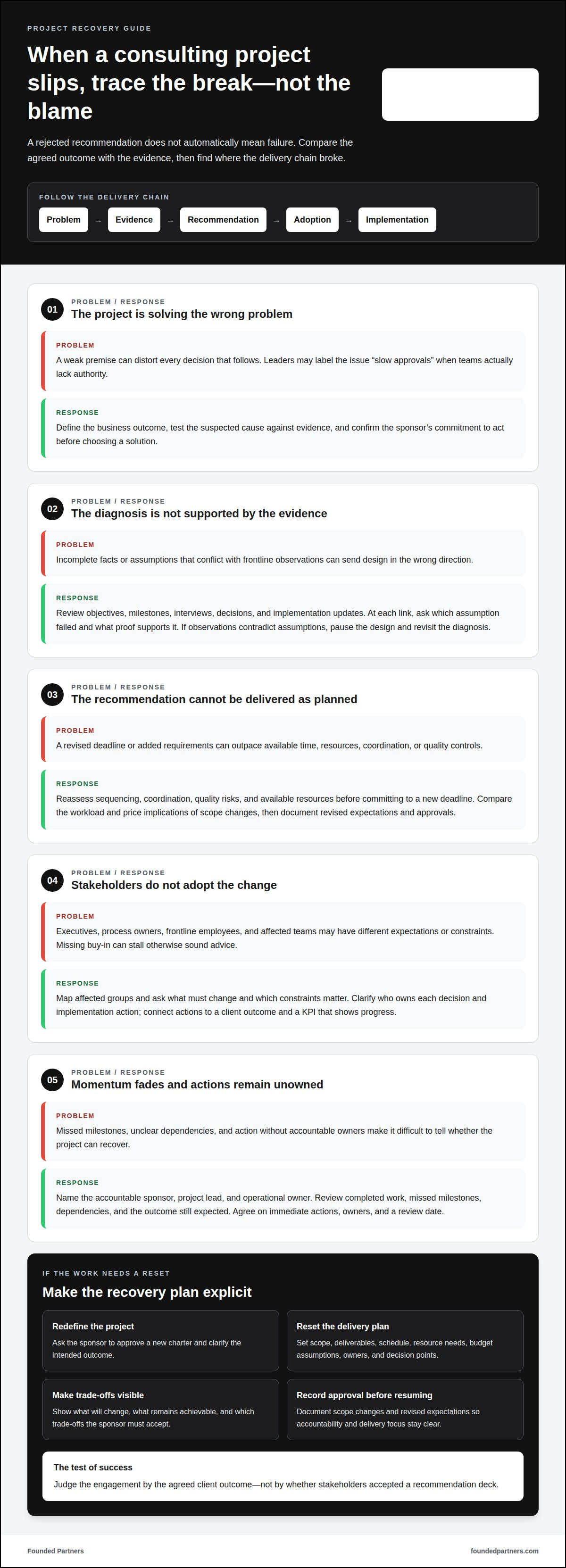
A weak project premise can distort every decision that follows. If leaders define the issue as “slow approvals,” interviews may show that teams lack authority, not process steps. A faster approval workflow would solve the wrong problem. Before choosing a solution, define the business outcome, test the suspected cause against evidence, and confirm the sponsor’s commitment to act.
Trace the chain in order: problem, evidence, recommendation, adoption, and implementation. At each link, ask which assumption failed and what proof supports it. Inconsistent handoffs, for example, may reflect unclear ownership rather than a flawed system. If frontline observations contradict executive assumptions, pause the design and revisit the diagnosis. Incomplete facts can make it harder for a recommendation to achieve its intended result.
Make the original agreement actionable. State the deliverables, decision owners, milestones, dependencies, and acceptance criteria. A website planned for one month cannot simply be promised in a week without changing the plan. Adding four programmers and overtime might help, but does not guarantee delivery. Reassess sequencing, coordination, quality risks, and available resources before committing to a revised deadline.
To create a recovery plan, ask the sponsor to redefine the project and approve a new charter. Then reset scope, deliverables, schedule, resource needs, budget assumptions, owners, and decision points. Show what will change, what remains achievable, and which trade-offs the sponsor must accept. Record approval before the team resumes the revised work.
Renegotiate scope or request a change order when new requirements, failed assumptions, or unavailable resources alter the agreed work. Compare the proposed change’s workload and price implications before accepting it, then document revised expectations and approvals. Do not absorb extra work silently; it obscures accountability and weakens delivery focus.
A disciplined business transformation approach can help reconnect the problem, plan, and execution when those links no longer support the intended outcome.
3. Implementation ownership, KPIs, cadence, and escalation
A clear answer to what to do when a consulting project fails starts with the next decision, not another status deck. Name the accountable sponsor, project lead, and operational owner. Review completed work, missed milestones, current dependencies, and the outcome still expected. Then agree on immediate actions, owners, and a review date. These steps help show whether the project can recover or needs a formal reset.
Good governance makes delivery visible. Assign each implementation action to one owner, connect it to a client outcome, and define a KPI that shows progress. Measures might track value realised, adoption, budget variance, schedule variance, stakeholder confidence, or decision quality. Choose measures that reveal the actual problem. A process can meet its deadline while adoption stays low, leaving the intended value unrealised.
When a milestone slips, consulting firms should explain the variance, its cause, and the recovery options. Distinguish a cost overrun caused by approved scope changes from one caused by rework or weak planning. For underperformance, compare results with the agreed success criteria and identify corrective actions. Bring the evidence to a decision-focused meeting, record approvals, and use the agreed escalation path when owners cannot resolve a blocker.
Client withdrawal often shows through observable behavior: meetings are postponed, reports go unread, feedback stops, or implementation decisions keep moving. Payments may slow, priorities may shift, and trust may weaken. If the client is unresponsive, send a concise written update listing the decision needed, its operational consequence, and the response date agreed through governance. Contact the sponsor through established channels, document dependencies, and escalate unresolved blockers. Do not treat silence as approval.
For leaders considering what to do when a consulting project fails, ownership must continue after consultants leave. Transfer the implementation plan, training materials, KPI definitions, and decision rights to named internal owners. Set a recurring review cadence and an escalation route for exceptions. During the first weeks of a new process, review edge cases and watch for old habits returning. Use performance feedback to make mid-course corrections, reinforce adoption, and prevent benefits from eroding after handover.
4. Distinguishing strategic, financial, operational, and organizational issues
A useful diagnosis identifies the kind of constraint before proposing another solution. Strategic issues concern direction: the chosen goal may not match customer demand or the company’s priorities. Test the underlying assumptions against customer behavior, market evidence, and current leadership decisions. If those assumptions fail, better execution of the original plan will not make the strategy successful.
Financial issues concern whether the business can support the proposed path. Compare expected benefits with actual spending, available resources, and the timing of returns. A plan may be strategically sound yet financially unrealistic if it depends on resources the organization cannot commit. Distinguish a weak business case from a delivery overrun; each requires a different decision.
Operational issues appear in the work itself: unclear handoffs, capacity limits, inconsistent processes, or service disruption. A proposed 15% headcount cut might improve a model while damaging service levels. Trace the effect through staffing, workload, customer outcomes, and process measures. That reveals whether execution needs redesign or the intended savings undermine the operating model.
Organizational issues involve authority, capability, incentives, and readiness. A team may understand a new process but lack the decision rights to use it. Leaders may endorse change while rewarding old behavior. Look for this gap by comparing stated priorities with meeting decisions, resource commitments, and frontline actions. Growth can also increase complexity, requiring clearer processes and broader decision-making.
Use a neutral diagnostic framework to sort evidence across all four areas. A structured, independent business health check can identify strengths, vulnerabilities, issues needing deeper review, the type of problem, and leadership readiness to act. Classify each finding, link it to evidence, and identify the decision it requires. This helps prevent personal opinions from obscuring the actual constraint.
If process capacity or execution is the central issue, explore operations optimization as a practical next step.
Founded Partners: Business Transformation Consulting
Founded Partners helps founder-led organizations address transformation challenges through Business Transformation Consulting. Turn to this support when a project’s diagnosis points beyond a missed milestone to deeper questions about direction, operating processes, or organizational readiness. The work can help clarify priorities, strengthen business foundations, and connect strategic decisions with practical execution.
A useful next step is to bring the project’s intended outcome, current obstacles, and decisions requiring leadership attention into a focused discussion. That creates a clearer basis for deciding what needs to change and how the organization can move forward. If the challenge instead concerns leadership alignment, growth capital, or preparing for a future transition, Leadership Advisory, capital raising support, or exit planning may be relevant.
Contact Founded Partners to discuss the challenges your organization is working through.
Turn the Diagnosis Into a Stronger Next Move
Knowing what to do when a consulting project fails ultimately means making a clear decision based on the available evidence. Some engagements need a focused reset; others reveal that the organization’s priorities or capabilities need attention first. The next move should fit the underlying issue, not simply preserve the original plan.
Use the project’s findings to inform broader decisions. A founder-led business may need to strengthen its operations, prepare for growth, or plan for a future transition. Founded Partners supports organizations through Business Transformation Consulting, capital raising support, and exit planning, aligning the work with the challenge at hand.
When you’re ready to consider the path forward, contact Founded Partners to discuss your project. A considered next step can turn a difficult engagement into clearer priorities and a stronger foundation for what comes next.
Frequently Asked Questions
How Not to Fail on a Consulting Project?
Test the proposed approach on one representative workflow before rolling it out broadly. For example, a team redesigning order approvals can trial the new sequence on a typical order and observe where work slows or creates extra steps. A small-scale test reveals practical friction while changes are still manageable. Use the results to refine the rollout plan before more teams depend on it.
What failure modes appear during execution of process consulting?
One subtle failure mode is local optimization: a team improves its own output while pushing delays downstream. Faster invoice review, for example, may create a larger payment queue if finance capacity stays unchanged. Trace a sample transaction from start to finish, noting where waiting time shifts. This helps distinguish genuine end-to-end improvement from a change that simply relocates the bottleneck.
What happens when the business owner resists external diagnosis?
Employees who depend on the owner’s decisions may find it harder to speak candidly about resistance. One safeguard is to offer confidential listening sessions with people in different roles, then report themes without attributing individual comments. The owner can respond to those themes and identify practical concerns without turning the discussion into a public challenge. This creates room for insight while protecting working relationships.
Why do process consulting results fade after the engagement ends?
Performance measures can lose relevance as customer demand or transaction mix changes. A workflow designed around routine orders may struggle when unusual requests become more common, even if the original process was sound. Define conditions that trigger a review, such as a sustained shift in the types of cases teams handle. Reassessing those assumptions helps keep the process suited to current operating realities.
When should you escalate, pause, or terminate a consulting engagement?
Prepare a decision memo comparing whether to continue, pause, or end the engagement against the outcome still at stake. For each option, state what work remains useful, which decision is reversible, and what follows from waiting. This gives leaders a grounded basis for action rather than relying on sunk effort or frustration. Escalate the choice when its consequences exceed the project lead’s authority.
What contract terms govern liability, refunds, and termination for a failed consulting project in the United States?
The signed agreement and applicable law govern liability, refunds, and termination. Review the terms covering scope, deliverables, payment, termination, liability, and dispute resolution.