
Key Metrics for a Founder to Track for CAC, Cash and Cadence

Daily tracking is for visibility, not verdicts. The key metrics for a founder to track daily should stay focused: watch cash and a few operational signals, then use a weekly review to separate meaningful movement from noise. Once customer acquisition is repeatable, review customer acquisition cost quarterly.
It’s tempting to check every number every day, especially when growth feels uncertain. But daily fluctuations can distract from meaningful trends, while delayed reviews can let problems build unnoticed.
This guide explains why customer acquisition cost matters and how to set a practical rhythm for reviewing metrics daily, weekly, monthly, and quarterly. You’ll also learn how to calculate cash burn and runway, and how a consistent review can turn a dashboard into clear decisions about where to focus.
Key Takeaways
- Assess customer acquisition cost alongside customer value and payback, so growth is judged by the returns it can support.
- Match each metric to a useful review cadence, and use weekly trends to avoid overreacting to daily fluctuations.
- Track cash burn and runway together to understand how long current spending can be sustained.
- Build a brief, recurring review ritual that turns key signals into clear decisions and follow-up actions.
1. Customer acquisition cost
Customer acquisition cost (CAC) is the average sales and marketing spend required to gain one customer. Calculate it by dividing those costs by the number of new customers acquired during the same period. Include relevant campaign and sales expenses, then compare results by channel and customer cohort. A blended figure can conceal costly channels or obscure efficient ones.
Daily metrics differ by business model: SaaS founders can watch active users and product-qualified leads, ecommerce founders can monitor website traffic, conversion, cart abandonment, and average order value, while marketplace founders can track demand-to-supply matching. A marketplace matching rate below 80% indicates liquidity problems.
Benchmarks give CAC context, but runway and retention matter too: B2B SaaS CAC payback is recommended under 12 months, with 6-9 months described as ideal, while seed-stage SaaS targets less than 18 months. SaaS monthly churn should stay below 2%; startups should maintain at least 12 months of runway, with 18-24 months ideal after a funding round.
Pair CAC with customer lifetime value (CLV), revenue, retention, and gross margin. A 3:1 CLV-to-CAC ratio is generally considered ideal for a startup. Compare customer lifetime value with acquisition costs, and review the business model if customer revenue does not justify the expense. For subscription businesses, track monthly recurring revenue and net revenue retention alongside new customer counts. Existing-customer revenue growing without new customers means net revenue retention is above 100%.
Marketing effectiveness needs more than ad-attributed revenue. For example, a campaign producing $300 from $100 in ad spend can still lose $20 after $220 in goods, packaging, shipping, and payment-processing costs. Track net return on ad spend and new-customer and blended CAC by channel and monthly cohort. Once acquisition is repeatable, review CAC quarterly; daily movements help spot operational changes, not prove lasting success.
2. Daily, weekly, monthly, and quarterly tracking cadences
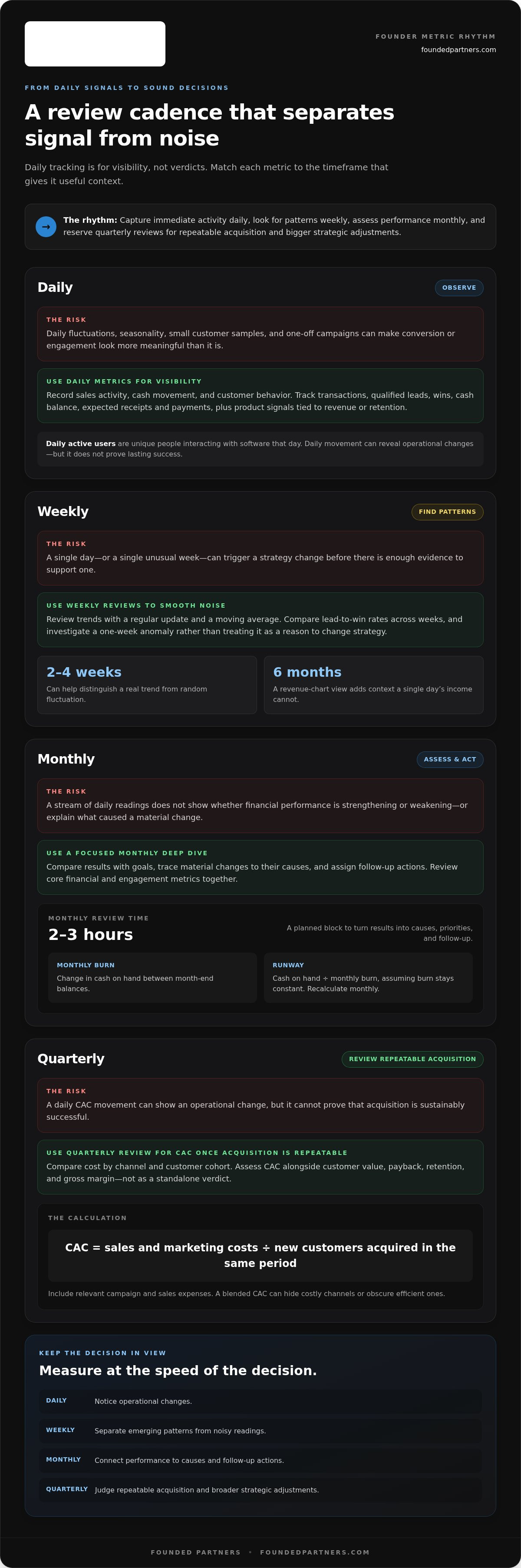
A useful cadence separates immediate signals from decisions that need context. Record sales activity, cash movement, and customer behavior daily; review trends weekly; and assess financial performance monthly. Daily tracking can reveal operational changes, but it’s often too noisy for strategic conclusions.
To track daily revenue, sales pipeline, and conversion rates, record transactions, qualified leads, and wins consistently. Calculate the lead-to-win rate by dividing leads that become customers by total leads, then compare results across weeks. A six-month revenue chart provides context that a single day’s income cannot.
For product engagement, measure daily active users, meaningful feature use, or product-qualified leads, choosing indicators tied to revenue and retention. Daily active users count unique people interacting with software that day. Seasonality, small customer samples, and one-off campaigns can make daily conversion or social media performance misleading; treat a single-week anomaly as something to investigate, not a reason to change strategy. It can take 2-4 weeks to distinguish a real trend from random fluctuation.
Use a regular weekly update and a moving average to smooth noise. A monthly deep dive can take 2-3 hours: compare results with goals, trace material changes to their causes, and assign follow-up actions. Review core financial and engagement metrics monthly; recalculate monthly burn rate as the change in cash on hand between month-end balances.
Founders can track recurring revenue as their subscription business develops. MRR is subscription revenue acquired in a month; account for discounts and customer losses. Calculate annual recurring revenue by multiplying MRR by 12. Send investor updates monthly, particularly after raising venture capital, with progress, income, expenses, and priorities.
Reserve quarterly reviews for repeatable acquisition and broader strategic adjustments. A steady measurement rhythm helps founders distinguish a temporary fluctuation from a pattern worth addressing. For a more structured operating review, consider a disciplined business review.
3. Financial health and cash burn
Each day, monitor cash balance, incoming payments, and outgoing expenses. These figures show immediate liquidity, while monthly calculations reveal whether the financial position is strengthening or weakening. Pair cash signals with revenue growth, customer acquisition, conversion rate, and engagement to understand what is driving change.
Operating cash flow can help show how much cash business operations generate. Net burn measures how much cash reserves decline over a month. Monthly burn rate compares cash on hand at the end of the current month with the previous month’s ending balance. Cash on hand is the amount available at that month-end.
Calculate runway by dividing cash on hand by monthly burn, assuming burn remains constant. Available cash for this calculation can be viewed as cash on hand plus collectibles minus payables. Recalculate runway monthly, beginning on day one, and use a 12-week trend line to distinguish a sustained shift from a short-lived change.
For daily financial monitoring, record the current balance and expected receipts and payments; assess burn and runway monthly. Startups should aim for at least 18 months of runway at their current burn rate. A minimum of 12 months is advised, with 18-24 months ideal after a funding round. These targets help frame strategic choices about hiring, investment, and the pace of spending.
A current ratio below 1 signals a need to improve cash flow, collect receivables faster, reduce short-term debt, and maintain adequate reserves. A liquidity ratio can help assess whether the business can meet its short-term obligations. Also review gross margin, net profit, revenue, and net burn. Break-even occurs when revenue equals expenses, while the path to profitability should be visible in projected financial statements.
Compare each result with company goals, not just an average from a different business model. If cash declines while conversion and revenue growth remain flat, examine expense commitments and collection timing. This turns a daily cash check into an early signal and a monthly review into a measured assessment of financial health.
4. Building a consistent founder metric ritual
A metric ritual turns a dashboard into decisions. Begin with a 15-minute Monday morning review, then assign each signal an owner and next step. Keep the routine efficient: scan the numbers, analyze meaningful changes, and record what the team will do before the next review.
Choose a small set of actionable daily KPIs by linking each number to a current business goal. Start with 3-5 company-level measures, such as cash, qualified pipeline, activation, or gross margin. For each performance area, select 2-4 KPIs that show progress toward quarterly objectives, not activity without a clear business connection.
A spreadsheet can work for a small team; a shared dashboard can combine sales, product, and financial metrics as operations grow. Keep each metric’s definition, owner, data source, and update timing visible. A conversion rate, for example, is useful only when everyone uses the same numerator, denominator, and reporting period.
Use leading indicators to anticipate lagging results. Product-qualified leads or weekly active users can signal future revenue movement, while revenue and profitability show realized outcomes. Leading indicators can predict lagging indicators 30-90 days ahead. Compare results against company goals, then look for trends lasting 3 or more weeks before making a strategic adjustment.
Close the review by noting one growing signal, one concern, and one experiment to run. If a metric stays flat for 4 or more weeks, consider a growth initiative or strategic shift. If it declines for 2 or more weeks, investigate the cause and plan an intervention. This keeps a percentage change tied to context, ownership, and a decision.
As the company scales, use a scalability strategy to align operating priorities with durable growth. A consistent review helps founders connect daily observations with the financial and organizational foundations of long-term success.
Founded Partners: Capital raising support
Founded Partners provides capital raising support for founders preparing to fund strategic growth. A clear view of customer acquisition cost, retention, gross margin, and cash runway can help frame the business’s needs and priorities for a potential raise.
Consider this support when operating metrics point to a growth opportunity, but the financing plan needs closer alignment with the company’s objectives. Organized financial and operating measures can help founders explain what is working, where capital could be deployed, and how progress will be assessed. The goal is a grounded financing discussion based on the business’s actual position and plans.
If your growth plans call for a more deliberate funding strategy, contact Founded Partners to discuss capital raising support.
Make the next decision with intention
The key metrics for a founder to track daily are valuable when they shape a deliberate choice. Use the patterns behind the numbers to decide what deserves attention, what can wait, and what the company may need to change. A dashboard is not the destination. Better judgment is.
As your priorities evolve, the work may extend beyond measurement. Founded Partners offers Business Transformation Consulting to help founders strengthen operations, capital raising support to fund strategic growth, and exit planning for a future transition. These services can connect today’s operating picture with the company’s next stage.
Bring your current priorities and the decisions in front of you to a conversation with Founded Partners. Discuss your metrics with Founded Partners and consider what a stronger foundation could make possible. You don’t need every answer before taking the next step; begin with a clear view of what matters, then build forward with purpose.
Frequently Asked Questions
Why does CAC matter?
CAC shows what the business invests to turn prospects into customers, helping founders judge whether an acquisition channel can support sustainable growth. For example, if paid campaigns bring in customers who rarely return, initial sales may hide weak long-term economics. Compare CAC across channels and customer groups, then consider customer value and retention before increasing spend. This grounds acquisition decisions in more than lead volume alone.
How Key Metrics Help You Grow Your Business?
Key metrics connect business goals to observable progress, helping founders focus on the constraint holding growth back. If sign-ups rise but few users complete onboarding, improving activation may be more useful than buying more traffic. Review the measure alongside its intended outcome, identify where the process slows, and assign a specific action. Metrics support growth when they clarify a decision, not just fill a report.
What is the Definition of Key Metrics?
Key metrics are quantifiable measures used to assess important aspects of business performance. A KPI is a metric tied to progress toward a vital, time-sensitive goal. For example, customer support response volume may describe workload, while successful onboarding may be a KPI if activation is a current priority. This distinction helps founders separate useful operational context from measures that directly guide a business objective.
What Daily Metrics Should Startup Founders Track?
The key metrics for a founder to track daily depend on the business model and its immediate priorities. A founder might check cash balance, completed sales, qualified pipeline changes, and a product-use signal linked to customer value. Use a consistent dashboard or spreadsheet, record the same measures each day, and note unusual events such as a campaign launch. Daily review is for awareness; decisions should reflect a broader trend.
What Customer Metrics Should Founders Review Daily, Such as Churn, Retention, and Support Volume?
Review new cancellations, renewal risks, customer feedback, and support requests by theme or urgency. Daily churn counts can be unstable, so use them to spot individual risks or sudden service issues, then assess retention over a meaningful business period. For example, a cluster of complaints about one feature may call for product investigation, while rising billing questions may point to unclear customer communication.