
Consequences of Hiring the Wrong Leader for a Business

A polished interview can conceal a poor fit, but that doesn’t make the hiring decision the candidate’s responsibility alone. The consequences of hiring the wrong leader can include stalled execution, damaged customer relationships, and the loss of employees’ trust. DDI found that 57% of employees have left a job because of issues with the leader they report to.
It’s understandable to feel misled when a new leader oversells their abilities or struggles to deliver. Candidates are responsible for representing themselves honestly, while employers must assess role fit, cultural compatibility, and capability before making a decision.
This article explains how leadership misalignment affects business performance, operations, customers, and employee retention. You’ll learn why a strong record elsewhere doesn’t guarantee success in a different organization, how to distinguish a candidate’s shortcomings from a flawed role or structure, and what a fair assessment looks like. The goal isn’t to assign blame after the fact. It’s to make a sounder decision before hiring and respond thoughtfully if the fit proves wrong.
Key Takeaways
- Assess the hiring process as well as the candidate: define the role clearly, use realistic scenarios, and include perspectives from the team.
- Look beyond short-term performance to see how leadership decisions may affect execution, customer trust, and investor confidence.
- Track turnover patterns and employee feedback to identify when management behavior is contributing to people leaving.
- Separate a leader’s capability from structural problems, unclear expectations, or insufficient resources before deciding how to respond.
- Compare role demands, working style, cultural compatibility, and capacity to lead in the organization’s actual conditions.
Blaming candidates instead of assessing them properly
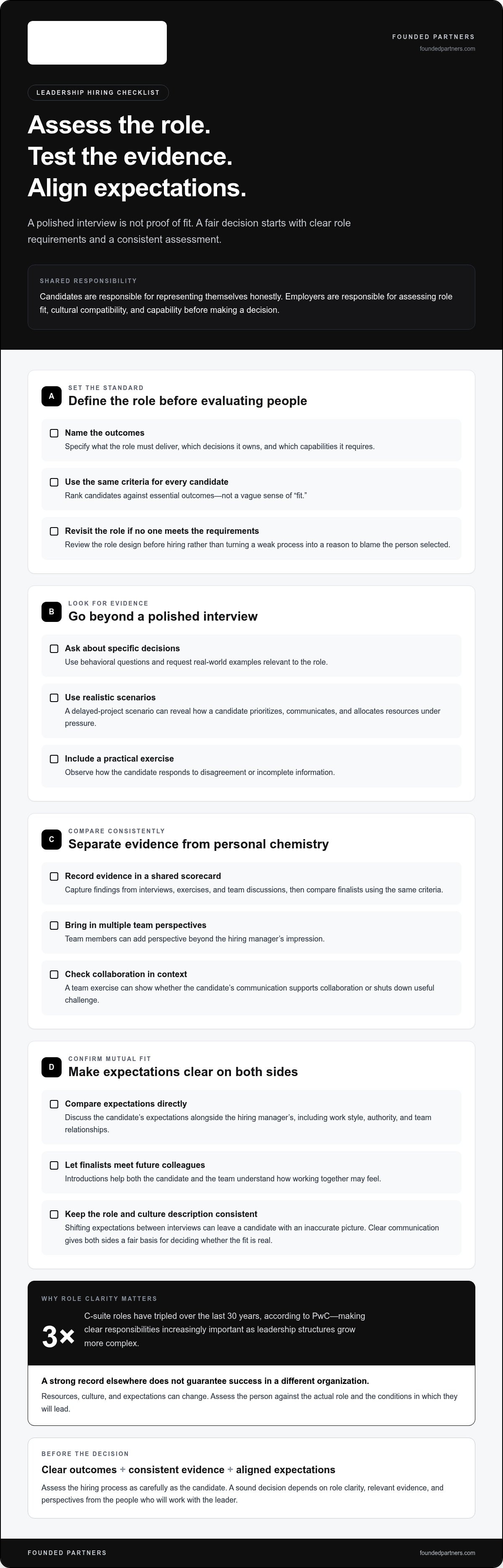
A candidate who oversells their ability is accountable for their claims. Employers still own the quality of the assessment. A leader who succeeded elsewhere may struggle when resources, culture, or expectations change. PwC reports that C-suite roles have tripled over the last 30 years, making role clarity increasingly important as leadership structures grow more complex.
Start by defining the outcomes the role must deliver, the decisions it owns, and the capabilities it requires. Then assess every candidate against the same criteria. For example, a technical leader may describe past delivery successes, but a scenario involving a delayed project can show how they prioritize, communicate, and allocate resources under pressure.
Look beyond a polished interview. Ask behavioral questions about specific decisions and request real-world examples relevant to the role. A practical exercise can reveal how a candidate responds to disagreement or incomplete information. Involving multiple team members adds perspective, while a shared scorecard helps distinguish evidence of ability from personal chemistry.
Test candidates’ claims consistently. Compare their expectations with the hiring manager’s, then discuss work style, authority, and team relationships directly. Introduce finalists to colleagues they would work with. A team exercise can show whether their communication supports collaboration or shuts down useful challenge.
Employer brand is part of this exchange. Candidates form impressions through the interview process, the clarity of the role, and how the company describes its culture. If expectations shift between interviews, a candidate may accept the job with an inaccurate picture of it. Clear, consistent communication gives both sides a fair basis for deciding whether the fit is real.
What are the legal and compliance risks of hiring an unsuitable leader? An untrustworthy leader who engages in criminal activity can expose a company to a lengthy, expensive legal battle. Clear oversight, documented responsibilities, and consistent review of decisions help organizations identify concerns before they spread.
How long does it typically take to recover from a bad leadership hire? A new hire can take 90 days to become fully integrated, while strategic missteps may take years to correct. Recovery depends on the damage, the time taken to address it, and how quickly responsibilities and decisions are stabilized.
How should a company address or replace an ineffective leader? Discuss specific performance concerns, recognize strengths, and agree on measurable goals, timelines, and support. A performance improvement plan can document those elements and the consequences. Regular check-ins show whether progress is being made. Reassess the role if a different scope would better match the person’s abilities.
Rank candidates against the role’s essential outcomes, not a vague sense of “fit.” Record evidence from interviews, exercises, and team discussions, then compare finalists using the same criteria. If no candidate meets the requirements, revisit the role design before hiring. A weak process shouldn’t become a reason to blame the person selected.
Effects on revenue, operations, customers, and investors
A leadership gap rarely stays inside one department. In a fast-growing organization, a few months of strategic delay can translate into millions of dollars in missed opportunities. A leader who repeatedly postpones decisions may leave a product launch, expansion, or customer response waiting for direction. Teams lose time, while competitors can move ahead.
Operational disruption often starts with unclear priorities. Imagine a sales leader changing targets mid-quarter while operations continues to follow the previous plan. Employees spend time reconciling conflicting instructions instead of serving customers. Review missed deadlines, rework, and stalled decisions together. A single metric may hide how leadership choices affect delivery.
Customer relationships can also suffer through everyday interactions. A leader who dismisses service concerns may let unresolved complaints accumulate. Frontline employees then have less authority to fix problems, and customers may lose confidence in the organization’s promises. Rebuilding trust takes sustained, consistent communication, not a single apology.
That damage can reach sales. Poor interactions by employees who communicate directly with customers can affect company sales, especially when a customer leaves before renewing or expanding an account. Current customers are often 5-10 times more valuable than new customers. Protecting established relationships therefore means paying attention to how leaders set service expectations and respond to customer feedback.
Reputation extends beyond existing accounts. Job seekers and customers can form negative impressions through poor experiences, negative feedback, and reviews. If a failed hire is later dismissed, that transition can create another opportunity for public criticism. Assess recurring complaints, response times, and customer departures together rather than treating each review as an isolated event.
How does an ineffective leader impact productivity and business performance? The CareerBuilder study found that productivity levels dropped by 39% as a consequence of a bad hire. In practice, unclear decisions can create rework, slow customer responses, and divert capable talent from planned work.
Investors may also view repeated leadership changes as a sign of organizational instability. Frequent executive changes can concern external talent, while shifting priorities can make business plans harder to evaluate. A leadership transition doesn’t prove a company is failing, but unexplained changes and delayed commitments can raise questions about execution and oversight.
To understand the impact, connect leadership decisions to operating evidence: compare planned and actual delivery, review customer complaints, and identify sales delays linked to service failures. These patterns can show whether the issue lies with an individual leader’s decisions or a wider process breakdown. The consequences of hiring the wrong leader can ripple across revenue, customer trust, and reputation.
Employee turnover linked to poor leadership
Employees experience leadership through daily decisions, communication, and follow-through. When those habits erode trust, morale and retention can decline together.
Team Morale and Employee Engagement
Team morale reflects employees’ confidence, energy, and sense of support at work. A leader who dismisses concerns, changes priorities without explanation, or takes credit for team results can weaken that confidence. One report found hiring mistakes can reduce team morale by 27%. The practical signal is a change in participation, collaboration, or willingness to raise problems.
Engagement matters because employees need to contribute their judgment, not just complete assigned tasks. For example, a capable team may stop flagging delivery risks if its leader reacts defensively to bad news. Compare feedback from team conversations, project reviews, and check-ins to spot changes. These signals help distinguish temporary workload strain from a pattern linked to leadership behavior.
Employee Turnover Risk
Turnover risk rises when employees decide that leaving is better than continuing under a difficult manager. A DDI study found that 57% of employees have left a job because of issues with the leader they report to. They may value the organization’s purpose and colleagues, yet still leave because daily interactions with their manager have become untenable.
That distinction matters: departures may reflect a leadership problem, not rejection of the whole organization. Review exit feedback alongside team turnover patterns, manager changes, and recurring concerns. If several employees leave the same team and cite similar leadership issues, treat the pattern as evidence that needs attention, not as a series of unrelated individual choices.
Leadership behavior also shapes how employees feel after difficult moments. How leaders manage their emotions and make other people feel are described as the strongest drivers of talent retention. A leader who responds calmly to missed targets can help employees focus on solutions. A leader who responds with blame may make people less willing to disclose risks early, adding pressure across the team.
A poor hire can create an added burden for colleagues. When a leader fails to set priorities or coach effectively, capable employees may take on extra decisions, rework, and support duties. That added load can contribute to frustration and disengagement. Training may help when a leader lacks a specific skill, but it won’t resolve a persistent mismatch in conduct, expectations, or role demands.
Address the pattern before it becomes normal. Hold regular check-ins, ask employees about specific interactions, and compare their feedback with observable team outcomes. When a new leader is struggling, take early responsibility for understanding why. Clarify expectations, provide practical support, and review progress over time. If employees continue to leave or raise the same concerns, reassess the leader’s role and the conditions around it.
What are the potential consequences of hiring the wrong person?
A failed executive hire brings visible recruitment expenses and less visible operating losses. The total depends on the role, time in the position, and disruption caused.
Financial Costs of a Failed Executive Hire
A failed executive hire can cost more than the salary paid during employment. A U.S. Department of Labor estimate cited in a LinkedIn post puts a bad hire’s cost at 30% of the employee’s first-year salary. For higher-level employees, estimates can reach 3.5 times annual salary, while a C-suite hire can cost as much as 213% of salary.
These estimates use different methods, so don’t add them together. Executive recruitment costs alone can reach six figures or more, and the full impact can reach millions for senior roles. Strategic mistakes may also take years to correct, extending the financial impact beyond the departure date.
Recruitment and Training Costs
Recruitment and training costs include resources spent before an employee contributes fully. Track recruiter time, screening, interviews, payroll, onboarding, and training as separate categories. If the hiring process must start again, the first round’s expenses remain sunk costs, while the next search adds new costs.
For example, a company can record staff hours spent interviewing an executive, onboarding expenses, and the time colleagues spend on training. Add documented transition costs, then compare the total with the role’s budget. This approach shows where a costly hiring process used resources without assuming every expense has the same impact.
Attrition and Replacement Costs
Attrition adds replacement expenses when a poor hire contributes to other employees leaving. Replacing an employee can cost between 30% and 200% of that employee’s annual salary. The range reflects differences in role, recruitment needs, lost productivity, and the time required for a replacement to become effective.
For a useful estimate, calculate the cost of replacing each employee separately. Include recruitment, screening, onboarding, training, and work left uncovered during the transition. Then compare turnover in the affected team with its previous pattern. This helps distinguish the cost of replacing the leader from the wider cost of losing experienced colleagues.
What are the warning signs that a leadership hire is not working out? Look for missed commitments, repeated priority changes, rising rework, and recurring concerns from direct reports. Patterns across team outcomes and feedback are more informative than a difficult project or isolated disagreement.
To assess the full financial impact, create a simple cost ledger with recruitment, training, replacement, and operating disruption as separate entries. Use actual internal records wherever possible, and note the assumptions behind any estimate. This helps decision-makers compare the cost of retaining, repositioning, or replacing a leader without treating every failed hire as financially identical.
Cultural fit, role fit, and capacity
A leader can have a strong record and still be mismatched to a new organization. Assess role demands, working norms, and available capacity together. Success depends on how those elements come together in practice.
Role fit means the leader’s strengths match the outcomes and decisions the position requires. Define those outcomes before comparing candidates. For example, a company that needs disciplined execution may require a leader who can turn strategy into clear ownership, timelines, and operating decisions. A candidate with impressive growth experience may not fit if the role mainly involves rebuilding internal processes.
Then examine capacity against the actual workload. Some positions require 55 hours of work per week, according to the research facts for this article. The figure matters only when it reflects the real demands of the role, rather than an assumption that long hours indicate commitment. Consider decision volume, team span, travel demands, and competing responsibilities when evaluating whether the leader can sustain the work.
Cultural fit isn’t about hiring someone who resembles the existing team. It’s about whether the person’s working style supports the organization’s values and expectations. A leader who favors rapid decisions may struggle in a company that relies on broad consultation. Neither approach is inherently wrong, but unspoken differences can create friction, slow decisions, and erode trust.
Make those differences discussable before hiring. Ask candidates how they handle disagreement, communicate setbacks, and share authority. Then compare their answers with the team’s actual working practices, not an idealized description of the culture. A conversation with future colleagues or a realistic group exercise can reveal whether the candidate listens, welcomes challenge, and adapts their communication.
Capacity also includes using strengths effectively. Consider whether a candidate can spend at least 80% of their time in their unique abilities, as the research facts recommend. If a role consumes most of a leader’s attention with tasks outside those strengths, performance may suffer even when the person is capable. Redesign responsibilities where possible, or reassess whether the role needs different capabilities.
Onboarding should turn the hiring decision into practical expectations. Set clear priorities, decision rights, and measures of progress, then hold regular check-ins where the leader and team can raise concerns. For example, if a new executive is expected to change a process, clarify who must be consulted and how success will be judged. This reduces ambiguity without treating every disagreement as a cultural mismatch.
When role scope, capacity, or team expectations remain misaligned, Leadership Advisory for executive role fit can help clarify leadership requirements and strengthen the organization’s approach to leadership decisions.
Founded Partners: Capital raising support
Founded Partners helps founder-led businesses align leadership and operating priorities with growth plans. When a leadership gap affects execution or investment readiness, its Leadership Advisory and Business Transformation Consulting can help clarify the organization’s needs and strengthen its foundations. For businesses preparing to fund strategic growth, Founded Partners also provides capital raising support. The right next step depends on the challenge: leadership alignment, operational transformation, or preparing to raise capital. These services support informed decisions about what the business needs to move forward, rather than treating every growth issue as a hiring problem. If you’re weighing leadership or capital decisions for your business, contact Founded Partners to discuss your needs.
Build the leadership foundation for what comes next
The consequences of hiring the wrong leader can extend beyond one appointment, shaping how a business pursues growth, transformation, and long-term ownership goals. A useful next step is to connect leadership decisions to the company’s broader direction: what capabilities are needed, what must change, and what the organization is preparing for.
Founded Partners supports founder-led businesses through Leadership Advisory and Business Transformation Consulting. When the next stage involves investment, its capital raising support can help align funding efforts with strategic growth objectives. For owners considering a future transition, Exit planning can bring long-term priorities into focus. The right area of support depends on the business challenge at hand.
Use the questions raised here to clarify what kind of leadership the business needs next. Contact Founded Partners to discuss leadership hiring and the priorities shaping your company’s next stage. A considered decision today can help create a stronger foundation for tomorrow.
Frequently Asked Questions
Is it fair to blame a bad hire for overselling themselves?
Not by default. Candidates should represent their experience honestly, but polished claims need to be tested against evidence. If someone says they led a turnaround, ask which decisions they owned, what changed, and what they learned when results fell short. Compare those details with references and a role-specific scenario. Fair accountability considers both the candidate’s candor and the employer’s evaluation process.
Now that you know what to avoid, how do you attract the right people?
Give candidates a credible picture of the role before they invest time in the process. Describe its actual priorities, decision-making environment, and inherited challenges. For example, explain whether a new leader must stabilize existing operations or build new capabilities. Consistency across the job description, interviews, and conversations with future colleagues helps candidates assess the opportunity and decide whether it fits their expectations.
What are the common consequences of hiring the wrong leader?
The consequences of hiring the wrong leader can include stalled decisions, misaligned priorities, strained customer accounts, and weakened team confidence. To spot the pattern, trace a missed business goal backward: identify the decision, handoff, or resource issue that contributed to it. This connects leadership behavior to business outcomes and helps distinguish an individual performance issue from a process problem.
How does poor leadership affect employee turnover and retention?
Poor leadership can prompt employees to leave a role even when they value the organization and their colleagues. Add stay conversations with remaining employees to exit interviews. Ask what makes their work harder, which management behaviors help them contribute, and what might prompt them to consider leaving. Compare responses across teams to identify recurring leadership patterns before more people depart.
What is the financial cost of a bad executive hire?
Calculate the cost by separating direct expenses from business disruption. Direct items include recruitment, onboarding, and training; disruption may include delayed decisions, unfinished initiatives, and colleagues’ time spent covering responsibilities. For example, list each affected project and record the work postponed or repeated. This gives decision-makers a clearer financial picture than salary alone and supports a more grounded choice about coaching, role changes, or replacement.
How can a wrong leadership hire damage company culture and morale?
A leader’s daily choices show employees which behaviors the organization accepts. If a manager rewards silence over constructive challenge, people may stop raising risks or offering new ideas. Over time, that can weaken collaboration and make stated company values feel disconnected from actual practice. Look at meeting participation, how disagreements are handled, and whether employees feel able to raise concerns without being dismissed.