

Family ownership should be a choice, not an obligation. Family business succession planning means deciding how ownership and leadership will pass, who may be ready to lead, and what the transition will involve. A written plan turns those decisions into a shared path instead of leaving them to a last-minute handover.
It’s natural to want a business to stay in the family, especially when generations have built it together. A strong succession plan also makes room for honest conversations about everyone’s interests, abilities, and ambitions. That way, the next generation can choose a meaningful role rather than inherit an expectation.
This article explains what succession planning can protect, how to make family ownership a genuine option, and how to prepare potential successors with clear development steps and written plans. It also shows how to consider leadership and ownership separately, giving the family and the business a more deliberate way forward.
Key Takeaways
- Build a written plan that sets out how leadership and ownership may transfer, and revisit it as the business evolves.
- Make family participation a genuine choice by separating readiness for leadership from the question of who owns equity.
- Prepare potential successors through practical experience, mentoring, and progressively greater responsibility.
- Clarify the business’s shared purpose and plan for unexpected transitions to support continuity and reduce uncertainty.
1. What is Family Business Succession Planning?
A succession plan sets out how leadership and ownership will pass to another generation. It identifies potential successors, prepares them for responsibility, and records a transition timeline. Start planning early, then revisit the plan as the business and family’s circumstances change. A written plan clarifies decision-making, reduces confusion, and helps family members discuss expectations before a transition becomes urgent.
Tax considerations belong in that plan. According to the Internal Revenue Service, the U.S. annual gift tax exclusion is $19,000 per individual or $38,000 per married couple filing jointly. The Internal Revenue Service also says generation-skipping transfer taxes apply when assets go to recipients two or more generations below the transferor. Transfers to children, grandchildren, or managers may also have income tax implications. Estate, gift, income, and generation-skipping transfer taxes can depend on how ownership moves and who receives it. Families should document the proposed transfer and coordinate its financial implications with their wider plan.
Gifting, selling, and inheritance work differently: gifts transfer shares without a sale, a sale exchanges ownership for payment, and inheritance passes ownership after an owner’s death. Each route has distinct financial and family implications, so the plan should state the intended method and explain its rationale. Gradual gifting can move ownership over time, while a sale can define payment terms and a timeline. The cost depends on the case and is provided after a quote request; business complexity, planning scope, and the professionals involved shape it.
Practical steps include agreeing on goals, assessing successor readiness, setting leadership and ownership terms, documenting financial details, and establishing a transition timeline. Communicate with family members, non-family employees, and other stakeholders about roles, reporting lines, and continuity. For example, a written plan can explain who makes operating decisions while ownership changes. Fairness doesn’t always mean identical roles or shares. Explain the criteria behind decisions and provide a clear way to raise concerns. After the transition, define governance responsibilities, decision-making processes, and review points. Ongoing reviews help the family update the plan as business needs, leadership, or family circumstances change.
2. Making family-business ownership an option, not an obligation
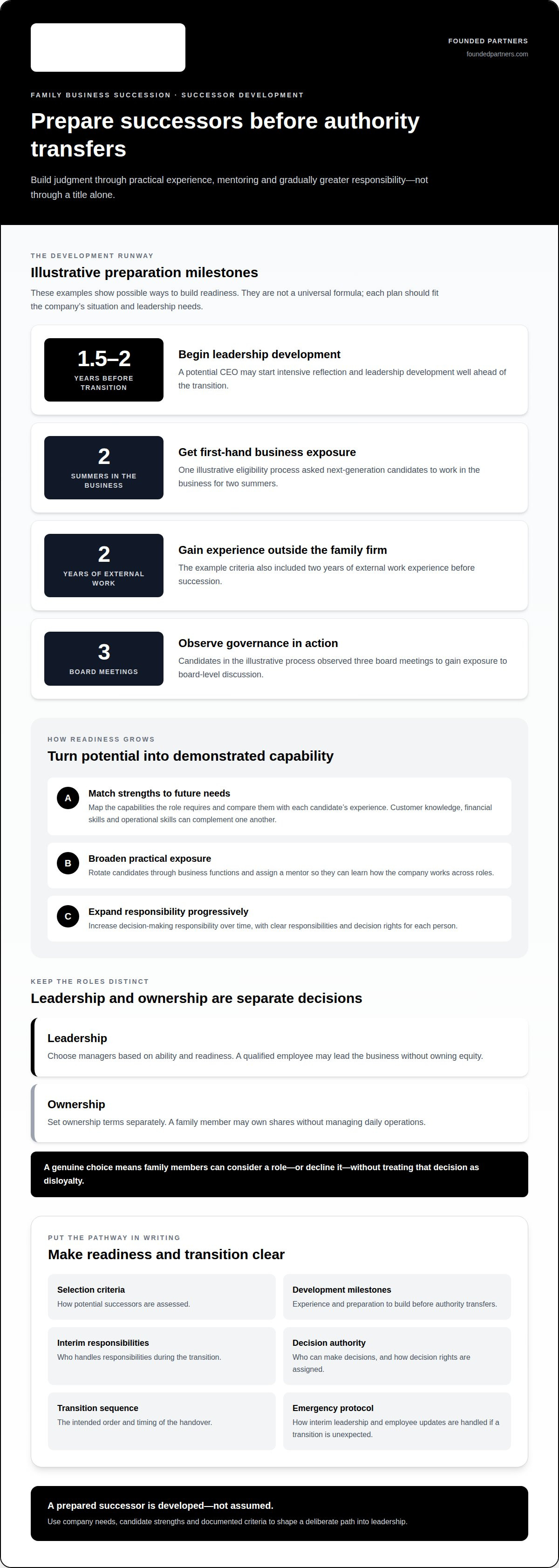
A written succession plan should make family ownership an invitation, not an inherited duty. Separate leadership succession from ownership succession: choose managers based on ability and readiness, then decide ownership terms separately. A family member may own shares without managing daily operations; a qualified employee may lead without owning equity. Distinguishing these roles can reduce conflict and protect continuity when family members have different interests or strengths.
Consider the illustrative Smith Manufacturing scenario: founder and CEO John Smith is 70, and the company is valued at $50 million. Retirement can be difficult when identity and daily purpose are closely tied to leadership. Rather than presume a child will take over, the family can discuss whether each next-generation member wants a role, what experience qualifies a candidate, and whether an external leader better serves the business. A fair process makes declining ownership or leadership possible without treating that choice as disloyalty.
Next, document how management appointments will be decided and how ownership may change. Specify who can vote on major decisions, which decisions require broader agreement, and how future owners may be selected. For example, a plan might distinguish voting control from economic ownership and record the rationale and decision-making process. Clear criteria help family members understand how ability, contribution, and readiness shape leadership decisions. They also give employees a clearer view of who will direct operations during the transition.
For a founder’s disability, death, or sudden departure, name interim decision-makers and document how they maintain operations. Set out who communicates with employees, who handles urgent business decisions, and how the permanent leader will be chosen. A defined process reduces uncertainty at a vulnerable moment. Families working through role clarity and leadership continuity can explore leadership advisory as a practical next step.
3. Successor development and written planning documents
A successor needs more than a title; preparation should build judgment before authority transfers. Identify potential leaders based on the business’s future needs, not family position alone. Map the capabilities the role requires, then compare them with each candidate’s experience. One person may bring customer knowledge, while another has stronger financial or operational skills. Complementary strengths can support a leadership team, provided responsibilities and decision rights are clear.
Development should combine training with practical exposure. Rotate candidates through business functions, assign a mentor, and gradually expand their decision-making responsibilities. A potential CEO may begin intensive reflection and leadership development 1.5-2 years before transition. One illustrative eligibility process asked next-generation candidates to work in the business for two summers, gain two years of external work experience, and observe three board meetings. Those are example criteria, not a universal formula; each plan should reflect the company’s situation and leadership needs.
Put the process in writing. A useful succession document records selection criteria, development milestones, interim responsibilities, decision authority, and the intended transition sequence. Add an emergency leadership protocol and explain how employees will receive updates. Document key operating processes too, so the incoming leader understands how the business handles decisions, customer commitments, and essential workflows. Review the plan when roles, business priorities, or family dynamics change.
In the United States, there isn’t one universal document checklist for every family business. A written plan can sit alongside a buy-sell agreement that defines transfer terms, valuation methods, funding mechanisms, and limits on sales to non-family members. Ownership and leadership documents should reflect the company’s structure and intended transition; legal and estate documents should support that plan. A business attorney can prepare the formal documents, while the family keeps development milestones and governance decisions clear. The result is a practical record employees and successors can use, not simply a file naming a future leader.
4. Definition and purpose of family business succession planning
Family business succession planning is the deliberate design of how a business continues when ownership or leadership changes. Its purpose goes beyond naming the next owner: it connects the family’s shared mission with the company’s strategy, governance, and future leadership needs. Start by defining what the family wants to protect, such as independence, customer relationships, or long-term employment. Those priorities can guide decisions when family dynamics and business interests pull in different directions.
A written plan turns those priorities into a workable transition. For example, a family may agree to keep the business family-owned while appointing a qualified non-family executive to lead operations. Another family may choose a sale because no family member wants the owner’s role. These paths differ, but each benefits from clear decision rights, stakeholder communication, and a defined approach to continuity.
Succession planning also means protecting value beyond the estate. If an owner becomes incapacitated or dies, employees, customers, suppliers, and family members need clarity about who leads and how decisions will proceed. A plan can identify interim authority, outline customer communications, and preserve essential operating knowledge. That structure can reduce disruption and give stakeholders a shared reference during a difficult transition.
Keep the plan connected to the business, not frozen in a file. Review it when strategy shifts, a successor’s readiness changes, or family circumstances alter ownership intentions. For instance, a new growth strategy may require capabilities the original candidate has not yet developed. A review can update development priorities or consider another leadership arrangement while preserving the family’s mission. This makes succession a continuing governance practice, not a one-time event.
Owners considering a family transition alongside a possible sale can explore exit planning to clarify strategic options and prepare for the next stage.
Founded Partners: Business Transformation Consulting
Founded Partners helps family-led businesses connect succession decisions with the organization’s next stage through Business Transformation Consulting. Turn to this work when a written plan needs to become practical changes in leadership, operations, or business structure. Clarifying priorities and responsibilities can help the company prepare for a transition while keeping its strategy in view.
When an owner is considering a sale rather than a family handover, Founded Partners’ exit planning can help shape the next steps. If the transition depends on developing leaders, Leadership Advisory can support that part of the process. The right focus depends on the business’s goals and the decisions the family is ready to make.
For a thoughtful conversation about your business’s next stage, contact Founded Partners.
Give the next generation a clear starting point
A transition becomes more workable when the family turns intentions into a first decision: what should the business be ready to do next? Set a practical priority, such as clarifying future leadership, strengthening operations, or deciding whether family ownership remains the right path. That choice gives conversations direction and connects the handover to the company’s broader strategy.
Family business succession planning can raise strategic questions beyond the handover itself. Founded Partners offers Business Transformation Consulting, Exit planning, and Capital raising support to help address organizational change, ownership-transition options, and growth financing needs. The right focus depends on the direction the family wants the business to take.
Progress doesn’t require every answer at once. A thoughtful next step can bring owners and future leaders around the same table, identify the decisions that need attention, and turn a broad intention into a workable path. Contact Founded Partners to discuss succession and consider the next stage for your business.
Frequently Asked Questions
What is Family Business Succession Planning?
Family business succession planning prepares a company for a change in ownership or leadership while preserving its ability to operate. In practice, it connects the owner’s goals with a transition path, such as assigning a future leader responsibility for key customer relationships before authority changes. This gives the business time to assess whether its operating structure supports the intended transition, rather than treating succession as a single handover event.
How do you choose and prepare a successor in a family business?
Choose a successor by matching the role’s demands with a candidate’s demonstrated capabilities, interests, and judgment. Then create opportunities to observe those capabilities in real work: a candidate might lead a process improvement, present results to the board, or manage a customer relationship. Feedback from employees and directors can reveal development needs. The plan should record what readiness looks like and who will assess progress.
How can a family business transfer ownership to the next generation?
A family can transfer ownership through gifts, a sale, or inheritance, with the chosen route reflected in the ownership documents. A buy-sell agreement can set out transfer terms, valuation methods, funding mechanisms, and restrictions on sales to non-family members. For example, it can describe how a departing owner’s interest will be valued and financed. Clear terms help align the transfer mechanism with the family’s intended ownership structure.
What are the tax implications of transferring a family business in the United States?
Tax implications depend on the transfer method, the asset, and the recipient. Gifts may involve gift-tax considerations; transfers to recipients two or more generations below the transferor can involve generation-skipping transfer taxes, according to the Internal Revenue Service. A recipient who later sells company stock may face capital gains tax. The plan should identify intended transfers and connect them with estate liquidity and ownership goals.
What are common risks and conflicts in family business succession, and how can they be prevented?
Common risks include unclear authority, perceived favoritism, and disagreements over compensation or employment. Define role and pay policies, decision rights, and a dispute-resolution process before a transition. A family council or advisory board can provide a structured forum for concerns, while regular communication helps employees understand reporting lines. For example, written criteria for leadership appointments make decisions easier to explain consistently.
What are the best practices for valuing a family business before succession?
Begin by agreeing on why the valuation is needed, since a transfer, buyout, or ownership discussion may call for different assumptions. Use reliable financial records, identify unusual items that could distort performance, and document the valuation method and assumptions. For a buy-sell agreement, ensure the method aligns with its transfer terms. Refresh the valuation when material business conditions change, so decisions rely on a current, transparent basis.