

The smartest route to growth may be the one that doesn’t begin with outside capital. Bootstrapping means starting and growing a business with the founder’s personal finances or the company’s operating revenue. A bootstrapping to profitability strategy keeps spending disciplined, builds around paying customers, and reinvests profits to support sustainable growth. It can also help founders retain ownership, though limited capital may make rapid expansion harder.
If you’re weighing this path, match your ambitions to the business’s cash needs. This article explains how to manage cash flow, learn from customers, and negotiate supplier terms, then considers which business models may suit self-funding. Service businesses, niche software companies, and content creators can often start without extensive inventory or substantial upfront capital; capital-intensive fields may need a different approach. Use this framework to decide whether bootstrapping fits your business and how to build toward profitability without letting growth outpace your resources.
Key Takeaways
- Build a lean operating plan around cash coming in and going out, and pace spending to protect room for growth.
- Use conversations with paying customers to refine your offer, strengthen retention, and find acquisition methods that can repeat.
- Supplier payment terms can help preserve working capital, while currency exposure deserves deliberate attention.
- Assess whether your business can reach customers without heavy inventory or substantial upfront investment before choosing a self-funded path.
1. Lean operations and cash flow management
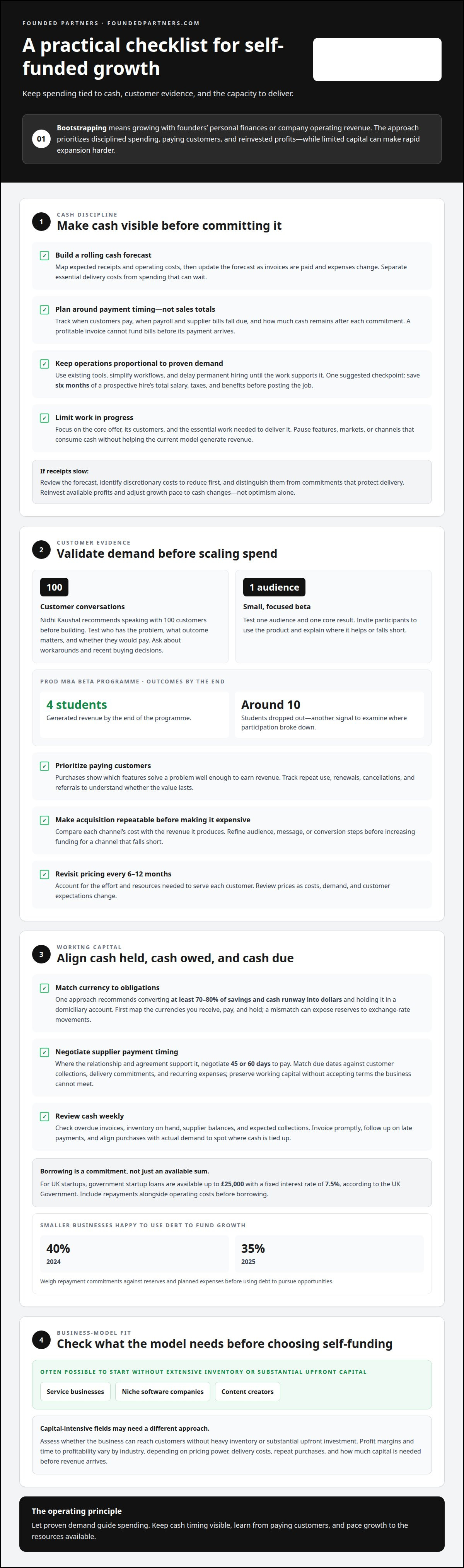
A bootstrapping to profitability strategy starts with visibility, not austerity. Map expected cash receipts and operating costs in a rolling forecast, then update it as invoices are paid and expenses change. Separate essential spending, such as delivering the product, from costs that can wait. This gives you a clearer basis for deciding what the startup can afford to build, maintain, or pause.
Plan around cash timing, not just sales totals. A profitable invoice cannot cover payroll or supplier bills before its payment arrives. Track when customers pay, when expenses fall due, and how much cash remains after each commitment. If a UK startup considers government startup loans, the available amount is up to £25,000; according to the UK Government, the fixed interest rate is 7.5%. Loan repayments add a future cash obligation, so include them alongside operating costs before borrowing.
Keep operations proportional to proven demand. Use existing tools, simplify workflows, and delay permanent hiring until the work supports it. One suggested checkpoint is to have six months of a prospective hire’s total salary, taxes, and benefits saved before posting the job. The key is to assess whether each expense generates customers or improves delivery, rather than keeping it out of habit.
Limit work in progress. Choose the core offer, the customers it serves, and the essential activities needed to deliver it. Pause secondary features, markets, or channels when they consume cash without helping the current model generate revenue. This isn’t a call to shrink indefinitely. It helps avoid rapid expansion or major expenses that strain finances before demand is established.
Review the forecast regularly and make decisions based on cash changes, not optimism alone. If receipts slow, identify which discretionary costs can be reduced first and which commitments protect delivery. Lean operations preserve options: they help a startup adjust its pace, reinvest available profits, and fund growth from a stronger base.
2. Customer acquisition, retention, and feedback
Start with a customer hypothesis: who has the problem, what outcome they value, and why they would pay. Nidhi Kaushal recommends speaking with 100 customers before building anything. Use those conversations to test assumptions, record recurring needs, and distinguish interest from willingness to buy. Ask about current workarounds and recent purchasing decisions, not only whether someone likes an idea.
A beta can test the offer before wider launch, but feedback needs a clear purpose. Set a small pilot around one audience and one core result, then invite participants to use the product and share where it helps or falls short. In the Prod MBA beta programme, four students generated revenue by its end, while around 10 students dropped out. Treat both outcomes as useful signals: identify what supported conversion and where participation broke down.
Prioritize paying customers when validating product-market fit. Their purchases show which features solve a problem well enough to earn revenue, while repeat use and renewals can reveal whether the value lasts. Track why customers return, cancel, or refer others. Use those patterns to improve the offer before spending to reach a broader audience.
Make customer acquisition repeatable before making it expensive. Measure each channel’s cost against the revenue it produces, and strengthen approaches that attract suitable customers. A repeatable go-to-market channel should generate revenue reliably relative to its cost. If a channel falls short, refine its audience, message, or conversion step before increasing funding.
Price for sustainable delivery, not just initial adoption. Account for the effort and resources required to serve each customer, then test whether the price reflects the outcome buyers value. Review and adjust startup prices every 6-12 months as costs, demand, and customer expectations change. For founders weighing customer revenue against external capital, growth funding decisions can be part of a disciplined plan.
3. Holding cash in USD and negotiating supplier terms
Currency choices should follow the business’s obligations. One approach recommends converting at least 70-80% of savings and cash runway into dollars and holding it in a domiciliary account. That may suit a company with substantial USD expenses, but founders should map currencies received, paid, and held. A mismatch can expose reserves to exchange-rate movements just as supplier invoices fall due.
Supplier terms can also change the timing of cash leaving the business. Negotiate 45 or 60 days to pay where the relationship and agreement support it. Match those due dates against customer collections, delivery commitments, and recurring expenses. The aim is to retain working capital without damaging trust with suppliers or accepting terms the business cannot meet.
Track cash weekly alongside a few operating measures: overdue invoices, inventory on hand, supplier balances, and expected collections. These show where cash is tied up and help pinpoint the cash conversion cycle, from paying for inputs to collecting customer revenue. Reduce avoidable delays by invoicing promptly, following up on late payments, and aligning purchases with actual demand. Partners who understand the company’s payment patterns can help plan terms around realistic cash flows.
Borrowing conditions shift with the wider economy. The share of smaller businesses happy to use debt to fund growth fell from 40% in 2024 to 35% in 2025. Treat borrowing as one option, and weigh repayment commitments against reserves and planned expenses before using it to pursue opportunities.
There is no single typical profit margin or time to profitability across industries. Both depend on pricing power, delivery costs, repeat purchases, and how much capital the model needs before revenue arrives.
Balance owner compensation with reinvestment by setting a sustainable draw, protecting cash for obligations, and directing available profit toward the clearest growth priorities. A sound plan gives the founder income without starving operations or leaving reserves exposed.
4. Business types suited to bootstrapping
The strongest candidates can sell before taking on heavy fixed costs. A consulting practice, specialist agency, or independent professional can start with expertise and a focused offer, rather than warehouses or complex equipment. Niche software and micro-SaaS can also fit when founders can build a narrow product and reach a defined audience. Content creators may begin with a small catalogue and expand as demand becomes clearer.
Consider what the venture must fund before its first sale. A service business can often deliver directly, while a digital subscription may serve more users without requiring physical inventory for every sale. By contrast, applied technology, biotechnology, and fintech can require substantial capital for development, testing, infrastructure, or market entry. Those demands can make self-funding difficult, especially when meaningful sales depend on lengthy development.
Assess fit by mapping three stages: the resources needed to launch, the cost of delivering each sale, and the time between spending and collecting revenue. If founder funds or early customer income can support each stage, bootstrapping may be practical. If progress depends on large upfront investment or rapid expansion, external funding may better match the venture’s needs. Venture capital can provide growth capital, but weigh that against sharing equity and decision-making.
In the United States, tax and legal obligations depend on the business structure, location, and activity. A self-funded company still needs to account for applicable taxes and relevant business requirements in its operating plan; bootstrapping does not remove them. Include these commitments when assessing whether the model’s cash needs are manageable.
The clearest takeaway is to match the funding path to the business architecture, not founder preference alone. A low-inventory service or focused software product may grow through customer demand; a capital-intensive venture may need outside funding to reach its market. For founders refining that choice, explore a business transformation strategy to connect operating needs with a sustainable growth path.
Founded Partners: Scalability Strategy
Founded Partners helps founder-led businesses plan for growth through Scalability Strategy and Business Transformation Consulting. Turn to this work when customer demand is growing but your operating model, team, or cash plan needs to keep pace. A clear growth plan connects priorities, capacity, and investment decisions without treating expansion as an end in itself.
If growth requires external capital, Founded Partners’ capital raising support can help align funding needs with strategic objectives. For founders considering a future transition, its exit planning can bring that decision into the wider business plan. The right next step depends on your company’s goals and current constraints.
Contact Founded Partners to discuss your business’s next stage.
Build the next stage with intention
A bootstrapping to profitability strategy is about more than reaching the next revenue milestone. It also means choosing what kind of company you want to build and ensuring each major decision supports that direction. As your business evolves, growth may call for a clearer operating model, a different approach to capital, or thoughtful preparation for a future transition.
Founded Partners supports this work through Business Transformation Consulting, capital raising support, and exit planning. These services help founders connect strategic priorities with the company’s next stage, whether the focus is strengthening the business, considering external capital, or planning an eventual exit.
Take the next step with a focused conversation about your priorities and the decisions ahead. Contact Founded Partners to discuss your plans, and keep building with clarity and purpose.
Frequently Asked Questions
What is bootstrapping?
Bootstrapping means building a business with the founder’s personal resources or money the business earns, rather than relying on outside investment. For example, a founder might begin with a small service offer, use early customer payments to cover delivery, and expand as demand develops. This approach can help founders retain ownership, but growth is shaped by available cash and the venture’s ability to generate revenue.
How can you effectively bootstrap your start-up to reach profitability?
Choose a defined customer and solve a problem they will pay to address. Test the offer with early buyers, deliver it consistently, and use their feedback to refine what you sell. Track the cash impact of each decision, including customer acquisition and delivery, so growth doesn’t depend on spending ahead of evidence. A sound bootstrapping to profitability strategy links customer demand with costs the business can sustain.
What does bootstrapping to profitability mean for a startup?
It means using founder resources and business income to move toward the point where revenue covers the costs of operating the company. Profitability isn’t the same as having cash available: unpaid invoices or planned purchases can affect liquidity even when sales exceed recorded expenses. Consider both measures when deciding whether to reinvest, maintain the current pace, or pursue outside capital.
How do bootstrapped startups calculate profitability and cash runway?
Calculate profitability by subtracting operating expenses from revenue over the same accounting period, including the costs required to deliver sales. To estimate runway, compare available business cash with the net cash the business uses over time. If customer payments arrive later than bills are due, adjust the forecast for those dates. Review assumptions regularly, especially after losing a large customer or taking on a new commitment.
What are the steps to build a bootstrapped business toward profitability?
Start by defining a specific customer and the problem your offer addresses. Test whether customers will pay, then refine delivery around what they value. Monitor revenue, expenses, and collection timing together, and direct investment toward activities that support customer demand or reliable delivery. Revisit the plan as evidence changes. If the model requires more capital than customer revenue can support, reassess the growth pace and funding approach.
Which startup costs should founders cut or prioritize when bootstrapping?
Prioritize expenses that enable delivery, customer support, and the essential systems needed to collect revenue. Review optional subscriptions, broad marketing campaigns, and features that don’t address a demonstrated customer need. Before cutting an expense, consider whether it protects quality, retention, or your ability to serve buyers. For example, removing a critical support tool may reduce spending today but make it harder to retain customers and sustain future revenue.