

What buyers look for in operational due diligence is evidence of how a business works beyond its financial statements. They examine contracts, people, intellectual property, technology, procedures, and operational risks to understand what they would acquire. The central question is whether the company can continue serving customers and operating effectively after the transaction.
A strong financial picture is only part of the story. Buyers also want to know whether key customer and supplier relationships are stable, whether essential knowledge rests with one person, and whether systems and processes support daily work. Gaps or inconsistencies can affect buyer confidence, deal terms, or transition planning.
This article explains how buyers review documents and data rooms, assess employees and management, examine intellectual property and operating systems, and look for warning signs such as customer concentration, deferred maintenance, and owner dependency. Understanding these areas makes diligence more manageable and clarifies what operational readiness looks like before a transaction moves forward.
Key Takeaways
- Organize contracts, financial records, and company documents so buyers can assess the business clearly and follow up on gaps.
- Map key roles, ownership of intellectual property, and reliance on particular systems or procedures to understand how the operation runs.
- Look beyond headline performance for risks such as customer concentration, deferred maintenance, and dependence on the owner.
- Use diligence findings to understand what may affect the transaction and where operational improvements or transition planning matter most.
Organizing documents and using a virtual data room
A buyer’s document review tests whether company records support the seller’s account of how the business operates. Contracts, corporate records, and a clear document trail can reveal gaps that may affect confidence in the deal or its timing.
Legal Documents and Compliance
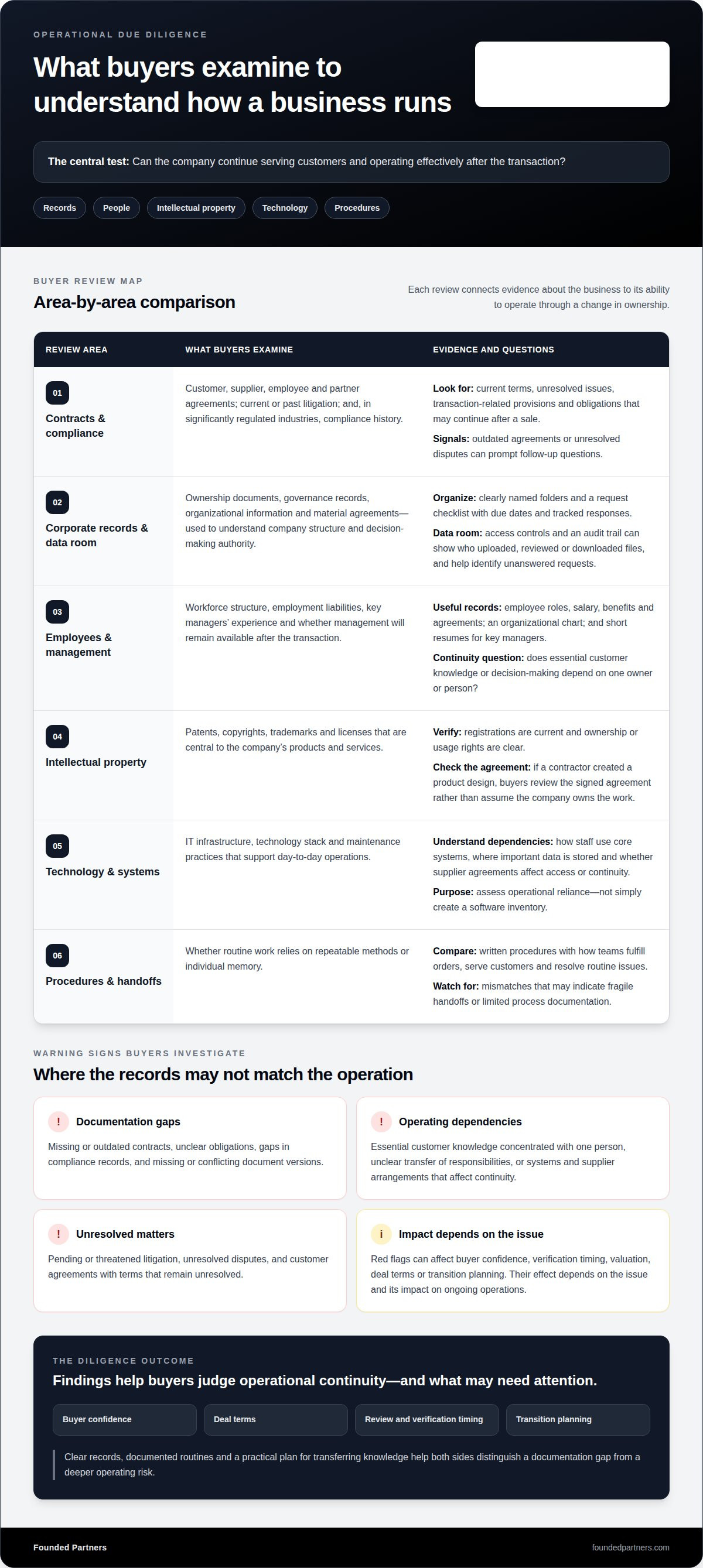
Legal documents and compliance records show the agreements and obligations that shape a company’s operations. Buyers review customer, supplier, employee, and partner contracts for current terms, unresolved issues, and provisions that could affect the transaction.
They also examine current or past litigation and, in significantly regulated industries, the company’s compliance history. An outdated supplier agreement or unresolved dispute, for example, may prompt follow-up questions. Organized records help buyers assess potential liabilities and understand which obligations may continue after a sale.
Corporate and Organizational Records
Corporate and organizational records describe the company’s structure, ownership, and key business arrangements. Buyers use them to understand decision-making authority, how the business is organized, and whether the seller’s explanations align with its records.
Sellers can group ownership documents, governance records, organizational information, and material agreements in clearly named folders. Sellers may use a virtual data room to share sensitive documents and agree on confidentiality arrangements before providing access. The buyer’s diligence team can prepare a request checklist with due dates and track responses against it.
Access controls and an audit trail add visibility: a virtual deal room can record who uploaded, reviewed, or downloaded confidential files. This helps sellers see which records buyers have examined and identify unanswered requests.
Document Review and Operational Red Flags
Document review compares records with the business’s account of its operations, helping buyers identify inconsistencies before they shape deal discussions. Common operational red flags that can reduce a business’s valuation include unresolved litigation, missing or outdated contracts, unclear obligations, and gaps in compliance records. Their effect depends on the issue and its impact on ongoing operations.
For example, revenue tied to a customer agreement with unresolved terms may receive closer scrutiny than revenue supported by a current contract. Missing documents or conflicting versions can also delay verification. Sellers can organize files by topic, flag outstanding items, and explain how each unresolved matter affects the business. Clear records keep the review focused and help both sides distinguish a documentation gap from a deeper operating risk.
Examining human resources, intellectual property, systems, and procedures
People, know-how, and operating infrastructure determine whether a business can continue performing after ownership changes. Buyers examine who does the work, who owns essential assets, and how routine tasks get done.
Workforce records help buyers understand the company’s structure and potential employment liabilities. An employee list can summarize each person’s role, salary, benefits, and employment agreements. An organizational chart shows reporting lines, while short resumes help buyers assess key managers’ skills and experience. Buyers also consider whether management will remain available to run the business after the transaction.
This review can reveal key-person dependency. If one owner holds essential customer knowledge or makes every major decision, buyers may ask how those responsibilities can transfer. Customer references and a transition plan can help show whether relationships and operating knowledge will continue without the owner’s daily involvement.
Intellectual property diligence tests whether the company owns or has rights to assets central to its products and services. Buyers review patents, copyrights, trademarks, and licenses, checking that registrations are current and ownership is clear. For example, a product may rely on a design created by a contractor. Buyers will want to understand the rights set out in the signed agreement, rather than assume the company owns the work.
Technology review goes beyond asset ownership. Buyers examine the IT infrastructure, technology stack, and maintenance practices that support daily operations. They may look at how staff use core systems, where important data is stored, and whether a supplier agreement affects access or continuity. The aim is to understand operational dependencies, not simply inventory the software.
Procedures reveal whether work depends on repeatable methods or individual memory. Buyers can compare written procedures with how teams actually fulfill orders, serve customers, and resolve routine issues. A mismatch may signal fragile handoffs or limited process documentation. Clear responsibilities, maintained systems, and documented routines give buyers a more practical view of continuity. A structured review of operating dependencies can help surface gaps before a transaction requires answers.
Identifying warning signs and planning for unexpected costs and risks
Buyers test whether operating conditions support the seller’s statements and the proposed transaction. Their findings can influence acquisition terms, transition planning, or the decision to proceed.
Risks and Obligations to Investigate
Operational risks are weaknesses that could disrupt service, increase future costs, or constrain the business after acquisition. Buyers examine employee agreements, leases, customer and supplier arrangements, warranties, and pending or threatened litigation.
They also assess equipment condition, inventory movement, employee turnover, and required repairs. Aging inventory combined with slow turnover, for example, may point to obsolescence and added operating pressure. Reviewing these issues helps buyers understand which obligations may continue after the transaction and where further investigation is needed.
Market Trends and Industry Risks
Market and industry risks are external changes that may affect demand, competition, or the company’s ability to deliver. Buyers assess the business model, strategic plan, competitive landscape, and important industry trends.
They also consider whether key customers and employees are likely to stay and whether customer or supplier concentration exposes the business to disruption. A shift in customer preferences, for example, may weaken demand for a core product. Comparing the company’s plans with market conditions helps buyers judge whether its outlook rests on durable strengths or vulnerable assumptions.
Supply Chain and Vendor Risks
Buyers assess supply chain and vendor risks by examining major suppliers, their agreements, and the company’s reliance on key relationships. They consider whether a supplier change, delayed delivery, or contract issue could interrupt production or service.
A buyer may compare supplier terms with purchasing records and identify inputs with few practical alternatives. Heavy reliance on one supplier creates exposure if that relationship changes. Buyers also consider vendors’ roles in daily operations, including whether essential knowledge or customer access depends on a particular relationship.
Mitigating Risks Before Signing
Risk mitigation means resolving, explaining, or accounting for material issues before the buyer signs an agreement. Buyers may request further evidence, assess repair and investment needs, or negotiate changes to the transaction’s structure.
For example, inspection findings may lead the parties to address deferred maintenance in the purchase terms. If diligence reveals serious operational concerns, a buyer may renegotiate, restructure parts of the acquisition, or walk away. Conducting diligence before signing helps buyers understand what they are buying and make decisions with a fuller view of the risks.
Operational diligence in acquisitions
Operational diligence tests how the business functions, not just what its statements report. In an acquisition, it helps buyers assess whether people, processes, and assets can support continued performance.
Operational and Financial Due Diligence
Operational due diligence examines how work gets done, while financial diligence tests earnings, cash flow, and the accuracy of financial information. Commercial diligence considers the business model, market landscape, customers, and competitive position. These reviews complement one another: strong reported earnings may depend on processes or relationships that will not transfer smoothly. Together, their findings help buyers understand what the acquisition includes and what successful ownership will require.
Operational Metrics Buyers Review
Operational metrics show how reliably a company turns resources into products or services. Buyers may examine product margins, revenue by customer, inventory aging, receivables and payables aging, employee turnover, and company assets. Each measure reveals a different pressure point. Slow inventory turnover, for example, can indicate obsolescence, while rising employee turnover may signal delivery disruptions. Buyers interpret metrics in the context of operating practices, not in isolation.
Operational Diligence Process
The process typically moves from information requests to investigation and then to findings shared with relevant parties. Buyers compare seller-provided information with operating records, visit premises, and speak with managers, executives, or employees. They may test whether customer relationships, production processes, and management capacity match the seller’s account. Teams track and prioritize open questions because unresolved issues can affect negotiations, transition planning, or timing.
Diligence Timing and Cost
Business acquisition due diligence can take six to 12 weeks or longer, depending on company and transaction complexity. Cost depends on the investigation’s scope, the quality of available records, and the specialists involved; a broad review requiring extensive verification takes more work than a focused one. There’s no single cost figure that applies across U.S. deals. Clear records and timely responses can help limit avoidable review work.
To strengthen operational readiness before a transaction, explore operations optimization support.
Founded Partners: Capital raising support
Founded Partners provides capital raising support to founder-led businesses pursuing investment aligned with their growth objectives. Operational diligence can clarify how the company works, where it depends on key people or systems, and what may need strengthening before a financing conversation.
When diligence points to broader operational changes, Founded Partners’ Business Transformation and Operations Optimization services can help address organizational priorities. If a sale is the goal, the firm’s exit planning support can help founders prepare for the transition and consider operational readiness. The right next step depends on the business’s objectives and the issues diligence has surfaced.
For founders considering growth capital or preparing for a future transaction, visit foundedpartners.com to learn more about Founded Partners.
Turn diligence insight into a stronger next move
Operational diligence can do more than inform a transaction. It can help leaders see where the organization relies on informal knowledge, where responsibilities need clearer ownership, and which capabilities deserve attention. The question is not only what buyers look for in operational due diligence, but how those findings can guide the company’s direction, whether a sale is near or still a future possibility.
Choose a practical next step: turn open issues into clear priorities, assign responsibility, and connect each decision to the business’s goals. This discipline can focus planning and help leadership approach growth or a transition with greater clarity.
Founded Partners works with founder-led organizations on strategic business needs. If you’re considering how to move forward after diligence, contact Founded Partners to discuss your goals. A considered next step can create a stronger foundation for what comes next.
Frequently Asked Questions
What Do Buyers Look for in Due Diligence?
Buyers look for evidence that a business’s performance, obligations, and operating model match the seller’s representations. Understanding what buyers look for in operational due diligence also means considering how the company handles everyday disruptions. Buyers may ask who can approve urgent purchases, how customer complaints are resolved, and whether essential work continues when a key decision-maker is unavailable.
What Is Due Diligence in a Business Transaction?
Due diligence is a buyer’s investigation of a business before completing an acquisition. It tests whether the information and assumptions behind the proposed transaction stand up to review. The findings can inform whether to proceed, revise terms, or investigate a concern further. For example, a buyer may compare the seller’s description of recurring revenue with customer records and the agreements supporting those sales.
What should you be looking for before signing a deal?
Before signing, look for unresolved issues that could change the deal’s value, risk, or practical terms. Check whether key assumptions are supported by evidence, whether important obligations will continue, and whether the transition plan clearly assigns responsibility. If the business depends on the seller to manage a major account, for instance, determine how that relationship will continue after ownership changes.
What to expect when someone is doing their due diligence on you?
Expect structured information requests, follow-up questions, and conversations with people who understand how the business operates. A buyer may ask you to explain a process, then compare your explanation with records or employee interviews. Keep answers consistent, assign someone to handle each request, and flag documents still being assembled. This helps prevent avoidable confusion during the review.
Why conduct due diligence?
Due diligence helps buyers make decisions based on evidence rather than assumptions. It can reveal issues that deserve a closer look, clarify which strengths support the business, and show where the proposed terms may need reconsideration. For sellers, a well-managed review can make explanations easier to follow. For example, documenting how a new customer is onboarded can demonstrate that service delivery isn’t dependent on informal knowledge alone.
What does operational due diligence cover in a business acquisition?
Operational due diligence covers the practical capabilities and dependencies that allow a business to function. It considers whether the workforce, facilities, systems, suppliers, and routine processes can support continued delivery after an acquisition. Buyers may also examine how the business responds to disruption, such as an unavailable system or delayed shipment. The goal is to understand what must remain in place for operations to continue.