

The right time for transitioning from founder to board chair is before the company depends on the founder to make every decision. Begin structured succession planning 12 to 18 months before the leadership change, and treat the move as a staged transfer of authority, not a title change. The timing should reflect the company’s readiness, the successor’s preparation, and the founder’s ability to support the new CEO without continuing to run the business.
It’s natural to want continuity: a founder’s experience and relationships remain valuable even as the company needs its next leader to take real ownership. This article explains how to plan succession, reshape the founder’s relationship with the board and CEO, and assess whether the organization is ready. It also clarifies the difference between serving as board chair and continuing as an executive, so you can give the next CEO room to lead while preserving the founder’s contribution.
Key Takeaways
- Build succession around a fair CEO review and a plan that gives potential successors room to develop trust and decision-making experience.
- Set clear boundaries: the new CEO leads operations, while the chair guides the board and brings concerns through the right channels.
- Assess readiness by whether the organization can operate without relying on the founder for routine decisions, not by tenure alone.
- Document the chair’s mandate, decision rights, and transition timeline so the founder’s ongoing contribution supports rather than constrains the next CEO.
1. How Do You Plan a Founder Succession?
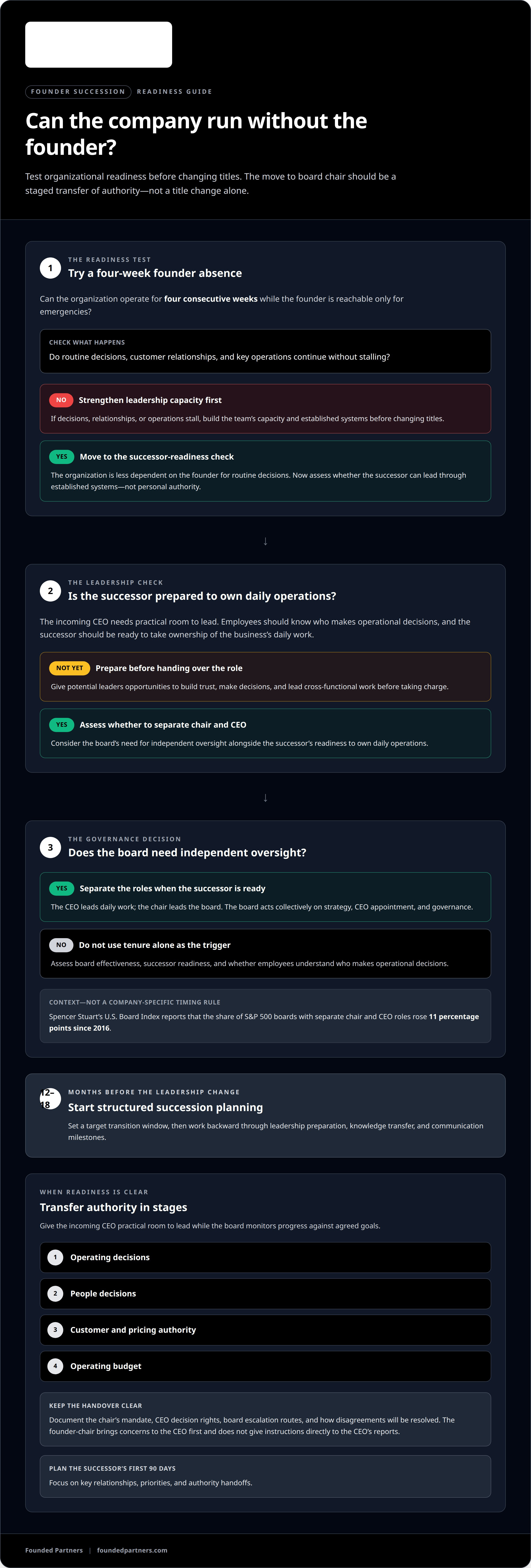
Begin succession planning 12 to 18 months before the leadership change. This gives the board time to assess leadership needs, prepare candidates, and align ownership around the company’s next stage. Set a target transition window, then work backward through hiring, knowledge transfer, and communication milestones.
The CEO performance review should be structured, not informal. The chair leads the review, while the board shares responsibility for its conclusions. If the founder-chair is also the majority owner, they shouldn’t conduct the review alone. Assess performance and future support needs against agreed strategic objectives, operating results, leadership-team development, and compensation alignment. Keep performance discussions separate from succession decisions so one review doesn’t predetermine the next appointment.
Succession planning should include people beyond the named successor. Give potential leaders opportunities to build trust, make decisions, and lead cross-functional work before taking charge. Plan the successor’s first 90 days around key relationships, priorities, and authority handoffs. In stakeholder meetings, align the board, founder, incoming CEO, second-generation owners, and family on what changes and what continues. A supportive partnership lets the next generation reshape the business rather than inherit a fixed playbook.
Plan for more than one scenario: a scheduled CEO departure, an accelerated transition, or a period when the founder can’t serve. Write an emergency succession plan even if no departure is expected. Name a deputy or vice chair to maintain board continuity if the chair becomes unable to serve. For a planned chair succession, define the role’s mandate, identify readiness gaps, and create a handover plan alongside CEO succession. Revisit scenarios as strategy or market conditions change.
A professional advisor can coordinate the transition timeline, clarify decision rights, and prepare a consistent announcement for employees, customers, investors, and other stakeholders. An advisor can also facilitate board and leadership meetings, surface unresolved ownership concerns, and keep the succession plan aligned with long-term priorities. This support is especially useful when the founder remains chair as CEO authority passes to a successor.
2. How Does the Board Relationship Have to Change?
The CEO leads the company’s daily work; the chair leads the board. A founder who becomes chair shifts from executive decisions to board governance, guiding discussion and supporting the CEO. Founder ownership may continue, but it doesn’t give the founder authority to direct employees.
The board acts collectively on strategy, CEO appointment, and governance. Its role is to challenge plans and guide management, not make operational decisions. For example, directors can question the risks of a proposed expansion, while the CEO and leadership team decide how to execute it.
Transfer authority in stages. Start with operating decisions, then move people decisions, customer and pricing authority, and the operating budget to the successor CEO. This gives the incoming executive practical room to lead while the board monitors progress against agreed goals and through regular meetings.
Set communication boundaries before the handover. The founder-chair should bring business concerns to the CEO first, then raise unresolved matters with the board. They shouldn’t give instructions directly to the CEO’s reports. A clear route protects the CEO’s authority and prevents employees from receiving conflicting directions.
Record the boundaries in a transition charter. Define the chair’s mandate, the CEO’s decision rights, board escalation routes, and how disagreements will be resolved. Schedule regular conversations between chair and CEO, focused on strategy, performance, and organizational needs rather than operational approvals.
A professional advisor can help draft the charter, map decision rights, and facilitate conversations when the founder’s expectations differ from the successor’s. Founded Partners’ Leadership Advisory can support the working relationship as the founder steps out of executive decision-making. The goal is to stay engaged at board level without undermining the CEO’s authority.
3. When Is the Right Time to Transition a Founder CEO?
Readiness matters more than a founder’s tenure. One useful test is whether the organization can operate during four consecutive weeks of the founder’s absence, with the founder reachable only for emergencies. If routine decisions, customer relationships, or key operations stall, strengthen leadership capacity before changing titles. Consider whether the successor can lead through established systems rather than relying on the founder’s personal authority.
Separate the chair and CEO roles when the board needs independent oversight and the successor is prepared to own daily operations. Spencer Stuart’s U.S. Board Index reports that the share of S&P 500 boards with separate chair and CEO roles rose 11 percentage points since 2016. That trend is context, not a timing rule for an individual company. Assess board effectiveness, successor readiness, and whether employees know who makes operational decisions.
In the United States, the chair leads the board, while directors share responsibility for stewardship and governance. The board acts collectively on strategy and CEO appointment or dismissal; executives run the business. Being chair does not make someone the board’s sole decision-maker or give them the CEO’s operational authority. Document the chair’s mandate and escalation process to keep accountability clear.
Before the transition, document the CEO’s and chair’s responsibilities, decision rights, and reporting relationships. Clarify how the board will assess the CEO’s performance and how the founder’s compensation will change with the role. Compensation should reflect actual responsibilities, not preserve executive authority through a title. Capture these arrangements in governance documents and explain them consistently to board members, employees, and stakeholders. As the successor assumes leadership, review whether the structure fits the organization’s values and operating model. If the founder continues to influence hiring or operational approvals, reset the boundaries before those habits become the informal basis for decisions.
4. Transitioning from founder to board chair
A founder-chair transition works when responsibilities change in practice, not just on the organization chart. The CEO directs operations and leads the executive team; the chair leads board meetings, shapes governance, and helps directors focus on the company’s long-term vision. Directors decide board matters collectively. The chair guides that process but doesn’t replace the board or manage the CEO’s team.
A successful transition makes room for the successor’s judgment. Set a written mandate that distinguishes board oversight from executive authority, then define how the chair raises concerns and how the CEO reports progress. The founder can contribute institutional knowledge, relationships, and strategic perspective without deciding operational questions. Clear accountability helps employees understand whose direction governs each decision.
The risks are practical: employees may keep looking to the former CEO, the founder may overstep, and conflicting messages can weaken the successor’s authority. Quigley and Hambrick analyzed 181 CEO successions in high-technology firms; their study found that a former CEO remaining chair could restrict the successor’s discretion and block large performance gains more than large performance drops. A written charter and consistent conduct help address those risks.
Rajeev Suri said he transitioned to chairman roles after 14 years as CEO. That example highlights a possible progression, not a template for every founder. In each case, the board should decide what skills the incoming chair needs, how the founder’s knowledge will transfer, and what the successor CEO must own. A staged handover can start with board leadership, then move public and stakeholder relationships as the new CEO establishes authority.
Review the arrangement after the first year. Ask whether directors receive useful strategic guidance, whether the CEO has clear authority, and whether the founder’s involvement matches the agreed mandate. If responsibilities remain blurred, revise the charter and communication practices. Plan a founder-chair transition with structured support for role clarity, accountability, and board effectiveness.
Founded Partners
Founded Partners helps founder-led organizations align leadership, governance, and business priorities during succession. When the founder’s future role, the successor’s authority, or the company’s readiness is unclear, Founded Partners’ Leadership Advisory and Business Transformation Consulting can help shape a more deliberate transition. The work can address role clarity, leadership capacity, and the organizational changes needed for the next stage.
For founders also considering ownership changes or a future sale, Founded Partners’ Exit planning can connect leadership decisions with longer-term business objectives. The right support depends on where the transition is most difficult: preparing the next CEO, clarifying the founder-chair relationship, or strengthening how the organization operates. A well-defined next step gives the board and leadership team a shared basis for action.
Contact Founded Partners to discuss your founder succession and transition priorities.
Make the Next Chapter Deliberate
The founder’s next contribution doesn’t need to mirror the role that built the company. The opportunity is to make space for new leadership while staying connected to the organization’s purpose and long-term direction. A thoughtful approach to transitioning from founder to board chair starts with a clear decision about what the business needs next and what role you’re ready to play.
That decision may also connect to broader strategic priorities. Founded Partners offers Capital raising support, Business Transformation Consulting, and Exit planning to help founder-led organizations address related business decisions alongside leadership change. Outside perspective can bring those decisions into focus without forcing a predetermined path.
When you’re ready to consider the next step, contact Founded Partners to discuss your transition. A well-planned handover can honor what you’ve built and give the next chapter room to take shape.
Frequently Asked Questions
When Is the Right Time to Transition a Founder CEO?
The right time comes when the company’s needs have outgrown the founder’s preferred leadership role and a successor is ready to lead. Look for evidence in recurring decisions: executives resolve cross-functional issues without waiting for the founder, customers trust the successor to make decisions, and the board can assess performance against shared priorities. If these conditions aren’t in place, address the gaps before setting a departure date.
How Do You Plan a Founder Succession?
Plan succession by matching future business needs to leadership capabilities, then preparing more than one candidate where possible. Compare internal candidates’ experience with the demands of the role, including strategic judgment, talent development, and stakeholder confidence. Include an emergency scenario, document who can step in, and plan how the successor will learn essential relationships and commitments. This keeps the plan useful even if circumstances change.
How Does the Board Relationship Have to Change?
The founder’s contribution on the board should shift toward questions, context, and constructive challenge rather than direct instruction. For example, if the founder disagrees with a hiring decision, they can raise the concern with the CEO or through board discussion rather than privately directing the hiring manager. This distinction helps employees understand whose authority applies and gives directors a consistent basis for board-level accountability.
How long should a founder stay?
There’s no single tenure that suits every founder or company. The founder should remain board chair only while their contribution supports effective governance and the CEO’s ability to lead. Set a review point based on agreed responsibilities, then consider whether the founder is adding strategic perspective or drawing decisions back into executive operations. A planned review keeps the role responsive to the company’s changing needs.
Should a founder promote an insider or hire an outside CEO?
Choose the candidate whose capabilities best fit the company’s next operating challenges, not simply the person who knows its history. An insider may bring established relationships and organizational knowledge; an external candidate may offer experience the current leadership team lacks. Assess both against the same criteria, including the ability to earn trust, make difficult decisions, and work productively with the founder and board.
What Are the Four Stages of Founder Evolution?
A practical way to think about leadership is through four stages: builder, manager, leader, and steward. The builder creates the initial product and customer base; the manager establishes repeatable processes; the leader develops people and delegates decisions; the steward focuses on long-term direction and governance. These are useful distinctions, not a fixed progression. A founder may move between them as the organization’s needs and leadership structure change.