

A first board meeting can last two to six hours, though an efficiently run meeting should take no longer than 60 minutes. Preparing for your first board meeting means getting ready not just for the time in the room, but for the decisions and discussion that make that time useful.
It’s natural to wonder how much material to prepare and what the board expects. The goal isn’t to present every detail; it’s to give directors a clear picture of the business and make room for focused, strategic discussion.
This guide covers how to review finances, product, customers, industry, and staffing; build concise presentations around the issues that matter; and establish a steady meeting rhythm that supports sound business decisions. You’ll also learn what to expect during the meeting, so you can arrive prepared, listen carefully, and contribute with confidence.
Key Takeaways
- Delegate meeting preparation clearly so materials, scheduling, and follow-ups have accountable owners.
- Review the board packet with attention to financial performance, product, customers, industry developments, and staffing.
- Use a central meeting theme and concise executive updates to keep discussion focused on strategic priorities.
- Turn discussion into disciplined follow-through by recording decisions, next steps, and who is responsible for each one, as recommended by the Agency for Toxic Substances and Disease Registry.
1. How long is a board meeting?
A board meeting can last two to six hours, while an efficiently run meeting should take no longer than 60 minutes. The length depends on the agenda, preparation, and time required for decisions. At a first meeting, introductions may take about five minutes each. A focused agenda helps members reserve discussion time for matters that need board attention.
Preparing for your first board meeting starts before directors arrive. Delegate logistics and document assembly, but retain clear ownership of the agenda, key decisions, and sensitive business updates. For example, ask a team member to collect reports and distribute the packet, while an executive checks the information and flags topics for discussion. Review fellow board members’ roles, expertise, backgrounds, and skills so you can direct questions to those with relevant experience.
For a U.S. corporate board member, legal duties depend on applicable state law and the company’s governing documents. Understand the responsibilities attached to your role and review relevant materials before voting. A new member’s vote follows the board’s governing process; nonprofit board members have an equal vote to other members. The chair asks attendees to disclose conflicts of interest connected to agenda items. Raise a relevant conflict promptly and follow the chair’s direction on how it is handled.
Meetings often begin with approval of the previous minutes and follow-up business, then move through the agenda. Ask questions that clarify the decision, its assumptions, and the expected next step. For example, ask what evidence supports a proposed growth plan or which risks could affect its timing. Make requests specific: name the issue, explain what advice you need, and say what decision or insight would help.
Listen closely to directors’ closing comments. They may draw on their experience to flag future challenges that did not come up earlier. After the meeting, ask the chair or another director for a debrief, record follow-up commitments, and review the minutes when they are circulated. This creates a practical record of decisions and helps you prepare for the next meeting.
2. Reviewing product, customers, industry, and staffing
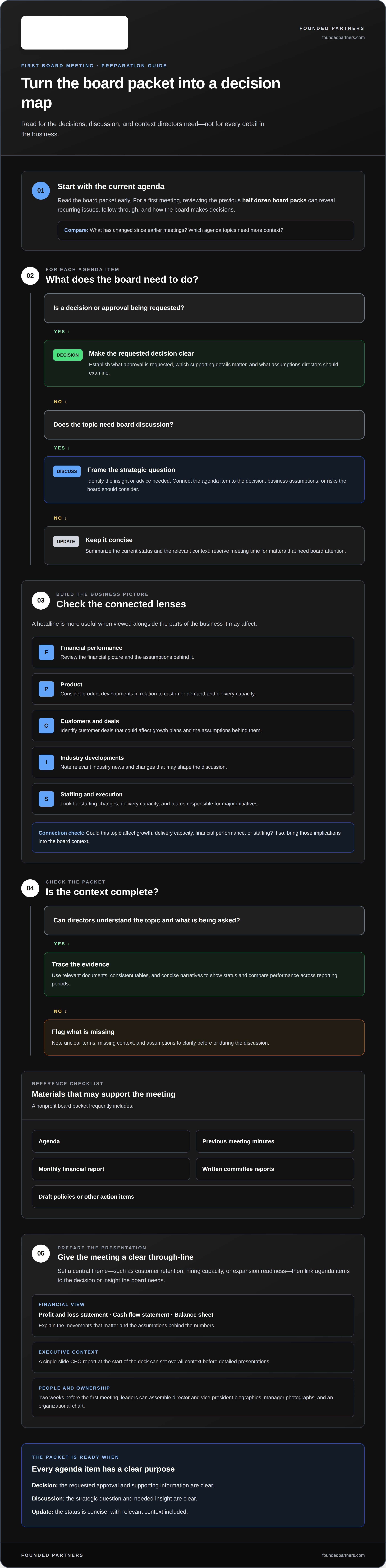
Start with the board packet, the collection of materials sent before a meeting. Read it early, then use the agenda to identify which topics call for a decision, discussion, or brief update. A first-time director can review the previous half dozen board packs to understand recurring issues, follow-through, and how the board makes decisions. Compare those patterns with the current agenda and note where a topic has changed or needs more context.
Review the business through connected lenses: financial performance, product, customer deals that affect growth, industry news, and staffing changes. A product update, for example, is more useful when considered alongside customer demand, delivery capacity, and the financial picture. Look for connections rather than treating each headline in isolation. If a customer deal could change growth plans, identify the assumptions behind it and the operational or staffing implications directors may need to discuss.
Background materials can help directors see who is responsible for execution. Two weeks before the first meeting, leaders can assemble director and vice-president biographies, manager photographs, and an organizational chart. Use the chart to trace reporting lines and see where a major initiative depends on a particular team. Biographies can also connect people’s expertise to agenda topics, helping clarify who may provide useful context during discussion.
Check that the packet supports each agenda item with relevant documents. A nonprofit board packet frequently includes an agenda, previous meeting minutes, a monthly financial report, written committee reports, and draft policies or other action items. For a company board, organize equivalent materials around the decisions and developments under consideration. Flag unclear terms, missing context, or assumptions you want clarified. If an agenda item calls for approval, establish what decision is requested and which supporting details matter. This preparation turns a dense packet into a working map of the meeting, helping you follow the discussion and contribute with informed questions. Leaders seeking a clearer view of organizational priorities can explore strategic business guidance.
3. Using meeting themes and executive presentations
Give each board meeting a central theme, such as customer retention, hiring capacity, or expansion readiness. A clear focus helps directors spend discussion time on the strategic question instead of moving through disconnected updates. Set the theme before building the presentation, then link each agenda item to the decision or insight the board needs to address. An expansion discussion, for instance, could cover demand, operating capacity, and the resources needed to deliver.
Present financial data in a way that shows results and the assumptions behind them. Include a profit and loss statement, cash flow statement, and balance sheet, then explain the movements that matter. Place detailed financial information early enough for directors to discuss the company’s position before turning to other topics. Many venture capitalists prefer financials in Excel so they can inspect calculations and assumptions. A lead investor on the board may also share examples of a preferred board-deck format.
Use consistent tables to track metrics across reporting periods. This lets directors compare performance over time and assess whether a change reflects a trend, a one-off event, or a revised assumption. Pair each table with a brief narrative describing the business area, its current status, and the question for the board. The packet should bring together financial reports, concise narratives, and a CEO executive summary. A single-slide CEO report at the start of the deck can set the overall context before detailed presentations.
Senior leaders should present when their operating plans or developments need board discussion. A functional vice president, for example, can explain a department’s priorities, trade-offs, and implications for the wider business. Focus on what has changed, what management recommends, and where directors’ experience could help. The CEO can translate detailed information into a high-level status update, while the executive closest to the work provides operational context. This gives directors a clearer view of both strategy and execution.
4. Using board meetings for business discipline
A board meeting can establish a dependable management rhythm, not just review past results. Provide monthly financials until the company has grown significantly. Move to quarterly reporting only after the board approves the change. Regular reporting gives directors a consistent view of performance and helps leaders spot when results depart from expectations. Use each meeting to connect results with decisions, owners, and follow-through.
Keep functional updates forward-looking. Ask each area to present its priorities for the next 1–3 months, the constraints affecting delivery, and the decisions requiring board input. Founders can bring 1–3 issues they are trying to solve or develop. Frame each request clearly, including the context and the kind of advice that would help. Questions about information already in the packet can be handled one-on-one after the meeting, leaving shared discussion for judgment and strategic trade-offs.
Candor is part of the discipline. Share difficult news with investors early and often, along with management’s response and unresolved risks. Cloudflare’s founders described how board members’ macro-level advice could help anticipate issues the company might face about three months later. They also discussed five potential threats despite strong business results. The lesson: make room to discuss risks even when current metrics look positive, so the board can consider what might disrupt the plan.
Close each discussion by capturing the decision, next step, and accountable person. The Agency for Toxic Substances and Disease Registry (ATSDR) recommends recording these details. For example, note whether management will revise a forecast, who owns the revision, and when it returns to the board. Review open actions at the next meeting, then explain what moved forward and what remains blocked. This turns advice into operating discipline. If you want to strengthen that connection between priorities and execution, work through your operating priorities.
Founded Partners
Founded Partners helps founder-led businesses strengthen their foundations and prepare for their next stage of growth. When board discussions reveal gaps in execution, leadership alignment, or strategic direction, its Business Transformation Consulting and Leadership Advisory can help turn priorities into a focused path forward. For founders considering investment or a future transition, Capital raising support and Exit planning can also support those strategic milestones.
Turn to Founded Partners when you need experienced advice connecting board-level priorities with the decisions and operational changes needed to advance them. The work is shaped around your organization’s needs and long-term direction, rather than a generic meeting template.
To discuss how Founded Partners can support your business, contact Founded Partners.
Carry the conversation into your next stage of growth
The value of preparing for your first board meeting goes beyond the meeting itself. Treat it as the start of an ongoing working relationship: keep sight of the questions your business needs to resolve, and stay open to perspectives that challenge familiar assumptions. Over time, this approach can help connect boardroom discussion with the leadership decisions shaping the company’s direction.
You don’t need every answer before sitting down with directors. Bring a considered perspective, a willingness to learn, and a clear sense of where guidance could make a difference. These habits create a stronger foundation for productive engagement as the business evolves.
If you’re considering how to strengthen your board approach and business direction, contact Founded Partners to discuss your board meetings.
Each meeting is an opportunity to build clarity and lead with greater intention.
Frequently Asked Questions
How long is a board meeting?
A board meeting may last two to six hours, though efficient meetings should take no longer than 60 minutes. The agenda and depth of discussion shape the actual duration. If a complex decision needs more time, allocate it deliberately rather than allowing every update to expand. For your first meeting, note which agenda items require discussion and which are primarily for information.
What should you review before your first board meeting?
Review the agenda, recent board materials, and the company’s current priorities before the meeting. Pay close attention to changes since prior discussions, such as a new customer commitment or a shift in hiring plans. Prepare notes that separate factual clarifications from strategic questions. This makes it easier to follow the conversation, understand why an item is on the agenda, and contribute without revisiting information already provided.
What documents should you prepare for a board meeting?
Prepare the materials directors need to understand the agenda and make decisions. These may include the agenda, previous minutes, financial reports, brief updates on major business areas, and any draft policy or action requiring approval. For a nonprofit, committee reports may also belong in the packet. Label each document clearly and link it to the relevant agenda item so members can find supporting information during discussion.
How do you create an effective board meeting agenda?
Build the agenda around decisions and strategic issues that need directors’ attention. Put routine updates in context, state the requested outcome for each discussion item, and leave room for questions or differing views. For example, label a hiring-plan item as a decision if approval is needed, rather than presenting it as a general update. Send background materials with enough context for directors to prepare thoughtfully.
What financial metrics and reports should board members review?
Board members should review financial reports that show performance, liquidity, and the company’s overall financial position. A useful set includes a profit and loss statement, cash flow statement, and balance sheet. Compare tracked metrics consistently across reporting periods, then focus discussion on material changes and the assumptions behind them. For example, a revenue variance is more informative when management explains its effect on cash and the operating plan.
What is the typical length and format of a board meeting?
Meetings can span two to six hours, while an efficiently conducted meeting should take no longer than 60 minutes. A typical format moves from prior minutes and follow-up business into financial and operational updates, then focused strategic discussion and closing comments. The chair guides the agenda, invites questions, and keeps attention on decisions. The company’s priorities and the complexity of outstanding issues determine how much discussion each item needs.