

An advisory board should sharpen decisions, not become a second board of directors. To understand how to set up an effective advisory board, start with a clear business purpose, choose members whose experience addresses real gaps, and define how their advice will be used. Its role is to offer insight, not direct company oversight.
That distinction matters. A strong advisory board can challenge assumptions and bring expertise the leadership team lacks, but its advice is useful only when leaders know what they need and have a practical way to act on recommendations.
This article explains why businesses form advisory boards, how to shape membership and meetings, and what helps keep the group effective over time. It also explains how an advisory board’s non-binding strategic role differs from a board of directors’ responsibilities, so you can choose a structure that fits your goals and supports the company’s next stage.
Key Takeaways
- Set the board’s purpose first, then align its size, member terms, leadership roles, and meeting cadence with that purpose.
- Use a written charter or agreement to clarify each advisor’s responsibilities, expectations, and how recommendations will be handled.
- Choose members whose complementary experience fills meaningful gaps and brings perspectives the leadership team doesn’t already have.
- Keep the distinction clear: advisors provide strategic input, while directors have an oversight role and decision-making responsibilities.
1. How does the advisory board differ from a Board of Directors?
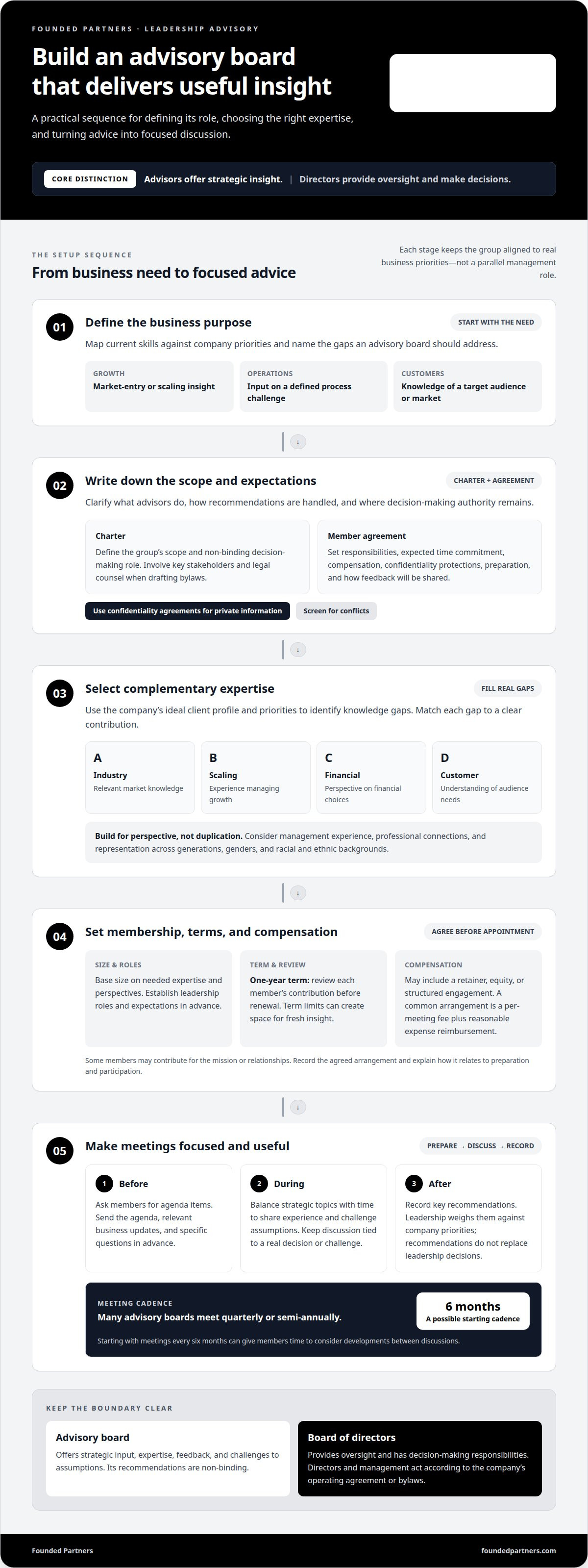
An advisory board offers strategic insight; a board of directors provides oversight. Advisory members advise, rather than take on the same legal or fiduciary responsibilities as directors. Their recommendations do not replace decisions by company leadership. Directors and management act according to the company’s operating agreement or bylaws. This distinction shapes the board’s purpose, membership, meeting structure, and influence. An advisory group can challenge assumptions without becoming a decision-making body.
Set the advisory board’s size according to the expertise and perspectives the business needs. Consider how members will work together, not just the credentials each person brings. Establish terms, leadership roles, and meeting expectations in advance. A one-year term provides a defined period to assess fit and contribution, while term limits can create space for fresh insight. Many advisory boards meet quarterly or semi-annually. Starting with meetings every six months can give members time to consider developments between discussions.
Focused meetings turn that structure into useful feedback. Before each meeting, ask members to suggest agenda items and identify the specific decisions or challenges where their insight is needed. Send an agenda in advance, along with relevant business updates and questions for discussion. Balance strategic topics with time for advisors to share experience and challenge assumptions. For example, a growth discussion could pair a concise performance update with questions about entering a new market. Keep the conversation focused and record key recommendations.
Advisors can also contribute between scheduled meetings when an opportunity matches their expertise or interests. A member with experience in a target market might join a focused discussion about expansion, while an operations expert could offer input on a defined process challenge. These contributions should support the board’s purpose, not create a parallel management role. Clear expectations preserve the distinction: directors oversee, while advisors offer insights and feedback for leaders to weigh against company priorities.
2. How do you ensure that you have an effective advisory board?
Put expectations in writing before inviting members to serve. Because the advisory-board sector is largely unregulated, clarify the group’s scope and decision-making role in its charter. Use confidentiality agreements when members will discuss private information, and screen candidates for conflicts that could affect their contribution. When drafting bylaws, involve key stakeholders and legal counsel.
A written agreement should describe each member’s responsibilities, expected time commitment, compensation, and confidentiality protections. Explain how members should share feedback, what preparation is expected, and how leadership will respond to recommendations. For example, specify whether an advisor reviews materials in advance, contributes during meetings, or joins a focused discussion between sessions. A clear role description shows members where their advice adds value without suggesting they have decision-making authority.
Use the company’s ideal client profile to identify knowledge gaps among prospective members. If the business serves a specific customer segment, prioritize advisors who understand that audience, its needs, or its market. Assess their experience against the board’s purpose, and ask about relevant conflicts before selection. Set a one-year membership term and review each member’s contribution before renewal. A defined term provides a practical opportunity to refresh expertise as company priorities evolve.
Decide compensation and expense reimbursement before appointments, then record the arrangement in each agreement. Members may contribute for the mission or relationships, or expect a retainer, equity, or structured engagement; clarity supports commitment. A common arrangement is a per-meeting fee plus reimbursement of reasonable expenses. Set expectations consistently, explain how payments relate to preparation and participation, and revisit the arrangement during renewal. If leadership needs support aligning responsibilities, expectations, and board engagement with business priorities, Leadership Advisory can help bring structure to that work.
3. Why should you consider forming an advisory board?
Forming an advisory board can bring expertise the leadership team lacks into important decisions. Start by mapping current skills against company priorities, such as entering a new market, improving operations, or preparing for growth. A business pursuing expansion might need market-entry insight, customer knowledge, and scaling experience. Aim for complementary perspectives, rather than several advisors offering the same one.
Identify gaps with specific questions. Does the leadership team understand its target customer segment? Has the company managed growth at a similar stage? Can it assess financial choices or changing industry trends? Advisors may contribute industry, scaling, financial, or customer expertise. Match each gap to a clear contribution, such as testing an expansion plan or challenging assumptions about customer demand. This makes advice relevant to real opportunities.
Look beyond technical credentials. Effective advisors bring management experience, varied industry knowledge, and a genuine interest in supporting the organization. Consider how a candidate’s skills, experience, and professional connections could address a defined business need. For example, a company exploring a new customer segment may benefit from an advisor who understands that audience. Representation across generations, genders, and racial and ethnic backgrounds can also broaden the perspectives around the table.
For a private, family-owned business, an external advisor may offer objective expertise in family business governance or succession planning. An advisory board can also be a practical step toward adding non-family members to a fiduciary board of directors or strengthening governance. It gives leadership a way to examine decisions from outside the family or management team while keeping the group’s role advisory. Choose members for the expertise and perspective the company needs, then connect their contributions to its long-term trajectory.
4. Advisory boards’ non-binding strategic role
Define the board’s goals, scope, and expected outcomes around the company’s long-term direction. Set outcomes for a 12–24-month period, then specify where advisors should offer insight and where management retains responsibility.
This boundary is central to the board’s strategic value. Advisory members make recommendations, but they do not have the same legal or fiduciary responsibilities as directors. A board of directors has an oversight role; an advisory board offers counsel, not company oversight. Management and directors still make decisions under the company’s operating agreement or bylaws. An advisor’s recommendation informs a decision but does not make it for the business.
Make the distinction practical by defining the group’s scope in its charter. For example, an advisory board might assess a proposed expansion, identify risks in a growth plan, or share insight on product development. It can question assumptions and present options. Leadership then weighs that advice against company priorities and decides what to do. This keeps the board useful without confusing strategic counsel with authority to direct daily operations or approve company decisions.
Use a focused agenda to connect each meeting to the board’s agreed goals. List the strategic priority, the issue requiring input, and the decision leadership expects to make afterward. A meeting on market development, for instance, could ask advisors to examine customer assumptions and highlight risks, rather than choose the market on management’s behalf. Record recommendations and assign follow-up to company leaders. At the next meeting, revisit the advice and explain which actions were taken or why others were not pursued.
Clear scope also helps the board stay aligned as company priorities change. Review its goals and agenda when the business enters a new stage, such as preparing for growth or refining its direction. Keep advice connected to defined outcomes, while leaving governance and decision authority with the appropriate company leaders. Discuss your strategic priorities and how leadership can turn advisory insight into a clear path forward.
Founded Partners: Leadership Advisory
Founded Partners provides Leadership Advisory for founders looking to strengthen how their leadership teams make and carry out strategic decisions. When advisory-board insights need to connect with company priorities, leadership roles, and the next stage of growth, this support can help bring those elements into alignment.
That work may sit alongside Business Transformation Consulting or Scalability Strategy when organizational structure or growth planning is also a priority. For founders preparing to raise capital or plan an exit, Capital raising support and Exit planning address those distinct needs. The right focus depends on the decisions the business needs to make and the capabilities its leadership wants to strengthen.
Contact Founded Partners to discuss the leadership challenges and priorities shaping your next stage.
Make advisory insight part of your next stage
An advisory board creates value when its insights influence decisions, not just the conversation in the room. As priorities evolve, revisit what the business needs from its advisors and how leadership will turn their perspectives into action. That ongoing discipline is central to how to set up an effective advisory board that stays relevant as the company grows.
When you’re ready to connect board strategy with wider business priorities, Founded Partners can support your next steps through Capital raising support, Business Transformation Consulting, or Exit planning. Each addresses a distinct need, from pursuing growth capital to strengthening the business or preparing for a transition.
Contact Founded Partners to discuss your advisory board and the priorities you want it to support. A thoughtful next step can help turn valuable outside insight into a stronger foundation for what comes next.
Frequently Asked Questions
How do you ensure that you have an effective advisory board?
Knowing how to set up an effective advisory board also means assessing whether its advice improves decisions. After a recommendation, record the action taken, who owns it, and why leadership chose a different path if it wasn’t pursued. Review attendance, participation between meetings, and progress against the board’s purpose. An annual member survey can show whether the board’s expertise and format still serve the business.
How do you find the right Advisory Board Members for your business?
Choose candidates by matching their experience to a defined business need, then assess whether they can contribute constructively. For example, a company considering a new customer segment could seek someone familiar with that audience. Ask candidates how they approached comparable challenges and what they learned. Reference checks can clarify their working style, while a conflict review can identify relationships that may affect their advice.
How does the advisory board differ from a Board of Directors?
An advisory board makes recommendations, while a board of directors provides oversight. For example, advisors might assess risks in a proposed market expansion, but company leadership decides whether to proceed. Directors’ responsibilities differ from advisors’ non-binding input. Before sharing information, make sure participants understand which group they serve, what authority they hold, and how company decisions are made.
When should you establish an advisory board, and how do you know if it’s the right time?
Consider establishing one when a consequential business priority requires insight the leadership team can’t readily provide internally. The need might arise during expansion, a shift in customer focus, or succession planning. Advisory Board Centre data indicates that organizations commonly form boards with revenue between $1.5 million and $100 million, but revenue alone doesn’t determine readiness. A clear purpose and willingness to engage with outside advice matter too.
What are important protocols for facilitating and maintaining an advisory board?
Share meeting materials a week before each meeting so members can prepare focused feedback. Keep a forward calendar, capture recommendations in concise minutes, and give advisors an agreed channel to share input between sessions. Afterward, leadership should explain which recommendations led to action and why others were not pursued. These practices create continuity, help members stay engaged, and make the board’s contribution easier to assess.
Why should you consider forming an advisory board?
Form an advisory board to bring outside experience, fresh perspectives, and useful connections into decisions that shape the business. An advisor with customer expertise, for instance, can help leadership test assumptions before committing resources to a new segment. Advisors may also support advocacy or help build resources through fundraising connections. The strongest reason is a specific business need that informed counsel can address, not simply adding another formal group.