

A strong sale is built before a buyer appears. An exit readiness checklist for founder-led businesses helps you assess whether the company can transfer with dependable revenue, clear contracts, reliable financials, and less dependence on its founder. Proper exit preparation takes three to five years, so the right time to identify gaps is before a sale becomes urgent.
Readiness isn’t only about making the business attractive to a buyer. It’s also about defining what a successful exit means to you and deciding which paths fit your goals. This guide shows you how to assess customer concentration, contract durability, recurring revenue, and pipeline quality, then consider timing and exit strategy options. You’ll get a clearer view of what’s working, what needs attention, and how to approach the next stage with intention.
Key Takeaways
- Assess whether your financial records, operating processes, and leadership can give a buyer confidence beyond the founder’s involvement.
- Review customer concentration, contract renewal risk, recurring revenue, and pipeline quality to understand how durable future sales appear.
- Use the time before a sale to strengthen gaps, align key people, and prepare a clear, credible picture of the business.
- Compare exit paths against your personal goals, desired level of ongoing involvement, and priorities for the terms of a sale.
What is an exit readiness checklist?
An exit readiness checklist for founder-led businesses is a structured review of whether a company can withstand buyer scrutiny and transfer with its value intact. It covers financial records, revenue quality, operating systems, management depth, and owner goals. It also helps owners identify gaps early enough to address them before a transaction.
Start with financial statements covering three to five years. Reconcile reported revenue and expenses to supporting records, then document adjustments that explain EBITDA clearly. Quality-of-earnings adjustments should remain below 3 percent of reported EBITDA. Buyers may discount valuation when earnings rely on unsupported add-backs, inconsistent accounting, or revenue that cannot be traced to customer contracts and invoices.
- Reconcile monthly results: Consistent closes make performance easier for buyers to assess.
- Review working capital: Model month-end balances for the past 24 to 36 months to reveal seasonal patterns.
- Test revenue recognition: Match recorded sales to contracts, delivery evidence, invoices, and collections.
- Separate owner expenses: Document proposed adjustments so buyers can assess the continuing cost of operating the business.
Owner goals belong in the review alongside financial needs. Define your preferred timing, ongoing role, and the proceeds needed for your next stage. If co-owners prefer sale dates several years apart, for example, that difference can affect the growth plan and transaction structure. An exit readiness checklist for founder-led businesses connects those personal priorities with business preparation.
For preparation, founders commonly assemble a CPA or quality-of-earnings specialist, a transaction attorney, and an investment banker or M&A advisor. Their fees vary with scope, deal complexity, and whether the work is a defined project or ongoing support.
Common risks include inconsistent reporting, unexplained EBITDA adjustments, weak working-capital records, and dependence on the founder. For an asset sale, the buyer and seller each report the allocation of the price among assets on IRS Form 8594, according to the Internal Revenue Service. The National Institute of Standards and Technology identifies its NIST Cybersecurity Framework 2.0 Small Business Quick Start Guide as publication SP 1300, dated February 2024, a useful reference when reviewing cybersecurity practices and records.
Customer concentration, contracts, recurring revenue, and pipeline
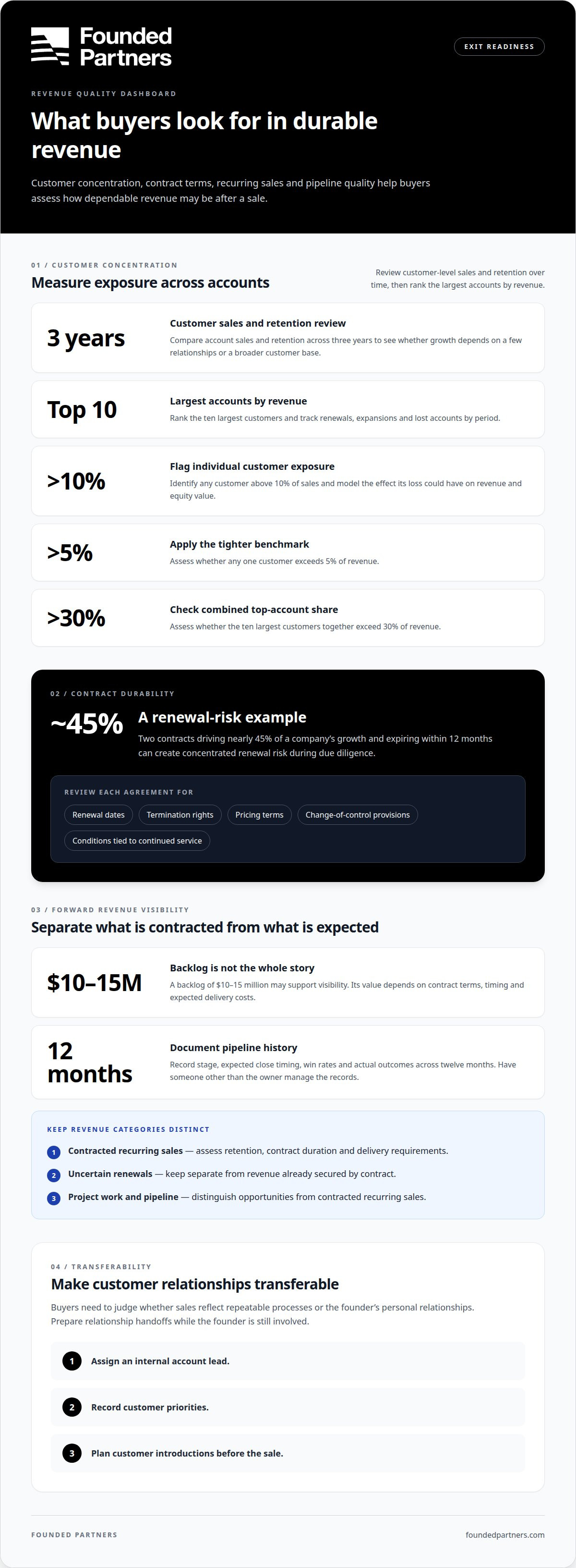
Buyers assess whether revenue is spread across customers, supported by durable contracts, and likely to continue after a sale. Review customer-level sales and retention over three years, then rank the ten largest accounts by revenue. This shows whether growth depends on a small number of relationships or a broader customer base.
- Flag concentration: Identify any customer above 10% of sales, then model how its loss would affect revenue and equity value.
- Set a tighter benchmark: Assess whether any customer exceeds 5% of revenue and whether the ten largest together exceed 30%.
- Track retention: Compare renewals, expansions, and lost accounts by period to distinguish repeatable revenue from one-time wins.
Contracts need the same scrutiny as customer totals. Record renewal dates, termination rights, pricing terms, change-of-control provisions, and any conditions tied to continued service. For example, two contracts driving nearly 45% of a company’s growth and expiring within 12 months can create a concentrated renewal risk during due diligence.
Recurring revenue can make future performance easier to assess, but buyers still examine retention, contract duration, and the work required to deliver it. Separate contracted recurring sales from renewals that remain uncertain, project work, and pipeline opportunities. A backlog of $10-15 million may support visibility, but its value depends on contract terms, timing, and expected delivery costs.
Document pipeline history for twelve months, including stage, expected close timing, win rates, and actual outcomes. Have someone other than the owner manage those records. This helps buyers judge whether forecasts reflect a repeatable sales process or the founder’s personal relationships.
Prepare relationship handoffs before selling. Assign an internal account lead, record customer priorities, and plan introductions while the founder remains involved. A structured review of customer revenue, contracts, and pipeline can help surface operational gaps; business transformation support can help address them.
Planning the sale 12 to 24 months ahead
Begin structured sale preparation 12 to 24 months before the first buyer conversation. Use the opening phase to identify gaps in earnings, management capacity, agreements, and diligence materials. A disciplined timeline creates room to address issues before a letter of intent sets transaction terms and pace.
Estimate valuation by reviewing normalized earnings, revenue durability, customer concentration, working capital, growth prospects, and founder dependence. A formal valuation can replace an owner’s gut estimate with a data-based range; update it annually and use the drivers to prioritize changes. Likely sale price depends on buyer interest, deal structure, and the evidence supporting future performance.
- Months 24 to 18: Complete a GAAP diagnostic, establish an exit timeline, and identify accounting or operational gaps.
- Months 18 to 12: Prepare quality-of-earnings materials, refine valuation ranges, and build a credible growth story.
- Months 12 to 6: Remediate concentration or working-capital issues, which can take four to six quarters.
Reduce founder dependence by transferring customer relationships, pricing decisions, and operating knowledge to the management team. Document key processes, assign accountable leaders, and test whether decisions continue without the founder. Leadership work usually takes at least 12 months to show as evidence, so succession planning should include clear responsibilities and retention plans for key people.
Keep exit planning active through regular owner conversations, rather than treating it as a one-time meeting. Co-owners can use a shared valuation to discuss goals, timing, and financial needs. Review progress against the timeline and update agreements when ownership or succession plans need alignment.
During the final year, prepare investor-ready reporting, coordinate the deal team, and build a buyer list before going to market. Begin earlier if diligence gaps, leadership transitions, or retention risks need more time; a rushed process can leave material issues unresolved before the first letter arrives.
Exit strategy options
Choose an exit around the life you want after closing, not valuation alone. A founder may sell 100% of the business and retire, or retain a role through a staged transition. Write down your actual priorities: liquidity, continued leadership, employee continuity, and customer relationships.
Compare buyer types and structures against those priorities. A strategic buyer may value the company’s fit with its existing operations; private equity may bring capital and a later resale horizon. Private-equity sponsors typically plan to exit within a three-to-seven-year holding period. Family or management succession can support continuity, but depends on successor readiness and agreed governance.
- Full sale: Consider whether a clean break matters more than ongoing influence after closing.
- Partial sale: Decide how much equity to transfer and what role you want to retain.
- Succession: Assess whether family members or managers can lead consistently without relying on you.
- Capital partner: Weigh new capital against shared decision-making and a future exit.
In a U.S. asset sale, the buyer acquires agreed business assets; in a stock sale, the seller transfers ownership interests in the company. The transaction’s structure affects which assets or interests change hands and how the parties document the deal. For an asset sale, the buyer and seller each report the allocation of the price among assets on IRS Form 8594, according to the Internal Revenue Service.
Terms matter as much as the headline offer. Compare cash at closing, contingent payments, transition expectations, and any continuing role. One example in the market uses a 30% contingent earn-out, illustrating how payment terms can depend on future performance rather than arrive entirely at closing.
Use a decision matrix to rank liquidity, control, confidentiality, employee continuity, and timing. Then test each path against your owners’ goals and the company’s readiness. Develop an exit strategy that aligns the transaction structure with the future you want.
Founded Partners: Business Transformation Consulting
Founded Partners helps founder-led businesses turn readiness findings into a practical plan for strengthening the company before a sale. Strategic Growth & Business Transformation can support improvements to operating performance, scalable processes, and organizational priorities. Exit planning helps align business preparation with ownership goals and a preferred transaction path.
Turn to Founded Partners when the assessment reveals connected challenges, such as founder dependence alongside unclear leadership responsibilities, or growth plans that need stronger operating foundations. Leadership Advisory can help clarify leadership priorities, while Capital raising support may fit when growth plans call for investment.
Preparation works best when it connects strategic choices with the practical steps needed to carry them through. Contact Founded Partners to discuss your business’s readiness and next steps.
Make readiness part of your next chapter
An exit plan should create choices, not force a departure. Treat an exit readiness checklist for founder-led businesses as a decision tool that can guide the company even if your timing or preferred path changes. Strengthening leadership, operations, and strategic priorities can support continued growth as well as a future transaction.
The next step is to turn your priorities into a shared plan. Founded Partners offers Exit planning and Strategic Growth & Business Transformation to help align business decisions with ownership goals. Capital raising support can also fit when pursuing growth requires investment. The right focus depends on your company’s direction and the outcome you want to build toward.
When you’re ready to discuss how to prepare for your next chapter, contact Founded Partners to discuss your exit. A thoughtful plan can help you move forward with greater clarity and purpose.
Frequently Asked Questions
How long before a sale should I start the checklist?
Start reviewing readiness several years before you expect to sell, then revisit the findings regularly. Preparation that is built properly takes three to five years and cannot be compressed into a few months. An early review gives you time to make changes, observe whether they hold, and align co-owners before a sale becomes an immediate decision.
How long does preparing the business usually take?
Allow three to five years for thorough preparation, especially if the business needs stronger leadership, cleaner reporting, or less owner dependence. The actual timeline depends on the gaps: updating records may be quicker than building management capability or changing customer patterns. Set milestones, assign an owner to each workstream, and review progress consistently rather than treating preparation as a last-minute project.
What evidence do buyers ask for in due diligence?
Buyers typically seek evidence that supports financial performance, ownership, operations, and future revenue. Organize financial statements, customer and supplier contracts, intellectual property records, operating agreements, and organizational charts. Include explanations for unusual results and records supporting key forecasts. A well-organized data room helps the team respond consistently; founders should be able to provide 80% of requested business information within a few hours.
Which part of the checklist matters most to buyers?
Buyers look for a business that can deliver predictable results without depending on the founder to hold it together. That means reliable revenue, sound financial records, capable management, and clear operating processes. Priorities vary by company and buyer, but a weakness that threatens continuity can overshadow strengths elsewhere. Focus first on the issue most likely to disrupt performance after ownership changes.
What does exit readiness mean for a founder-led business?
Exit readiness means the company can support a credible ownership transition while continuing to serve customers and deliver results. It involves more than preparing sale documents: key decisions, customer knowledge, and operating responsibilities must be understood beyond the founder. For example, a management team that resolves routine issues independently gives a buyer evidence that the business is transferable, not simply profitable today.
What financial records and KPIs should be prepared before selling a business?
Prepare consistent monthly financial statements, supporting schedules, and records explaining material changes in revenue, expenses, and working capital. Build a weekly scorecard with 10 to 15 numbers and 52 weeks of history, alongside a 13-week cash-flow forecast tracked against actual results for at least a quarter. These records help buyers connect reported performance with the company’s operating trends and cash needs.