

A plan that leaves employees out is harder to put into practice. Creating a strategic plan my team will actually use starts with a small set of clear priorities, measurable goals, and named owners, then connects those priorities to everyday work. It should also make room for employee perspectives, not just financial targets.
It’s easy to see why leaders want a focused process: teams need to understand what matters, how their work contributes, and where decisions belong. The challenge is making room for candid debate and useful input without turning planning into an endless series of meetings. A strong plan gives people direction while staying simple enough to guide real choices.
This article explains how to shape broader goals, break strategic change into manageable steps, and make space for rigorous discussion. It also explores how to gather input from employees beyond the planning team, so the strategy reflects more of the organization and is easier to put into action.
Key Takeaways
- Set a focused direction that includes customer, product, and team outcomes alongside financial aims.
- Translate strategic priorities into owned initiatives, clear milestones, and regular opportunities to adjust.
- Use structured debate to test assumptions, clarify trade-offs, and decide what the organization will prioritize.
- Gather employee perspectives beyond the planning group so the strategy reflects practical insight from across the organization.
Modelling goals beyond financial performance
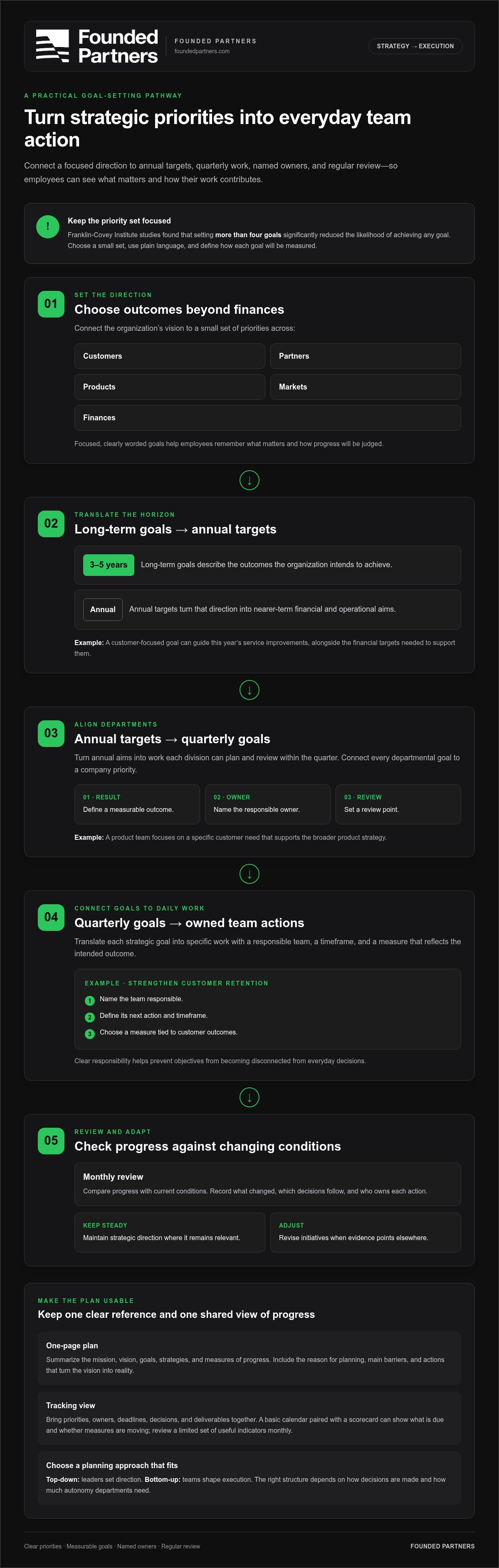
Strategic planning should connect the organization’s vision to goals for customers, partners, products, markets, and finances. Turn each priority into a team action with a named owner, a timeframe, and a way to assess progress.
Long-Term Goals and Annual Targets
Long-term goals describe the outcomes an organization intends to achieve, while annual targets translate that direction into nearer-term financial and operational aims. Strategic plans generally cover 3-5 years, giving leaders a horizon for choices without making annual planning abstract. For example, a customer-focused goal can inform this year’s service improvements, alongside the financial targets needed to support them. For small business owners balancing broader growth objectives with sustainable financial management, advisory resources from bucketlistaccountant.com.au can help align yearly targets with long-term vision.
Quarterly Departmental Goals
Quarterly departmental goals turn annual targets into work each division can plan and review within the quarter. Connect each goal to a company priority, then define a measurable result, a responsible owner, and a review point. For example, a product team might focus on a specific customer need that supports a broader product strategy. Quarterly alignment helps departments contribute without creating competing agendas.
Focused, Clear, and Memorable Goals
Focused goals limit competing priorities, while clear wording helps employees remember what matters and how progress will be judged. A Franklin-Covey Institute series of studies found that setting more than four goals significantly reduced the likelihood of achieving any goal. Choose a small set, use plain language, and define how each goal will be measured. The U.S. Environmental Protection Agency describes goals with measurable objectives, timeframes, and evaluation mechanisms.
Turning Goals Into Team Actions
Team-level actions translate a strategic goal into specific work, assigned owners, and a timeframe. Without clear responsibility, an objective can remain disconnected from daily decisions. For example, if the goal is to strengthen customer retention, name the team responsible, define its next action, and choose a measure that reflects customer outcomes. In the U.S. Environmental Protection Agency’s Destiny phase, participants generate potential actions and organize themselves to act on them.
Breaking strategic change into manageable steps
Leaders develop strategic plans to guide action without locking teams into outdated assumptions. For a small team, creating a strategic plan my team will actually use means choosing a clear framework, a concise reference, and a practical way to track progress.
Adapting Plans to Changing Conditions
Adaptable planning means reviewing assumptions and adjusting actions when opportunities or threats emerge. This matters because market conditions, technology, and organizational capacity can shift during a plan’s life. Set a monthly review to compare progress with current conditions, then record what changed, which decisions follow, and who owns each action. Keep the strategic direction steady where it remains relevant, and revise initiatives when evidence points elsewhere.
Frameworks for Small-Team Planning
Small teams can use a top-down approach, where leaders set direction, or a bottom-up approach, where teams shape execution. The right structure depends on how decisions are made and how much autonomy departments need. A centrally guided team benefits from clear templates. An empowered team can work from shared objectives and budgets, then choose its own execution steps.
Elements of a One-Page Plan
A one-page plan summarizes the organization’s mission, vision, goals, strategies, and measures of progress. Employees can use it to connect daily choices to the organization’s intended direction. Include the reason for planning, the main barriers, and the actions that turn the vision into reality. Keep the wording concise so the page serves as a working reference, not a dense report.
Tools for Tracking Strategic Plans
A tracking template brings priorities, owners, deadlines, decisions, and deliverables into one shared view. For a small team, a basic calendar paired with a scorecard can show what is due and whether measures are moving. Use a limited set of useful indicators, and review them monthly. A practical way of creating a strategic plan my team will actually use is to connect growth aims with operational readiness through a Scalability Strategy.
Facilitating rigorous debate and decision-making
Strong strategic decisions come from testing assumptions, hearing different views, and naming trade-offs. A focused meeting gives the team room to challenge proposals and decide what to implement.
Before the meeting, circulate the agenda and relevant reports so participants can prepare. State the meeting’s purpose, allocate time for each discussion item, and assign a timekeeper. For example, a discussion about entering a new market should examine its value for customers, resource demands, and fit with the organization’s direction.
The chair keeps the group on the agenda and makes space for every participant to speak. Invite quieter members to share their perspectives before the group settles on a decision. When discussion runs long, the timekeeper alerts the chair, who can clarify whether the group needs more evidence, a decision, or a separate follow-up.
Use the strategic plan as a decision filter. For each proposed program or idea, ask whether it supports a stated priority, what resources it requires, and what existing work may need to stop. Discuss both what the organization will do and what it will not do. Recording the rationale helps teams understand how a difficult choice supports execution.
Outside facilitation can help when leaders need to contribute fully rather than manage the meeting. An experienced facilitator can structure the discussion, surface competing assumptions, and guide the group toward decisions without taking ownership away from participants. This can be useful when departments disagree about priorities or senior leaders dominate the conversation.
To make decisions actionable, close each agenda item with a clear record: the decision, its rationale, the next action, and its owner. If the team cannot decide, document the open question and what evidence would resolve it. The meeting scribe can capture these points in minutes for the chair to review and circulate to participants.
Collecting input from employees outside the planning team
A strategy gains practical insight when employees outside the planning group can describe what customers need and where work gets stuck. Invite input before priorities are finalized, while leaders can still act on what they hear. For example, frontline staff may identify a recurring handoff problem that leadership discussions have overlooked.
Make participation purposeful. Explain the planning goal, which decisions remain open, and how responses will shape the plan. Use a short survey to gather views across teams, then hold focused listening sessions for deeper discussion. Ask consistent questions: what helps customers, what slows delivery, and what opportunity deserves attention? These prompts turn broad feedback into useful themes.
Include employees with different roles and perspectives, not just the most senior or vocal contributors. A sales employee may spot a changing customer need, while an operations colleague sees the capacity required to respond. Managers can also collect feedback in existing team meetings, making it easier to engage people without adding an unnecessary process.
Separate observations from proposed solutions as you review responses. Group similar comments, note where experiences differ, and identify which strategic assumptions deserve another look. For example, if staff describe different causes for a delayed service, investigate the handoff before choosing a fix. This approach helps leaders weigh evidence without treating every suggestion as a new priority.
Close the feedback loop. Share the main themes, explain which ideas influenced decisions, and clarify why other suggestions did not become priorities. During later progress reviews, report what changed and invite employees to flag new conditions. Regular communication shows that participation has a purpose and gives teams a way to surface issues as implementation unfolds.
When employee feedback points to deeper organizational change, discuss how to engage teams in transformation and translate insight into coordinated action.
Founded Partners: Capital raising support
Founded Partners provides capital raising support for founder-led organizations whose strategic growth plans require investment. Turn to this support when your priorities are clear, but funding needs, investor readiness, or the right capital approach remain part of the execution challenge.
Capital raising works best when it supports the organization’s broader direction rather than standing alone as an objective. A thoughtful plan can clarify what investment is intended to support and how it fits the company’s growth priorities. If strategic change also calls for operational or leadership changes, Business Transformation Consulting or Leadership Advisory may be relevant. For owners considering a future transition, exit planning can help bring long-term choices into view.
If you’re aligning a growth strategy with capital needs, contact Founded Partners or visit foundedpartners.com to discuss the next step.
Give your strategy room to become real
A plan becomes useful through the choices people make after planning conversations end. Creating a strategic plan my team will actually use means treating it as a living guide, not a document to file away. Keep asking whether current priorities still fit the organization’s direction, and make room to adjust when new evidence changes the picture.
The next step is to bring that discipline into your leadership decisions. Identify where execution feels unclear, where teams need alignment, and which strategic choices demand deeper consideration. A thoughtful conversation can help turn those questions into a practical path forward, grounded in your organization’s priorities and circumstances.
Discuss your strategy with Founded Partners and explore the next step for your organization. With clear intent and steady follow-through, your team can build momentum around a direction it understands and believes in.
Frequently Asked Questions
What are the steps to create a practical strategic plan with a team?
Start by agreeing on the planning question, such as whether to prioritize growth or improve service reliability. Review current conditions, define the desired outcome, compare possible approaches, and choose the work the team can support. Record decisions and unresolved assumptions. Then translate the chosen direction into a working document and revisit it in regular leadership discussions, rather than treating approval as the finish line.
How do you involve employees in strategic planning so they use the plan?
Give employees a clear way to influence decisions before priorities are finalized. Ask teams for examples of customer needs, operational obstacles, and opportunities they see in their roles. For instance, customer-facing employees may identify a recurring request that deserves strategic attention. After considering the feedback, share which themes shaped the plan and how employees can raise new observations during implementation.
How do you set measurable strategic goals and KPIs?
Define the outcome first, then select a measure that shows whether the organization is moving toward it. Pair a customer or operational result with a timeframe and a clear evaluation method. For example, a goal to improve service should specify what improvement means and how it will be assessed. The U.S. The U.S. Environmental Protection Agency says a strategic plan can define mutually agreed-upon measurable goals and objectives, timeframes, and mechanisms for evaluation.
How many strategic priorities should a team focus on at once?
Keep the priority list short enough for people to remember and act on. A Franklin-Covey Institute series of studies found that setting more than four goals significantly reduced the likelihood of achieving any goal. Use that finding to scrutinize additions: ask whether each proposed priority advances the direction or distracts from existing commitments. If everything is urgent, teams lack a clear basis for choosing.
How often should teams review and update a strategic plan?
Review progress monthly, then adjust actions when conditions or assumptions change. A monthly review gives leaders a regular opportunity to examine stalled work, new opportunities, and decisions that need attention. It doesn’t mean rewriting the whole strategy each time. Keep the direction that remains relevant, update actions that no longer fit, and communicate changes to the people responsible for carrying them out.
What are common reasons strategic plans fail to get used?
Plans often lose traction when they are too complex, disconnected from daily work, or unclear about ownership. A priority without a responsible lead can fall between departments, while a lengthy document may not help employees make everyday choices. Plans also become less useful when leaders stop referring to them or fail to adapt actions as conditions shift. Linking priorities to decisions keeps the plan active.